Emergency food storage: how much to store, what to buy and how to keep it safe
How much emergency food to store, from a 3-day kit to two weeks at home: no-cook foods, calories, special diets, rotation and when to throw out damaged cans.
By PreparedStates editors · Updated October 22, 2026 · Sourced to Ready.gov, USDA, the FDA and the American Red Cross
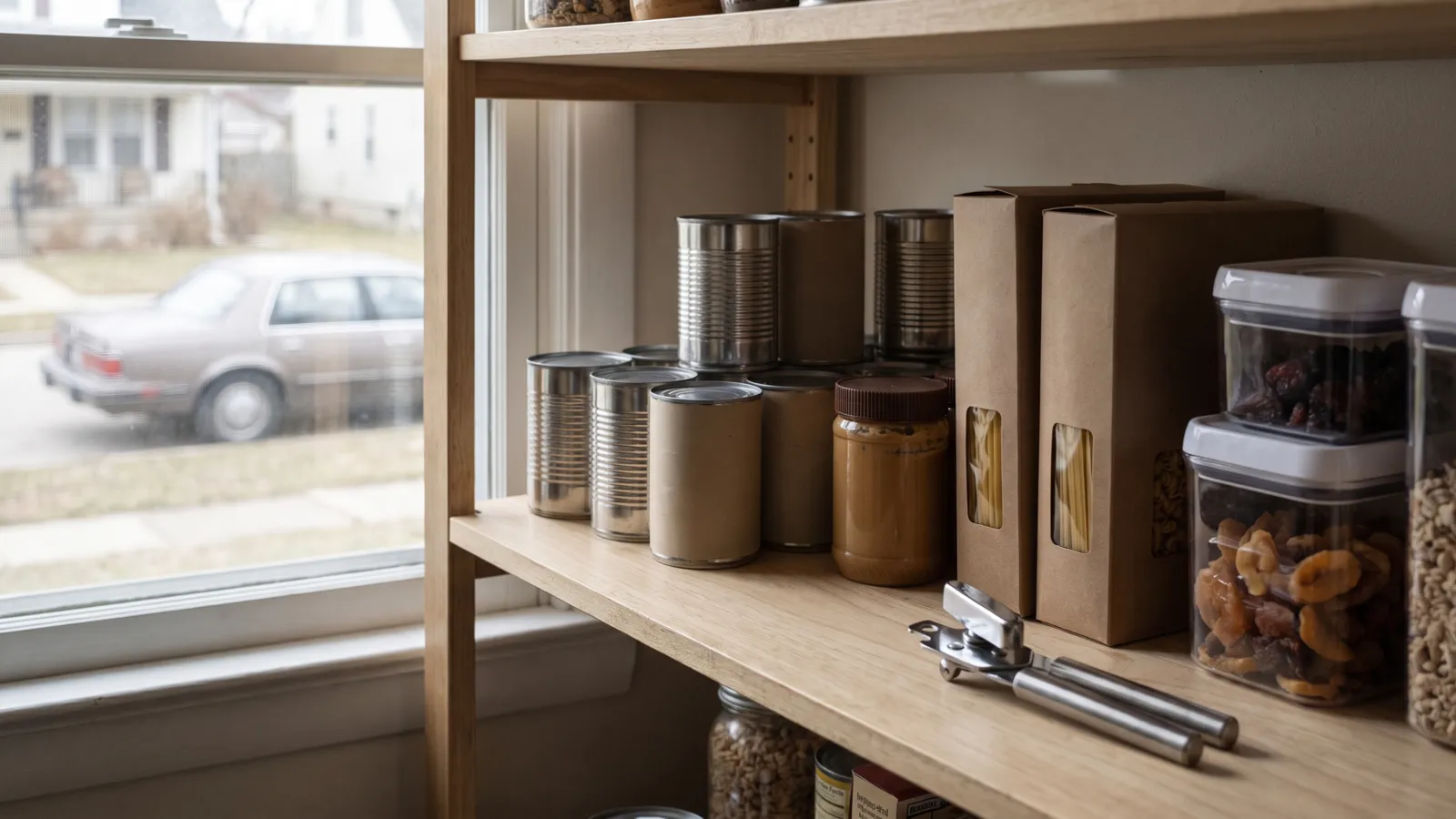
- Store at least a several-day supply of non-perishable food. The Red Cross lists a 3-day supply for evacuation and a 2-week supply at home.
- Pick food that needs no refrigeration, water or cooking: canned meats, fruits and vegetables, bars, cereal, peanut butter, dried fruit.
- The FDA uses 2,000 calories a day as a general guide for nutrition advice. Your needs vary with age, sex, size and activity.
- Keep food cool and dry, use older items first, and don't eat from cans that are swollen, dented or corroded.
- Include a manual can opener, any special diets, infant food and pet food.
How much food to store
Ready.gov says to store at least a several-day supply of non-perishable food. The American Red Cross lists non-perishable, easy-to-prepare food for 3 days if you have to evacuate and for 2 weeks at home.
You may not need to buy much. Ready.gov says you may already have many of the suggested foods on hand, and to replace expired items as needed. If you want a ready-made option, compare emergency food kits.
How many calories?
The FDA says 2,000 calories a day is used as a general guide for nutrition advice, but your calorie needs may be higher or lower depending on your age, sex, height, weight and physical activity level. Multiplying that general guide out gives 6,000 calories per person for 3 days and 28,000 calories per person for 2 weeks. That is our arithmetic, not an official emergency figure.
Treat those totals as a starting point, not a rule. Ready.gov says to choose foods your family will eat, and its list includes high-energy foods and comfort or stress foods.
What to store: foods that need no cooking
Ready.gov says to stock canned foods, dry mixes and other staples that do not require refrigeration, cooking, water or special preparation. Commercially canned food may be eaten out of the can without warming, and Ready.gov says to include a manual can opener and eating utensils. The foods below are Ready.gov's list.
Ready-made food bars and MREs are one compact option, and freeze-dried meals are another. Read the callout below first, because any food that you add water to uses up water you also need to drink.
- Ready-to-eat canned meats, fruits and vegetables
- Protein or fruit bars
- Dry cereal or granola
- Peanut butter
- Dried fruit
- Canned juices
- Non-perishable pasteurized milk
- High-energy foods
- Comfort and stress foods
- Food for infants
- A manual can opener and eating utensils
Special diets, infants and pets
Ready.gov says to remember any special dietary needs. The American Red Cross says to add the unique things each member of your family may need, and its examples include baby supplies such as bottles, formula and baby food.
For infants, Ready.gov says to use ready-to-feed formula, and to use bottled water or boiled water to mix formula only as a last resort. In its flood advice, the FDA says to try to use prepared, canned baby formula that requires no added water.
Pets need a supply too. Ready.gov says to keep several days' supply of pet food in an airtight, waterproof container. Our emergency kit checklist has the full pet list.
Store it cool and dry, and rotate it
Ready.gov says to keep canned food in a cool, dry place and to store boxed food in tightly closed plastic or metal containers. USDA's Food Safety and Inspection Service says temperatures below 85°F are best, and never to store canned and other shelf-stable foods above or beside the stove, under the sink, in a damp garage or basement, or anywhere exposed to high or low temperature extremes.
Use the oldest food first. USDA says to check your pantry every few weeks and use canned goods you have had on hand for a while, and that dates on cans are usually best-if-used-by dates for peak quality. Its storage times for unopened shelf-stable foods are below.
- High-acid canned goods, such as canned fruit, juices like orange or tomato, tomatoes and pickles: 12 to 18 months
- Low-acid canned goods, such as canned meat and poultry, stews, soups (except tomato), corn, beans and peas: 2 to 5 years
- Rice and dried pasta: 2 years
- Commercially packaged jerky: 12 months
- Tuna and other seafood in retort pouches: 18 months
- MREs: 4 1/2 years at 70°F, but only 1 month at 120°F
Canned food safety
Ready.gov says not to eat foods from cans that are swollen, dented or corroded, even though the product may look safe to eat, and not to eat any food that looks or smells abnormal, even if the can looks normal. Its rule for any food is: when in doubt, throw it out. USDA says to discard deeply dented cans (a deep dent is one you can lay your finger into), any can with a deep dent on any seam, heavily rusted cans and any swollen cans. Never use food from leaking, bulging or badly dented cans, or from any container that spurts liquid when you open it, and USDA says not even to taste it.
If cans have been in floodwater, the FDA says to discard any food and beverage that is not in a waterproof container if there is any chance it touched floodwater. Containers with screw-caps, snap lids, pull tops and crimped caps are not waterproof. The FDA also says to discard any food in damaged cans, which it describes as cans with swelling, leakage, punctures, holes, fractures, extensive deep rusting, or crushing or denting severe enough to prevent normal stacking or opening with a manual, wheel-type can opener.
Undamaged, commercially prepared food in all-metal cans can be saved. Remove the labels if they are the removable kind, brush or wipe away any dirt or silt, and wash the cans thoroughly with soap and water, using hot water if it is available. Rinse them with water that is safe for drinking, if available. Sanitize them by placing them in water, bringing it to a boil and boiling for 2 minutes, or by soaking them for 15 minutes in a solution of 1 cup (8 oz/250 mL) of unscented household (5.25% concentration) bleach mixed with 5 gallons of water. Air dry them for a minimum of 1 hour before opening or storing, re-label them with the expiration date in permanent marker, and use the food as soon as possible.
Cooking and eating when the power is out
To heat food in a can, Ready.gov says to remove the label, thoroughly wash and disinfect the can using a diluted solution of one part bleach to 10 parts water, and open the can before heating. Charcoal grills and camp stoves are for outdoor use only, so use a camp stove outside.
Ready.gov lists candle warmers, chafing dishes, fondue pots or a fireplace as alternative cooking sources in an emergency. An older FEMA and American Red Cross booklet, Food and Water in an Emergency, adds: use only approved devices for warming food, and always put out open flames before leaving the room.
The same booklet says that if your water supply is limited, you should not eat salty foods, since they will make you thirsty, and should choose salt-free crackers, whole grain cereals and canned foods with high liquid content instead. Our guide on how much water to store helps you plan for both. For fridge and freezer food, see food safety in a power outage.
Ready.gov suggests staples that do not require refrigeration, cooking, water or special preparation, and USDA says freeze-dried foods must be rehydrated with water. Anything you mix with water draws on the same limited supply you need for drinking, so do not build your whole food supply around meals that need it. If you do buy them, add that water to your water plan.
Common questions
How much food should I store for an emergency?
Ready.gov says at least a several-day supply of non-perishable food. The American Red Cross lists a 3-day supply for evacuation and a 2-week supply for home.
How many calories do I need per day in an emergency?
The FDA uses 2,000 calories a day as a general guide for nutrition advice, but your needs may be higher or lower depending on your age, sex, height, weight and activity level.
What foods can I store that need no cooking?
Ready.gov lists ready-to-eat canned meats, fruits and vegetables, protein or fruit bars, dry cereal or granola, peanut butter, dried fruit, canned juices and non-perishable pasteurized milk.
How often should I rotate emergency food?
USDA says to check your pantry every few weeks and use canned goods you have had on hand for a while. It gives 12 to 18 months for high-acid canned goods such as fruit and tomatoes, and 2 to 5 years for low-acid canned goods such as meat, most soups, corn and beans.
Is it safe to eat from a dented can?
Ready.gov's emergency advice is not to eat from cans that are swollen, dented or corroded. USDA says a can with a small dent that is otherwise in good shape should be safe, but to discard deeply dented cans, any can with a deep dent on a seam, and any swollen can. When in doubt, throw it out.
Can I cook on a camp stove indoors?
No. Ready.gov says charcoal grills and camp stoves are for outdoor use only.
Sources (8)
- Ready.gov: Food
- Ready.gov: Build A Kit
- Ready.gov: Pets and Animals
- American Red Cross: Survival Kit Supplies
- USDA FSIS: Shelf-Stable Food Safety
- FDA: Calories on the Nutrition Facts Label
- FDA: Food and Water Safety During Power Outages and Floods
- FEMA and American Red Cross: Food and Water in an Emergency (2004 booklet)
Get one calm email when it matters
Seasonal checklists and gear price drops. No spam, unsubscribe any time.
Keep reading
 Emergency kit checklist: what to include, how much to keep and where to store itA plain-English emergency kit checklist built on Ready.gov's basic kit and extra items, with how many days of …
 How much water to store for an emergency: per person, per pet and for how longHow much water to store for an emergency: 1 gallon per person per day, pets, which containers to use, when to …
 Food safety in a power outage: how long food lasts and what to throw outHow long food stays safe in the fridge and freezer without power, what to throw out, and when you can refreeze…
 Power outage checklist: what to do before, during and afterA calm power outage checklist from Ready.gov and CDC: what to prepare, how to protect food, medicines and medi…