How much water to store for an emergency: per person, per pet and for how long
How much water to store for an emergency: 1 gallon per person per day, pets, which containers to use, when to replace stored water and hidden sources at home.
By PreparedStates editors · Updated October 22, 2026 · Sourced to the CDC, Ready.gov, EPA, FEMA and the American Red Cross
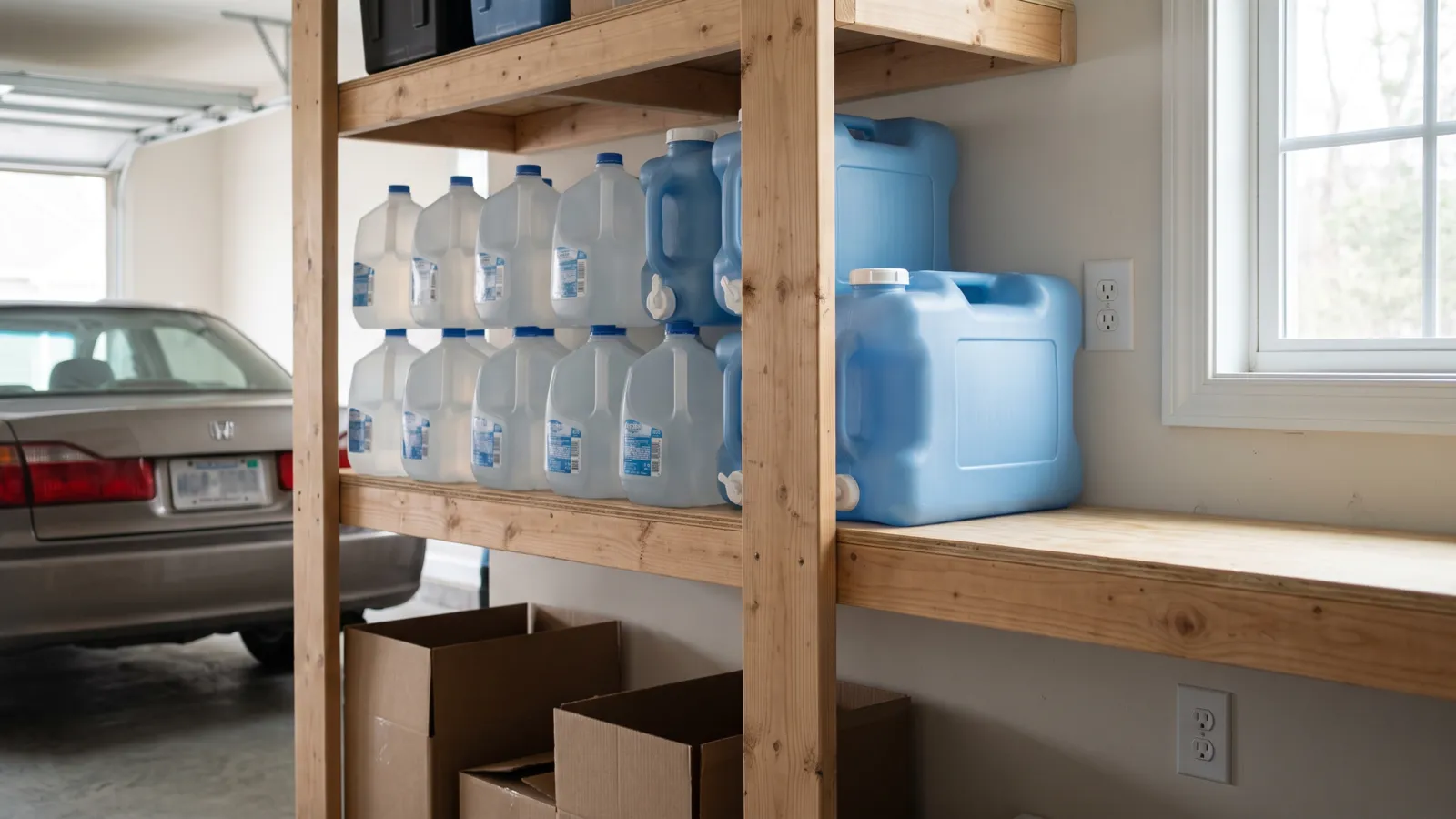
- Store at least 1 gallon of water per person, per day for 3 days, and try to store a 2-week supply if possible.
- Consider storing more for pregnant women, people who are sick, pets, or if you live in a hot climate.
- Unopened, commercially bottled water is the most reliable. If you fill your own containers, replace the water every 6 months.
- Keep containers in a cool place, 50°F to 70°F, away from direct sunlight, gasoline and pesticides.
- Your tap water heater tank and ice made from uncontaminated water are back-up sources. Never drink water from heating radiators or boilers, pools or spas.
The basic rule: 1 gallon per person per day
The CDC says to store at least 1 gallon of water per person, per day for 3 days, and to try to store a 2-week supply if possible. You can use this water for drinking, cooking, brushing teeth and other uses. Ready.gov gives the same rate for drinking and sanitation, and says a normally active person needs about three quarters of a gallon of fluid daily, from water and other beverages.
Here is that minimum rate multiplied out for different household sizes. This is our arithmetic on the CDC figure, not an official table, and it does not include extra for pets or hot weather. Our water storage comparison lists containers that make it easy to hold this much.
- 1 person: 3 gallons for 3 days, 14 gallons for 2 weeks
- 2 people: 6 gallons for 3 days, 28 gallons for 2 weeks
- 3 people: 9 gallons for 3 days, 42 gallons for 2 weeks
- 4 people: 12 gallons for 3 days, 56 gallons for 2 weeks
When to store more, and what about pets
The CDC says to consider storing more water than the basic rate for pregnant women, people who are sick, pets, or if you live in a hot climate. Ready.gov adds that children, nursing mothers and sick people may need more water, that a medical emergency might require additional water, and that in very hot temperatures, water needs can double.
For pets, Ready.gov says to store a water bowl and several days' supply of water. Neither the CDC nor Ready.gov gives a per-pet amount, so ask your veterinarian how much your animal drinks and add it on top of the figures above. Ready.gov says never to ration drinking water unless authorities order you to: drink the amount you need today and try to find more for tomorrow.
Choose the right containers
The CDC calls unopened, commercially bottled water the safest and most reliable source of water in an emergency. Ready.gov says to buy it and keep it in the sealed original container in a cool, dark place, and the CDC says to observe the expiration date on store-bought water.
If you fill your own, the CDC says FDA-approved food-grade water storage containers are best. Otherwise choose a container with a top that closes tightly, made of durable, unbreakable materials (not glass), with a narrow neck if possible so you can pour from it.
An older FEMA and American Red Cross booklet, Food and Water in an Emergency, adds that if you reuse bottles, you should choose two-liter plastic soft drink bottles, not plastic jugs or cardboard containers that held milk or fruit juice. Milk protein and fruit sugars cannot be adequately removed and provide an environment for bacterial growth.
How to clean and fill your own containers
The CDC gives a step-by-step method for filling your own containers. It uses unscented liquid household chlorine bleach that contains 5% to 9% sodium hypochlorite. The steps are below.
- Wash the container with soap and rinse completely with water
- Sanitize it with 1 teaspoon of unscented liquid household chlorine bleach in 1 quart (4 cups) of water
- Cover the container tightly and shake it well, so the solution touches all inside surfaces
- Wait at least 30 seconds, then pour the sanitizing solution out
- Let the empty container air-dry
- Pour clean water into the container and cover it with a tight lid
Where to keep it and when to replace it
Label each container 'drinking water' and add the storage date, the CDC says. If you use a scoop or other device to take water out, use a clean one each time, and do not touch the water or the inside of the container with your hands.
The CDC says to keep containers in a cool place, 50°F to 70°F, away from direct sunlight and away from toxic substances such as gasoline or pesticides. If you filled the containers yourself, replace the water every 6 months. Ready.gov says the same for water that has not been commercially bottled.
For store-bought water, go by the expiration date on the package instead.
Back-up water sources in your home
If you have no bottled, boiled or treated water, the CDC lists the sources below as other sources of clean and safe water inside your home. FEMA also says you can safely drink water from your home's water heater tank. EPA says you may be able to find water by melting ice cubes or draining your hot water tank or pipes, and that whatever the source, you should treat the water using its boiling or disinfection steps.
Use the tap water heater tank, the one that feeds your faucets and showerheads, not the tank that supplies hot water to radiators in some older homes. The same older FEMA and American Red Cross booklet explains how to drain it: make sure the electricity or gas is off, and open the drain at the bottom of the tank. Start the water flowing by turning off the water intake valve at the tank and turning on a hot-water faucet. Refill the tank before you turn the gas or electricity back on, and if the gas was turned off, a professional is needed to turn it back on.
Listen to local officials for advice on water precautions in your home. The CDC says you may need to shut off the main water valve to your home to stop contaminants entering your pipes, so find it before you need it. If you are unsure whether water is safe, see our guide to making water safe, and keep a filter or purification tablets as back-up.
- Water from your tap water heater tank
- Melted ice cubes made with water that was not contaminated
- Water from the toilet tank (not the bowl), only if it is clear and has not been chemically treated with toilet cleaners, such as those that change the color of the water
- Liquid from canned fruit and vegetables
- Swimming pool and spa water for hygiene and cleaning only, never for drinking
- Never use water from radiators or boilers that are part of your home heating system for drinking, cooking or hygiene
If you run out: outdoor water sources
The CDC lists rainwater, streams, rivers and other moving bodies of water, ponds and lakes, and natural springs as possible sources that could be made safe by treatment. Rivers, streams and lakes might be contaminated with livestock waste, human sewage and chemicals, so water from outside the home must be treated to kill harmful germs. FEMA's disaster FAQ is stricter about rainwater and says not to drink collected rainwater. EPA says flowing water is generally better than still, stagnant water, and not to use water with floating material in it or water that has a dark color or questionable odor.
If you suspect or know the water is contaminated with toxic chemicals or fuels, the CDC says it cannot be made safe and you should not drink or bathe in it. Ready.gov says treating suspicious water may become necessary once you have used all of your stored water and there are no other reliable clean water sources. Our guide on making water safe covers boiling, bleach, filters and tablets step by step.
Your water storage checklist
Use this list to turn the figures above into a plan. Each item comes from the CDC, Ready.gov or EPA guidance covered in this guide.
- Count everyone in your household, including anyone who is pregnant or sick, and your pets
- Multiply 1 gallon by the number of people, then by 3 days as a minimum
- Work toward a 2-week supply if you can, and add extra if you live in a hot climate
- Choose sealed commercially bottled water or clean food-grade containers
- Label each container 'drinking water' and add the storage date
- Keep containers at 50°F to 70°F, out of direct sunlight and away from gasoline and pesticides
- Replace water you filled yourself every 6 months, and check the date on store-bought water
- Keep a bottle of unscented liquid household chlorine bleach (5% to 9% sodium hypochlorite) for sanitizing containers
- Know where your main water valve is
The CDC says not to use containers that previously held liquid or solid toxic chemicals, such as bleach or pesticides, and to choose durable, unbreakable materials, not glass. The older FEMA and American Red Cross booklet also says not to reuse jugs or cartons that held milk or fruit juice, because the residue provides an environment for bacterial growth.
Common questions
How many gallons of water do I need per person?
At least 1 gallon per person, per day, according to the CDC and Ready.gov. The CDC says to store enough for 3 days and to try for a 2-week supply if possible.
How long can I store water?
Follow the expiration date on commercially bottled water. If you filled the containers yourself, the CDC says to replace the water every 6 months.
How much water does a pet need?
Neither the CDC nor Ready.gov gives a per-pet amount. The CDC says to consider storing more water for pets, and Ready.gov says to keep a water bowl and several days' supply of water. Ask your veterinarian about your animal.
Can I use old milk jugs or juice bottles?
An older FEMA and American Red Cross booklet says no, because milk protein and fruit sugars cannot be adequately removed. The CDC says FDA-approved food-grade water storage containers are best.
Is the water in my water heater safe to drink?
The CDC lists your tap water heater tank as a source of clean water and FEMA says you can safely drink it, though EPA advises treating water from any source before use. Use the tank that feeds your faucets, never a heating-system boiler or radiator.
Should I ration my water?
Ready.gov says never to ration drinking water unless authorities order you to. Drink what you need today and look for more for tomorrow.
Sources (8)
- CDC: How to Create an Emergency Water Supply
- CDC: How to Find Clean Water in an Emergency
- CDC: Make Water Safe in an Emergency
- Ready.gov: Water
- Ready.gov: Pets and Animals
- EPA: Emergency Disinfection of Drinking Water
- FEMA: Where can I find clean drinking water after a disaster?
- FEMA and American Red Cross: Food and Water in an Emergency (2004 booklet)
Get one calm email when it matters
Seasonal checklists and gear price drops. No spam, unsubscribe any time.
Keep reading
 How to make water safe to drink in an emergency: boiling, bleach, filters and tabletsHow to make water safe to drink in an emergency: boiling times, exact unscented bleach amounts, what filters a…
 Emergency kit checklist: what to include, how much to keep and where to store itA plain-English emergency kit checklist built on Ready.gov's basic kit and extra items, with how many days of …
 Emergency food storage: how much to store, what to buy and how to keep it safeHow much emergency food to store, from a 3-day kit to two weeks at home: no-cook foods, calories, special diet…
 Power outage checklist: what to do before, during and afterA calm power outage checklist from Ready.gov and CDC: what to prepare, how to protect food, medicines and medi…