Food safety in a power outage: how long food lasts and what to throw out
How long food stays safe in the fridge and freezer without power, what to throw out, and when you can refreeze, based on CDC and Ready.gov guidance.
By PreparedStates editors · Updated October 22, 2026 · Sourced to CDC and Ready.gov
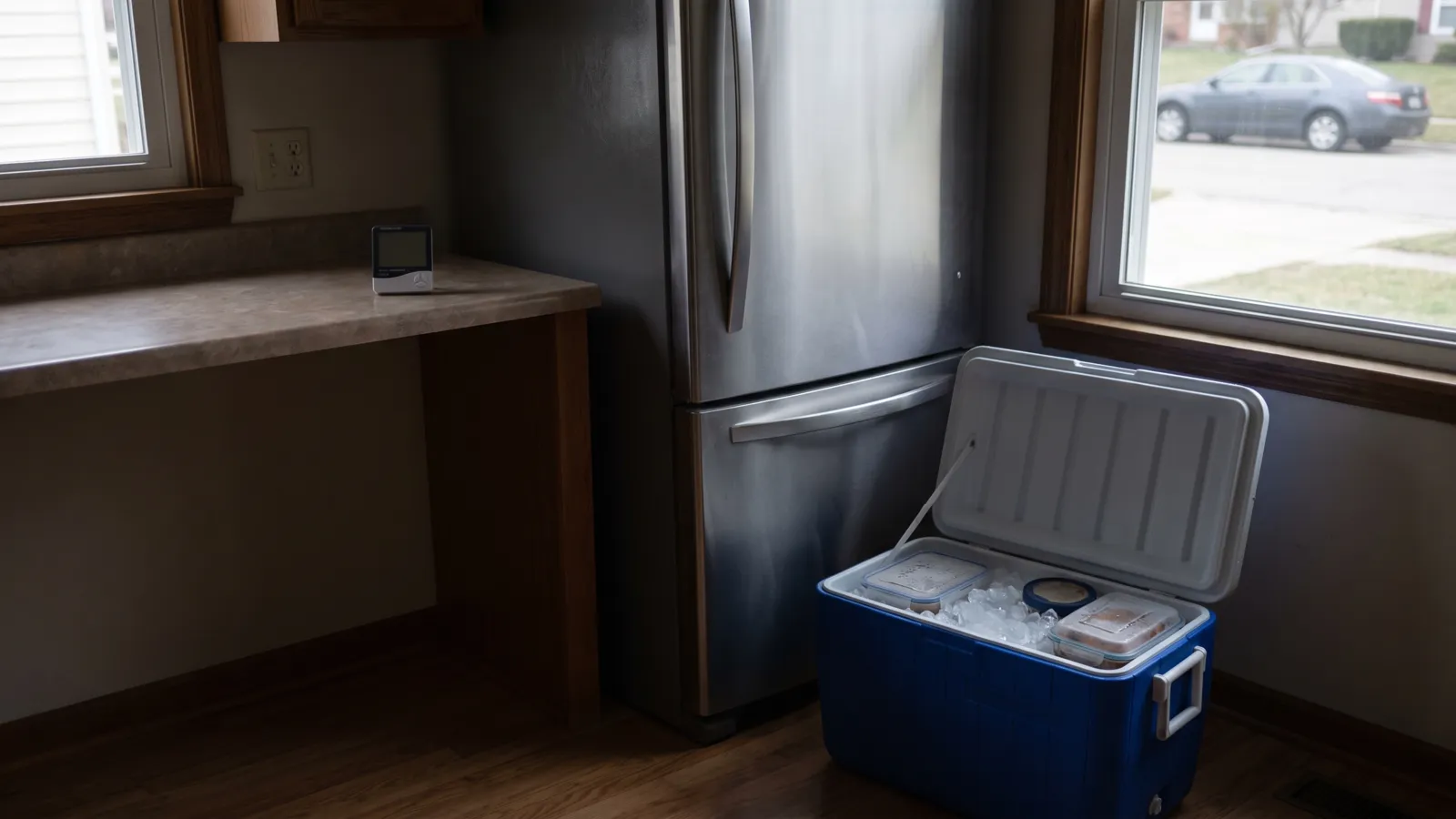
- A closed refrigerator keeps food safe for about 4 hours without power. A full freezer holds for 48 hours, a half-full one for 24.
- Keep the doors shut. After 4 hours, move perishables to a cooler with ice and keep them at 40°F or below.
- Throw out meat, fish, cut fruits and vegetables, eggs, milk and leftovers after 4 hours without power or a cold source.
- Thawed food that still has ice crystals, or is at 40°F or below, can be refrozen or cooked.
- Never taste food to decide if it is safe. When in doubt, throw it out.
How long food lasts without power
The clock starts when the power goes out, and it only holds if you keep the doors closed. CDC says food stays safe for up to 4 hours in a refrigerator, 48 hours in a full freezer and 24 hours in a half-full freezer. Ready.gov gives the same guide: about four hours for the refrigerator and about 48 hours for a full freezer.
A full freezer holds for twice as long as a half-full one, so how full it is matters. Opening the door to check on things shortens that time, so resist the urge. A thermometer lets you check without opening anything.
Ready.gov's short version is the same. Keep freezers and refrigerators closed, use coolers with ice if necessary, and monitor temperatures with a thermometer.
- Refrigerator, door closed: up to 4 hours
- Full freezer, door closed: 48 hours
- Half-full freezer, door closed: 24 hours
Get ready before an outage
A few cheap items make a big difference. CDC suggests keeping appliance thermometers in your refrigerator and freezer. The refrigerator should be at 40°F or below and the freezer at 0°F or below. If you do not know the temperature, you are guessing.
CDC also suggests you freeze containers of water and gel packs to help keep food at 40°F or below. Have a cooler and frozen gel packs ready in case you have to take food out of the refrigerator to keep it cold. If an outage might be long, buy dry ice or block ice. A good cooler is the simplest way to keep food cold once the fridge window runs out.
Ready.gov adds one more habit: have enough nonperishable food and water. Our guide to emergency food storage covers what to stock.
- Appliance thermometers in the fridge and freezer
- Frozen water containers and gel packs
- A cooler for moving food out of the fridge
- Dry ice or block ice if the outage may be long
- Enough nonperishable food and water
During the outage: a simple timeline
Keep refrigerator and freezer doors closed. That is the core rule. Decide what you will eat before you open the door, then open it once.
If the power has been out for 4 hours and you have a cooler and ice, CDC says to put refrigerated perishable foods in the cooler and add ice or another cold source to keep them at 40°F or below. Use a thermometer to check, because the temperature is what matters, not how the food feels.
- Power goes out: close the fridge and freezer, and note the time
- Up to 4 hours: food in a closed refrigerator stays safe
- At 4 hours: move perishables to a cooler with ice or a cold source
- 24 hours: the limit for a half-full freezer
- 48 hours: the limit for a full freezer
- Power returns: check thermometers, then use the rules below
What to throw out
CDC lists the perishable foods in your refrigerator to throw out after 4 hours without power or a cold source: meat, fish, cut fruits and vegetables, eggs, milk and leftovers. Throw out any food with an unusual smell, color or texture too.
Ready.gov adds a second rule, which needs a thermometer: throw away any food that has been exposed to temperatures of 40 degrees or higher for two hours or more. The 4-hour rule still applies if you have no thermometer, and whichever rule you hit first, the food goes. For food kept in coolers or in a fridge with an added cold source, CDC says to check the temperature and throw out anything above 40°F.
- Meat and fish
- Cut fruits and vegetables
- Eggs and milk
- Leftovers
- Anything with an unusual smell, color or texture
- Any food at 40°F or higher for two hours or more
- Food in a cooler that is above 40°F
Freezer food and refreezing
Freezer food is more forgiving, but check it. CDC says you can safely refreeze or cook thawed frozen food that still contains ice crystals or is at 40°F or below. If you have an appliance thermometer in your freezer, check it when the power returns.
Two checks matter here: is there still ice in the food, and what does the thermometer say? Food that still contains ice crystals, or is at 40°F or below, passes. Food that has neither does not. CDC's wording is plain on this point, and it covers both cooking and refreezing.
If food has no ice crystals left and you cannot confirm it is at 40°F or below, it does not meet that test. CDC points readers to a chart on FoodSafety.gov that lists which foods to discard and which can be refrozen. Use it when you are unsure about a particular item.
If the outage came with a flood
Floods make the rules stricter. CDC says to throw out perishable food that has not been refrigerated or frozen properly due to power outages, and food that may have come in contact with floodwater or stormwater. It also lists food in packages that are not waterproof, and food in cardboard containers, including juice, milk and baby formula boxes.
Containers with screw caps, snap lids, crimped caps, twist caps, flip tops and snap tops go too. So do home-canned foods, and canned foods or containers that are bulging, open or damaged. CDC also says to throw out cans or containers that spurt liquid or foam when you open them.
CDC warns that unsafe food can make you sick even if it looks and smells normal. It adds that wooden cutting boards, baby bottle nipples and pacifiers that have touched floodwaters should be thrown out as well.
Do not judge food by tasting it
Never taste food to know if it is safe to eat. CDC is blunt about this, and so is Ready.gov: when in doubt, throw it out.
It can feel wasteful to throw out a fridge full of food. Use the time and temperature rules to decide, not how the food looks, and restock gradually afterward.
Medicines in the fridge
Some medicines need to stay cold too. Ready.gov says that if the power is out for more than a day, you should discard any medication that should be refrigerated, unless the drug's label says otherwise, and consult your doctor or pharmacist immediately for a new supply.
CDC explains why this matters: some drugs require refrigeration to keep their strength, including many liquid drugs. It says to replace all refrigerated drugs as soon as possible.
If a life depends on a refrigerated drug that has been at room temperature, CDC says to use it only until a new supply is available. Talk to your provider before an outage so you know what applies to your medicines. Our power outage checklist covers the full plan.
Never taste food to find out whether it is safe. Refrigerated perishables go after 4 hours without power or a cold source. If a thermometer shows food has been at 40°F or higher for two hours or more, throw it out too.
Common questions
How long can a fridge stay closed without power?
Up to 4 hours. After that, put perishable foods in a cooler with ice or another cold source to keep them at 40°F or below.
How long does a freezer keep food frozen without power?
A full freezer holds for 48 hours and a half-full freezer for 24 hours, if you keep the door closed.
Can I refreeze food that has thawed?
You can refreeze or cook thawed food that still has ice crystals or is at 40°F or below. Throw out food that has been warmer than that.
Which refrigerator foods should I throw out after 4 hours?
CDC lists meat, fish, cut fruits and vegetables, eggs, milk and leftovers. Also throw out anything with an unusual smell, color or texture.
Should I taste food to check it?
No. CDC says never to taste food to know if it is safe to eat. Use a thermometer and the time rules instead.
What temperature should my fridge and freezer be?
CDC says the refrigerator should be at 40°F or below and the freezer at 0°F or below. An appliance thermometer in each lets you check.
Get one calm email when it matters
Seasonal checklists and gear price drops. No spam, unsubscribe any time.
Keep reading
 Power outage checklist: what to do before, during and afterA calm power outage checklist from Ready.gov and CDC: what to prepare, how to protect food, medicines and medi…
 Emergency food storage: how much to store, what to buy and how to keep it safeHow much emergency food to store, from a 3-day kit to two weeks at home: no-cook foods, calories, special diet…
 How to make water safe to drink in an emergency: boiling, bleach, filters and tabletsHow to make water safe to drink in an emergency: boiling times, exact unscented bleach amounts, what filters a…
 Portable generator safety: where to run it, carbon monoxide and cordsHow to use a portable generator safely in an outage: 20 feet from windows, never in a garage, CO alarms, outdo…