How to protect yourself from wildfire smoke: AQI, clean room, filters and N95s
How to protect yourself from wildfire smoke: check the AQI, set up a cleaner-air room, use MERV 13 filters and air cleaners, and know what N95s cannot do.
By PreparedStates editors · Updated October 22, 2026 · Sourced to AirNow, the EPA and the CDC
- Check your local AQI at airnow.gov or in your weather app, and stay inside if authorities tell you to.
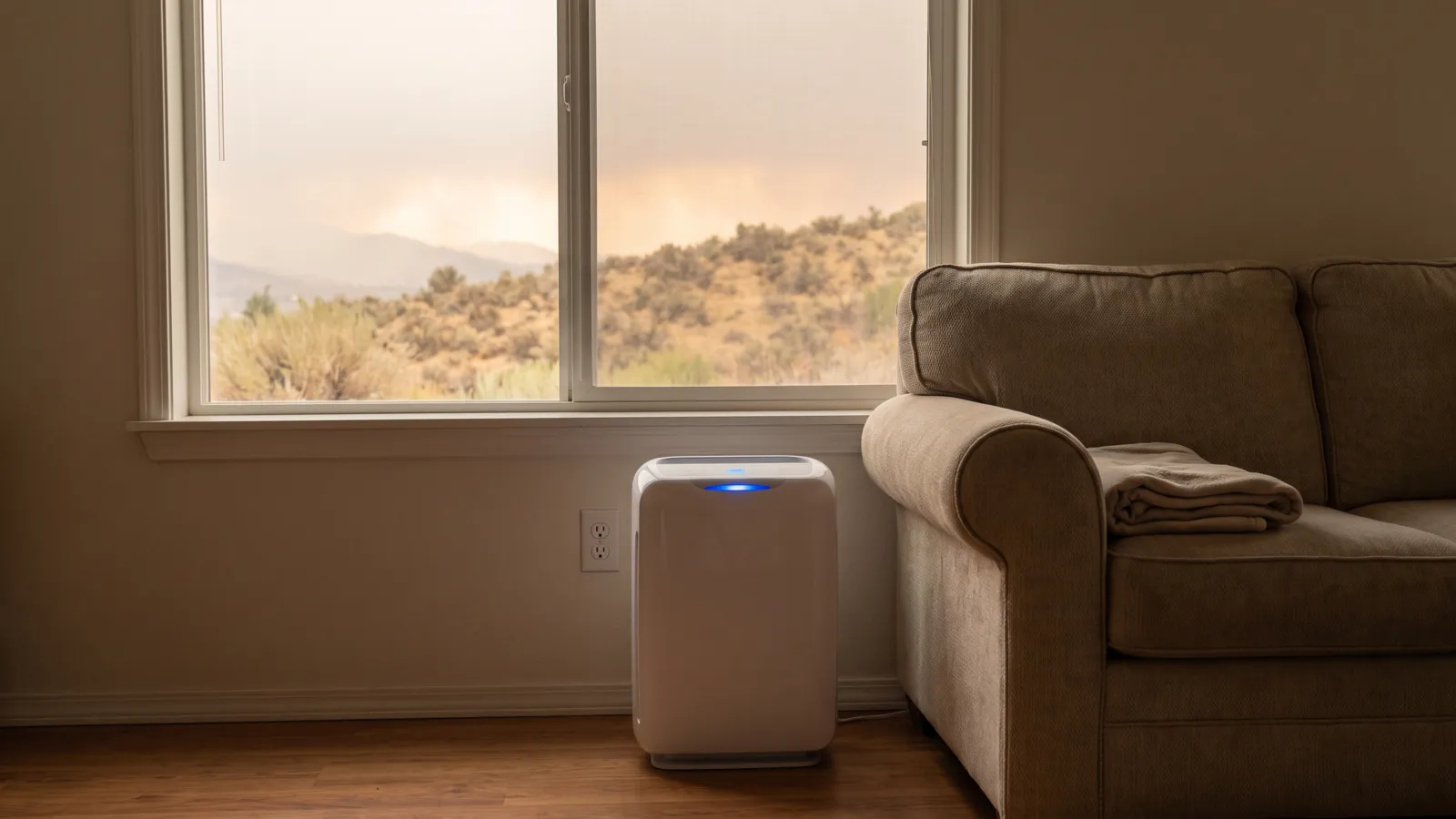
- Pick a room you can close off, keep its windows and doors shut, and run a portable air cleaner on the highest fan setting.
- For central air, the EPA recommends a MERV 13 or higher filter if your system can handle it.
- Outdoors in smoke, a properly fitting N95 or P100 respirator can reduce your exposure, but it needs a tight seal, and facial hair prevents one.
- Children, people with asthma, COPD, heart disease, diabetes or kidney disease, and people who are pregnant need to be especially careful.
Check the air quality first
Check your community's outdoor air quality by entering your location at airnow.gov or on your phone's weather app. The Air Quality Index (AQI) shows levels of air pollution in your community. The CDC also points to AirNow's Fire and Smoke Map, which has a map of fires throughout North America. If authorities tell you to stay inside, do so.
AirNow's scale runs from Good at 0 to 50 up to Hazardous at 301 and higher. At 101 to 150, called Unhealthy for Sensitive Groups, members of sensitive groups may experience health effects while the general public is less likely to be affected. At 151 to 200 some members of the general public may feel effects too, and at 201 to 300 the risk of health effects is increased for everyone.
Who is most at risk
Wildfire smoke irritates your eyes, nose, throat and lungs. It can make it hard to breathe and make you cough or wheeze. The CDC says children and people with lung diseases such as asthma or COPD need to be especially careful about breathing wildfire smoke. So do people with heart disease, diabetes or chronic kidney disease, and people who are pregnant.
If you have a lung disease such as asthma or COPD, heart disease or diabetes, or are pregnant, pay attention to any health symptoms. The CDC says to get medical help if you have any new or worsening symptoms.
Stay inside and set up a cleaner-air room
The CDC's advice is simple: staying inside is best. Choose a room you can close off from outside air. The EPA says it should be big enough to fit everyone in your household and comfortable to spend time in. Close all windows and doors in the room, but don't do anything that makes it hard to get out.
Set up a portable air cleaner or a filter to keep the air in that room clean. The EPA says to run a portable air cleaner continuously on the highest fan setting if you can. Avoid creating more smoke or particles indoors. The CDC says to avoid burning anything indoors as much as possible, including candles, gas, propane, incense or wood, and the EPA adds cooking and smoking to that list.
The EPA's wildfire smoke factsheet lists two more ways to cut your exposure: reducing physical activity and using portable air cleaners indoors. If you can't stay cool at home, the electricity goes out, or too much smoke is still getting in, the EPA says it may be best to seek shelter elsewhere.
HVAC filters and MERV 13
If you have central heating and cooling, a better filter can help. The EPA recommends a high-efficiency HVAC filter, such as one with a Minimum Efficiency Reporting Value (MERV) 13 rating. The CDC says to use high efficiency filters, preferably MERV 13 or higher if your system can use it.
Not every system can take a higher-rated filter. The EPA says to consider upgrading to a MERV 13 or higher rated filter if your system can accommodate it, and to check with an HVAC professional if you are unsure. If your system has a fresh air intake, the CDC says to set the system to recirculate mode or close the outdoor intake damper.
Portable air cleaners and CADR
CADR stands for clean air delivery rate. The EPA says the higher the CADR, the more particles the air cleaner can filter and the larger the area it can serve. Portable air cleaners often reach a high CADR by using a high-efficiency particulate air (HEPA) filter.
Match the CADR to your room. The EPA's sizing chart for particle removal lists a minimum CADR of 65 cfm for a 100 square foot room, 130 for 200 square feet, 195 for 300 and 390 for 600. Those figures assume an 8-foot ceiling, so if yours are higher, the EPA says to consider a cleaner sized for a larger area.
Avoid portable air cleaners and furnace or HVAC filters that intentionally produce ozone, which is a lung irritant. The CADR rating covers particles only, though a cleaner with a high CADR and an activated carbon filter can filter both particles and gases. The CDC says never to leave a do-it-yourself box fan filter unattended. Our air purifier comparison covers the portable options.
N95 respirators: what to look for
The EPA says the most effective way to protect yourself is to limit your time outdoors when there is smoke in the air. If you must go outside, the CDC says to wear a well-fitting respirator or mask. A respirator is a face covering that fits tightly to your face to filter out smoke before you breathe it in. The EPA says that when you need to be outside for extended periods in smoky air or an ash-covered area, a properly fitting N95 or P100 respirator can reduce your exposure.
Look for a NIOSH Approved model, with the words NIOSH and either N95 or P100 printed on the filter material. Choose a size that fits over your nose and under your chin and seals tightly to your face. Place it over your nose and under your chin, with one strap below your ears and one above. If it has a nose clip or nosepiece, use two hands to press it firmly to your nose and face. Our N95 mask comparison covers common models.
Follow the instructions on the package for checking the face seal each time you put it on. The EPA says to throw the respirator away when it gets harder to breathe through or if it gets dirty. It also says to wear an N95 respirator to protect your lungs from breathing in ash during cleanup after a fire.
N95 limits: fit, facial hair, children and health
Fit is where the limits show up. The EPA says a good seal is not possible with facial hair, so the skin should be clean shaven where the respirator touches your face. It also warns against masks with only one strap, or two straps that go around your ears, because they will not seal tightly or protect your lungs.
On children, the EPA and CDC say the same thing: children ages 2 years and older can wear respirators, but NIOSH Approved respirators do not come in sizes suitable for young children. Choose a size that fits over the child's nose and under the chin, does not impair vision and is comfortable, and watch that your child wears it correctly. Masks and respirators should not be worn by children younger than 2 years old.
Disposable respirators like these only filter out particles. They do not protect against gases or vapors, and they do not provide oxygen. Wearing one can make it harder to breathe, so if you have a heart or lung problem or are pregnant, talk to your doctor first. If you have difficulty breathing or get dizzy while wearing one, go to a place with cleaner air and remove it, and get medical attention if the symptoms do not get better or are severe. Wearing a respirator when it is hot or you are active can raise the risk of heat-related illness, so take breaks often and drink water.
The EPA says the most effective way to protect yourself during wildfires is to limit your time outdoors when there is smoke in the air. A mask with only one strap, or two straps that go around your ears, will not protect your lungs, and N95 and P100 respirators do not protect against gases or vapors.
Common questions
What AQI level is unhealthy during wildfire smoke?
AirNow rates 101 to 150 as Unhealthy for Sensitive Groups, 151 to 200 as Unhealthy, 201 to 300 as Very Unhealthy and 301 and higher as Hazardous.
What MERV rating should my HVAC filter have for smoke?
The EPA recommends MERV 13 or higher if your system can accommodate it. If you are not sure what your system supports, check with an HVAC professional.
Do N95 masks work against wildfire smoke?
The EPA says a properly fitting NIOSH Approved N95 or P100 respirator can reduce your exposure when you need to be outside in smoky air. It has to seal tightly to your face, and a good seal is not possible with facial hair.
Can children wear N95 respirators for smoke?
The EPA and CDC both say children ages 2 years and older can wear respirators, but NIOSH Approved respirators do not come in sizes suitable for young children. Children younger than 2 should not wear masks or respirators.
What does CADR mean on an air purifier?
It stands for clean air delivery rate. The higher the CADR, the more particles the cleaner can filter and the larger the area it can serve.
Where can I check wildfire smoke near me?
Enter your location at airnow.gov or in your phone's weather app. AirNow's Fire and Smoke Map also shows fires throughout North America.
Sources (8)
- CDC: Safety Guidelines for Wildfires and Wildfire Smoke
- CDC NIOSH: How to Protect Workers and the Public from Wildfire Smoke
- AirNow: AQI Basics
- AirNow
- EPA: Wildfires and Indoor Air Quality
- EPA: Create a Clean Room to Protect Indoor Air Quality During a Wildfire
- EPA: Guide to Air Cleaners in the Home
- EPA: Protect Your Lungs From Wildfire Smoke and Ash (factsheet)
Get one calm email when it matters
Seasonal checklists and gear price drops. No spam, unsubscribe any time.
Keep reading
 Emergency kit checklist: what to include, how much to keep and where to store itA plain-English emergency kit checklist built on Ready.gov's basic kit and extra items, with how many days of …
 Go-bag checklist: what to pack in case you have to evacuateWhat to pack in a go-bag: documents, medications, cash, chargers, per-person items, kids and pets, and how it …
 Power outage checklist: what to do before, during and afterA calm power outage checklist from Ready.gov and CDC: what to prepare, how to protect food, medicines and medi…
 Hurricane preparedness checklist: what to do before, during and after a stormHurricane season dates, watch vs warning, how to find your evacuation zone, storm surge, supplies, and what to…