Go-bag checklist: what to pack in case you have to evacuate
What to pack in a go-bag: documents, medications, cash, chargers, per-person items, kids and pets, and how it differs from a home kit. Official sources.
By PreparedStates editors · Updated October 22, 2026 · Sourced to Ready.gov and the American Red Cross
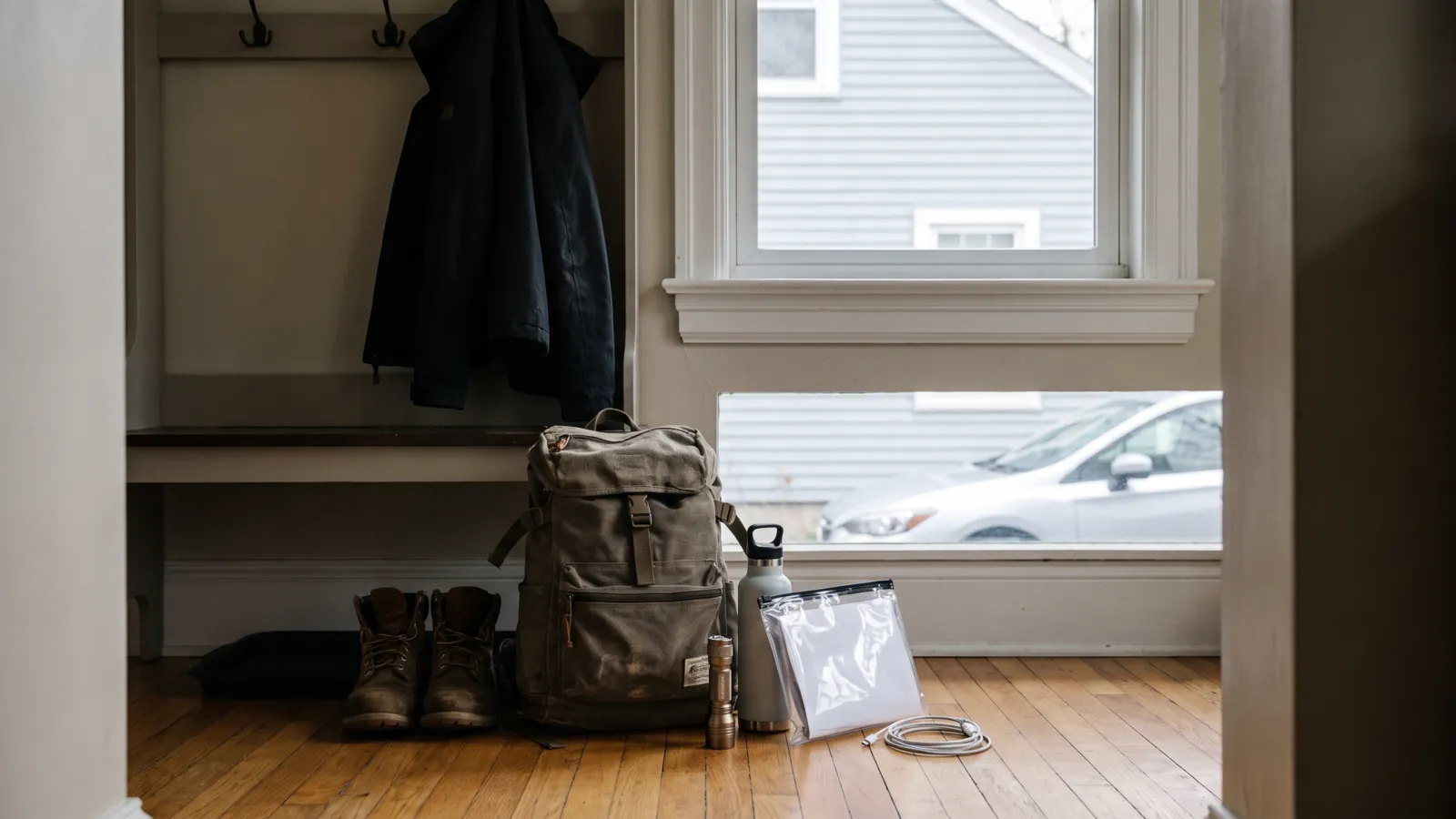
- A go-bag holds at least three days of supplies you can carry. A stay-at-home kit holds at least two weeks.
- Pack copies of ID, insurance and medical records, a medication list, a 7-day supply of medications, extra cash and emergency contacts.
- Include a phone with chargers and a backup battery, a flashlight, a radio, extra batteries and a whistle.
- Add per-person items: water, food, a blanket, a change of clothes and sturdy shoes, plus baby and pet supplies if you need them.
- Keep the bag in a known spot, make sure everyone knows where it is, and review it every year.
Go-bag or stay-at-home kit: what is the difference?
The Red Cross suggests organizing supplies into two kits. The go-kit holds at least three days of supplies you can carry with you, and the stay-at-home kit holds at least two weeks of supplies. Its basic supply list shows the same split for water and food: a 3-day supply for evacuation and a 2-week supply for home. Ready.gov's reason for building a go-bag ahead of time is that you will not need to scramble in an evacuation situation.
Ready.gov says to prepare a go-bag you can carry if you evacuate on foot or by public transportation, plus supplies for traveling longer distances if you have a car. Some items on its basic list, such as plastic sheeting, scissors and duct tape (to shelter in place) or a wrench or pliers (to turn off utilities), suit a home kit better than a bag you carry. Our emergency kit checklist covers the full stay-at-home list.
Documents, cash and contacts
Ready.gov lists important family documents such as copies of insurance policies, identification and bank account records, saved electronically or in a waterproof, portable container. The Red Cross asks for copies of personal documents: a medication list and pertinent medical information, proof of address, a deed or lease to your home, passports, birth certificates and insurance policies.
Add extra cash, which the Red Cross includes in its minimum list, along with family and emergency contact information. Ready.gov also suggests a household plan to stay in touch if you become separated, with a meeting place, and an out-of-state contact you can tell where you are going. The Red Cross adds an extra set of car keys and house keys, and maps of the area.
Medications, health items and chargers
The Red Cross minimum list includes medications (7-day supply) and medical items, a first aid kit, and sanitation and personal hygiene items. For medical supplies it names hearing aids with extra batteries, glasses, contact lenses and syringes. Ready.gov adds prescription eyeglasses and contact lens solution, and non-prescription medications such as pain relievers, anti-diarrhea medication, antacids or laxatives. Our first aid kit comparison is a good place to start.
If anyone relies on powered devices, the Red Cross winter storm page says to include critical backup batteries and chargers for devices such as a cell phone, CPAP or wheelchair. It also suggests carrying a list of your medications and dosages on a small card.
Both lists include a cell phone with chargers, and Ready.gov specifies a backup battery. Add a flashlight, extra batteries and a whistle to signal for help. Ready.gov also lists a battery-powered or hand crank radio and a NOAA Weather Radio with tone alert, and our power bank comparison covers the charging side.
Water, food, clothing and bedding for each person
The Red Cross lists water at one gallon per person, per day, and non-perishable, easy-to-prepare food, both as a 3-day supply for evacuation. Ready.gov adds a manual can opener for food. Both lists work per person, so count everyone in your household.
Ready.gov suggests a sleeping bag or warm blanket for each person, and a complete change of clothing appropriate for your climate and sturdy shoes. The Red Cross lists an emergency blanket and extra clothing, a hat and sturdy shoes. When you leave, Ready.gov says to wear sturdy shoes and clothing that provides some protection, such as long pants, long-sleeved shirts and a hat. See our emergency blanket comparison for warmth options.
Personal items matter too. Ready.gov lists feminine supplies and personal hygiene items, and moist towelettes, garbage bags and plastic ties for personal sanitation. The Red Cross adds a multi-purpose tool.
Babies, kids, older adults and pets
For babies, Ready.gov lists infant formula, bottles, diapers, wipes and diaper rash cream, and the Red Cross adds baby food. Both lists include games or activities for children, which Ready.gov describes as books, games, puzzles or other activities.
For pets, the Red Cross lists a collar, leash, ID, food, carrier and bowl, and Ready.gov adds extra water for your pet. Ready.gov says most public shelters allow only service animals, so if needed, identify a place to stay that will accept pets. It also says to consider the unique needs of your family, such as supplies for pets or seniors.
Keep the bag ready
Ready.gov says to store items in airtight plastic bags and put the whole kit in one or two easy-to-carry containers, such as plastic bins or a duffel bag. Keep it in a designated place, and make sure everyone in your household knows where the bag is stored and who is responsible for it in an emergency. Our ready-made go-bag comparison shows what is available if you want a head start.
Maintain it. Ready.gov says to keep canned food in a cool, dry place, store boxed food in tightly closed plastic or metal containers, and replace expired items as needed. It also says to re-think your needs every year and update your kit as your family's needs change.
If you have a car, Ready.gov says to keep a half tank of gas in it at all times in case of an unexpected need to evacuate, because gas stations may be closed during emergencies and unable to pump gas during power outages. It also says to make sure you have a portable emergency kit in the car. For winter-specific items, see our winter car emergency kit guide.
When you are told to leave
Ready.gov's advice is to leave early enough to avoid being trapped by severe weather. Listen to a battery-powered radio and follow local evacuation instructions. Take your emergency supply kit, follow recommended evacuation routes, and do not take shortcuts, because they may be blocked.
If time allows, call or email your out-of-state contact and tell them where you are going, close and lock your doors and windows, and leave a note telling others when you left and where you are going. Ready.gov also suggests signing up for alerts from your local emergency management agencies and the National Weather Service, and downloading the FEMA app for a list of open shelters during an active disaster.
Go-bag checklist at a glance
Use this short list as a starting point and adjust it for your household. Every item appears on the Ready.gov or Red Cross lists described above. Pack for each person, not just for the household as a whole.
- Copies of ID, insurance policies and medical information, in a waterproof, portable container
- Extra cash, plus family and emergency contact information
- Medications (7-day supply) and a medication list
- Phone, chargers and a backup battery
- Flashlight, extra batteries and a whistle
- Battery-powered or hand crank radio
- Water and non-perishable food for each person
- First aid kit and hygiene items
- Blanket or sleeping bag, a change of clothes and sturdy shoes
- Baby, child and pet supplies as needed
- Extra car keys and house keys, and local maps
Ready.gov says to stock the basic items, then consider what unique needs your family might have, such as supplies for pets or seniors. It also says to re-think your needs every year and update your kit as your family's needs change. A ready-made bag cannot know your prescriptions, documents or contacts, so check every item against your own household.
Common questions
What is the difference between a go-bag and an emergency kit?
The Red Cross describes a go-kit as at least three days of supplies you can carry, and a stay-at-home kit as at least two weeks of supplies. Ready.gov says a go-bag is one you can carry if you evacuate on foot or by public transportation.
How many days of supplies should a go-bag hold?
The Red Cross says at least three days. Its supply list shows a 3-day supply of water and food for evacuation.
How much water should I pack for an evacuation?
The Red Cross lists one gallon per person, per day, with a 3-day supply for evacuation.
What documents should go in a go-bag?
The Red Cross lists copies of a medication list and pertinent medical information, proof of address, a deed or lease to your home, passports, birth certificates and insurance policies. Ready.gov says to keep copies saved electronically or in a waterproof, portable container.
How often should I update my go-bag?
Ready.gov says to re-think your needs every year and update your kit as your family's needs change. It also says to replace expired items as needed.
Can I take my pet to a public evacuation shelter?
Ready.gov says most public shelters allow only service animals. Identify a place that will accept pets before you need it.
Get one calm email when it matters
Seasonal checklists and gear price drops. No spam, unsubscribe any time.
Keep reading
 Emergency kit checklist: what to include, how much to keep and where to store itA plain-English emergency kit checklist built on Ready.gov's basic kit and extra items, with how many days of …
 Hurricane preparedness checklist: what to do before, during and after a stormHurricane season dates, watch vs warning, how to find your evacuation zone, storm surge, supplies, and what to…
 How to protect yourself from wildfire smoke: AQI, clean room, filters and N95sHow to protect yourself from wildfire smoke: check the AQI, set up a cleaner-air room, use MERV 13 filters and…
 Winter car emergency kit: what to keep in your car and what to do if you're strandedWhat to keep in your car for winter and what to do if you get stranded: stay with the car, clear the exhaust p…