How to make a family emergency plan: steps, questions and a communication plan
How to make a family emergency plan: Ready.gov's four steps, the questions to ask, a communication plan, meeting places, alerts, and planning for kids and pets.
By PreparedStates editors · Updated October 22, 2026 · Sourced to Ready.gov, the Red Cross, the FCC and FEMA
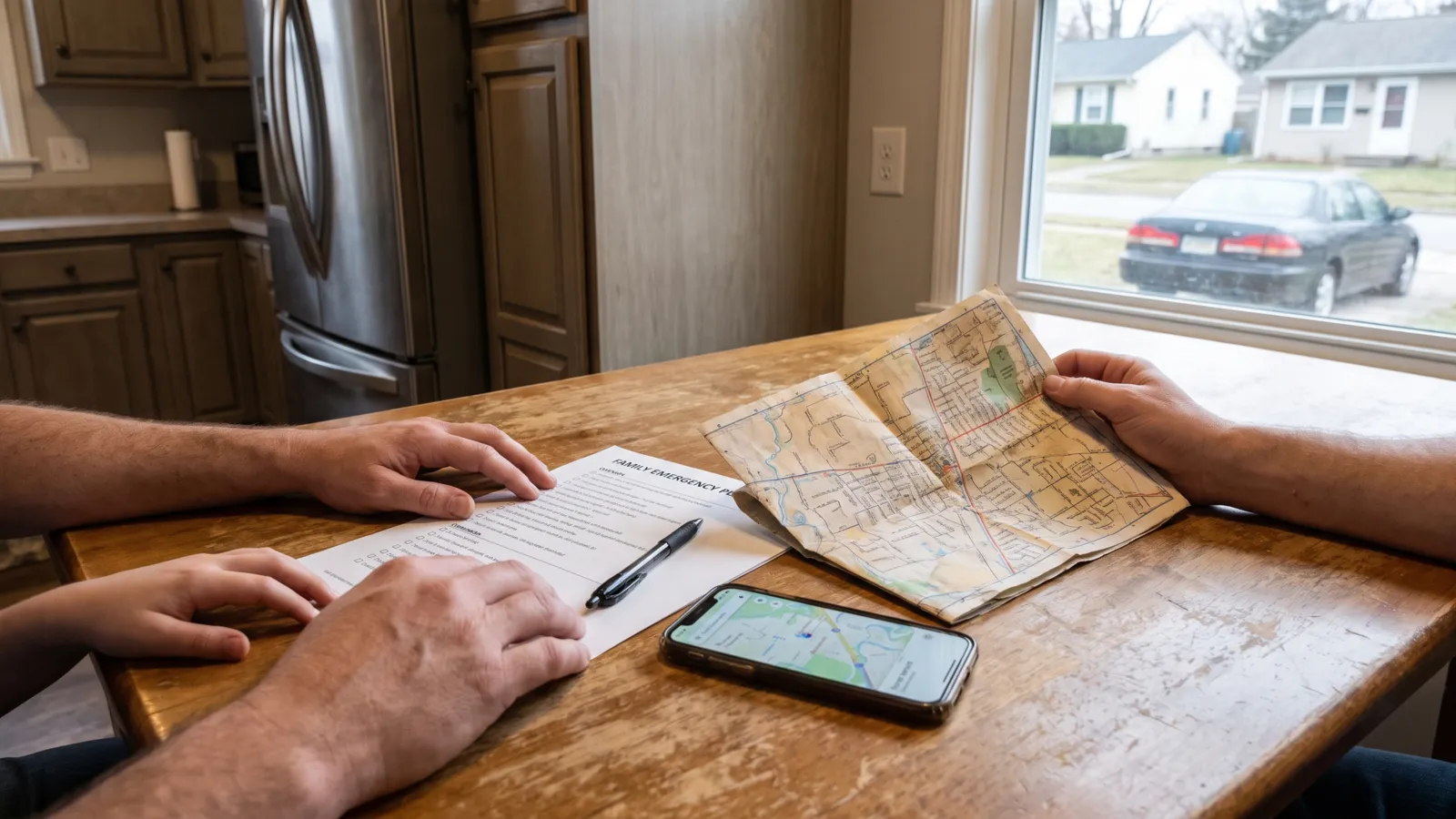
- Ready.gov's four steps: meet with your family, assess your household's needs, document your plan, then practice it together.
- Start by discussing five questions: alerts and warnings, your shelter plan, your evacuation route, your communication plan, and whether your kit needs updating.
- Choose an out-of-town contact for everyone to reach, plus meeting places in your neighborhood, outside it and outside your town. Text rather than call.
- You need not sign up for Wireless Emergency Alerts, but check your phone can get them and sign up for local alerts.
- Review, update and practice the plan at least once a year, or whenever your information changes.
Step 1: meet with your family
Ready.gov says your family may not be together if a disaster strikes, so it is important to know which types of disasters could affect your area. Know how you'll contact one another and reconnect if separated. To start your plan, discuss the questions below with your family, friends or household.
The Red Cross adds that you should plan for the emergencies most likely where you live, learn, work and play. Think about which may call for sheltering in place, such as a winter storm, and which may call for evacuation, such as a hurricane. For the kit question, see our emergency kit checklist.
- How will I receive emergency alerts and warnings?
- What is my shelter plan?
- What is my evacuation route?
- What is my family or household communication plan?
- Do I need to update my emergency preparedness kit?
Step 2: assess your household's needs
Ready.gov says to customize your plans and supplies to your specific daily living needs and responsibilities. Discuss how people in your network can assist each other with communication, care of children, business, pets or other needs. Consider the following:
- Different ages of members within your household
- Responsibilities for assisting others
- Locations visited frequently
- Dietary needs
- Medical needs, including prescriptions and equipment
- Disabilities or access and functional needs, including devices and equipment
- Languages spoken
- Cultural and religious considerations
- Pets or service animals
- Households with school-aged children
Children, older adults, people with disabilities and pets
The Red Cross says talking about emergency preparation ahead of time helps reduce fear, particularly for younger children. It also says to find out the emergency plans at your children's schools, day care or other places they regularly spend time, so you can reinforce them at home. Ready.gov says to discuss these plans with children and let them know who could pick them up in an emergency.
For older adults and people with disabilities, Ready.gov says to create a support network, and to make sure at least one person has an extra key to your home, knows where you keep your emergency supplies, and knows how to use lifesaving equipment or administer medicine. It also says to plan ahead for accessible transportation, ask your local emergency management office about voluntary registries, and talk to your doctor about keeping powered medical equipment running in an outage (see medical devices in a power outage). The Red Cross tells older adults to keep at least 30 days of medications and extra assistive items such as a cane or eyeglasses.
Pets belong in the plan too. Ready.gov says many public shelters and hotels do not allow pets inside, so know a safe place where you can take them and set up a buddy system. Our pet emergency kit guide has the full checklist.
Step 3: document your plan, starting with communication
Ready.gov says to document your plan with its fillable form, which asks for household information, names and contacts of family members, meeting places and medical information. Its family communication plan has three steps: collect, share and practice. Collect a paper copy of the contact information for your family and other important people or offices, such as medical facilities, doctors, schools or service providers. Make sure everyone carries a copy in a backpack, purse or wallet, and post one in a central location in your home.
Pick someone outside your community or state as a central point of contact, and pick the same person for each family member. Ready.gov says it may be easier to make a long-distance phone call than to call across town, because local phone lines can be jammed. The Red Cross says to make sure places where your children spend time, like school or day care, have the contact numbers too.
Ready.gov's advice for phones is to text, not talk. A text message may get through when a phone call will not, because a text requires far less bandwidth, and short messages such as "I'm OK. At library" are good. If you do call, keep it brief and wait 10 seconds before redialing.
Keep your phone working
Ready.gov's communication plan says to conserve phone battery by reducing the brightness of your screen, placing your phone in airplane mode and closing apps you do not need. It says to keep charged batteries, a car phone charger and a solar charger as backup power. If you charge your phone in your car, be sure the car is in a well-ventilated area, not a closed garage, to avoid life-threatening carbon monoxide poisoning. Our power bank comparison covers backup power.
Meeting places and your evacuation route
Ready.gov says to choose safe, familiar places where your family can go for protection or to reunite, and to make sure they are accessible for household members with disabilities. If you have pets or service animals, think about animal-friendly locations. Pick one in your neighborhood, such as a big tree, the mailbox at the end of the driveway or a neighbor's house, and one outside your neighborhood, such as a library, community center, house of worship or a family friend's home. If you live where tornadoes, hurricanes or other high-wind storms can happen, also pick an indoor place for protection, such as a small, interior, windowless room on the lowest level of a sturdy building.
Add a place outside your town or city, such as the home of a relative or family friend, and make sure everyone knows the address and how they would get there. The Red Cross says to decide where you would go if you had to evacuate, such as a hotel or motel, the home of friends or relatives a safe distance away, or an evacuation shelter. Plot alternate routes in case roads are impassable, and save locations and maps on your phone and on paper.
Sign up for alerts and warnings
Wireless Emergency Alerts are short emergency messages that authorities can send to any WEA-enabled mobile device in a locally targeted area. Ready.gov says there is no need to subscribe and you are not charged for receiving them. They look like text messages but have a unique sound and vibration, repeated twice.
To receive one, the FCC says your phone must be WEA-capable, switched on, not in airplane mode, and receiving service from a cell tower of a participating carrier. Ready.gov says older phones may not be WEA capable, some models require you to enable them, and some providers call them Government Alerts or Emergency Alert Messages. Children will also receive alerts on their WEA-enabled phones, so talk to them about WEAs and staying safe in an emergency.
Many jurisdictions also have opt-in systems, where you must sign up to receive local text or email alerts. To find yours, search for your town, city or county name and the word "alerts", check the website of your local emergency management or public safety office, or call them. A NOAA weather radio broadcasts official warnings, watches and forecasts 24 hours a day, and the FEMA app gives National Weather Service alerts for up to five locations.
Step 4: practice your plan
Ready.gov's fourth step is to practice your plan with your household. Its communication plan suggests practicing texting and calling your out-of-town contact and sending a group text, gathering at your indoor and neighborhood meeting places, and talking about how each person would get to your out-of-neighborhood and out-of-town meeting places. Make sure everyone, including children, knows how and when to call 911, which Ready.gov says is only for a life-threatening emergency.
The Red Cross says to practice evacuating your home twice a year: grab your emergency kit, just like in a real emergency, then drive your planned evacuation route. Our go-bag checklist can help you pack it. Ready.gov says to review, update and practice the communication plan at least once a year, or whenever your information changes.
Ready.gov says communication networks, such as mobile phones and computers, could be unreliable during disasters, and electricity could be disrupted. Having contact information written down will help you reconnect with others if you do not have your mobile device or computer with you or if the battery runs down.
Common questions
What should a family emergency plan include?
Ready.gov says to cover how you will get alerts and warnings, your shelter plan, your evacuation route, your communication plan, and whether your kit needs updating. Its fillable form asks for household information, names and contacts of family members, meeting places and medical information.
Who should be my out-of-town contact?
Ready.gov says to identify someone outside of your community or state who can act as a central point of contact, and to pick the same person for each family member. Someone out of town may be easier to reach in a disaster.
Do I have to sign up for Wireless Emergency Alerts?
No. The FCC says consumers do not need to sign up and the alerts are free, but you need a WEA-capable phone and a wireless carrier that participates in WEA. Local text and email alert systems are different, and Ready.gov says you must sign up for those.
Should I text or call in an emergency?
Ready.gov says to text, not talk, because phone lines may be tied up and texting leaves them open for emergency workers. A text may also get through when a call will not, because it needs far less bandwidth.
How often should we practice our plan?
Ready.gov says to review, update and practice the communication plan at least once a year, or whenever your information changes. The Red Cross says to practice evacuating your home twice a year.
How do I include my kids in the plan?
The Red Cross says talking about it ahead of time helps reduce fear, particularly for younger children. Ready Kids offers a family communications plan for kids to fill in and says to hold regular household meetings to review and practice your plan.
Sources (12)
- Ready.gov: Make a Plan
- Ready.gov: Family Emergency Communication Plan (PDF)
- Ready.gov: Ready Kids, Make a Plan
- Ready.gov: Emergency Alerts
- Ready.gov: Know Your Alerts and Warnings (PDF)
- Ready.gov: Older Adults
- Ready.gov: People with Disabilities
- Ready.gov: Pets for Disasters
- Red Cross: Make a Plan
- Red Cross: How Families Can Prepare for Emergencies
- Red Cross: Emergency Preparedness for Older Adults
- FCC: Wireless Emergency Alerts (WEA)
Get one calm email when it matters
Seasonal checklists and gear price drops. No spam, unsubscribe any time.
Keep reading
 Emergency kit checklist: what to include, how much to keep and where to store itA plain-English emergency kit checklist built on Ready.gov's basic kit and extra items, with how many days of …
 Go-bag checklist: what to pack in case you have to evacuateWhat to pack in a go-bag: documents, medications, cash, chargers, per-person items, kids and pets, and how it …
 Pet emergency kit: what to pack, where to go and what to do after a disasterHow to build a pet emergency kit and plan: what to pack, ID and microchips, what shelters and hotels allow, pe…
 Power outage plan for electric medical devices and refrigerated medicinesHow to plan for a power outage if you use electric medical devices or refrigerated medicine: questions to ask,…