Home fire escape plan: how to make one, practice it and get out safely
How to make a home fire escape plan: two ways out of every room, an outside meeting place, escape ladders, drills twice a year, and when to call 911.
By PreparedStates editors · Updated October 22, 2026 · Sourced to Ready.gov, the U.S. Fire Administration, the CPSC and the Red Cross
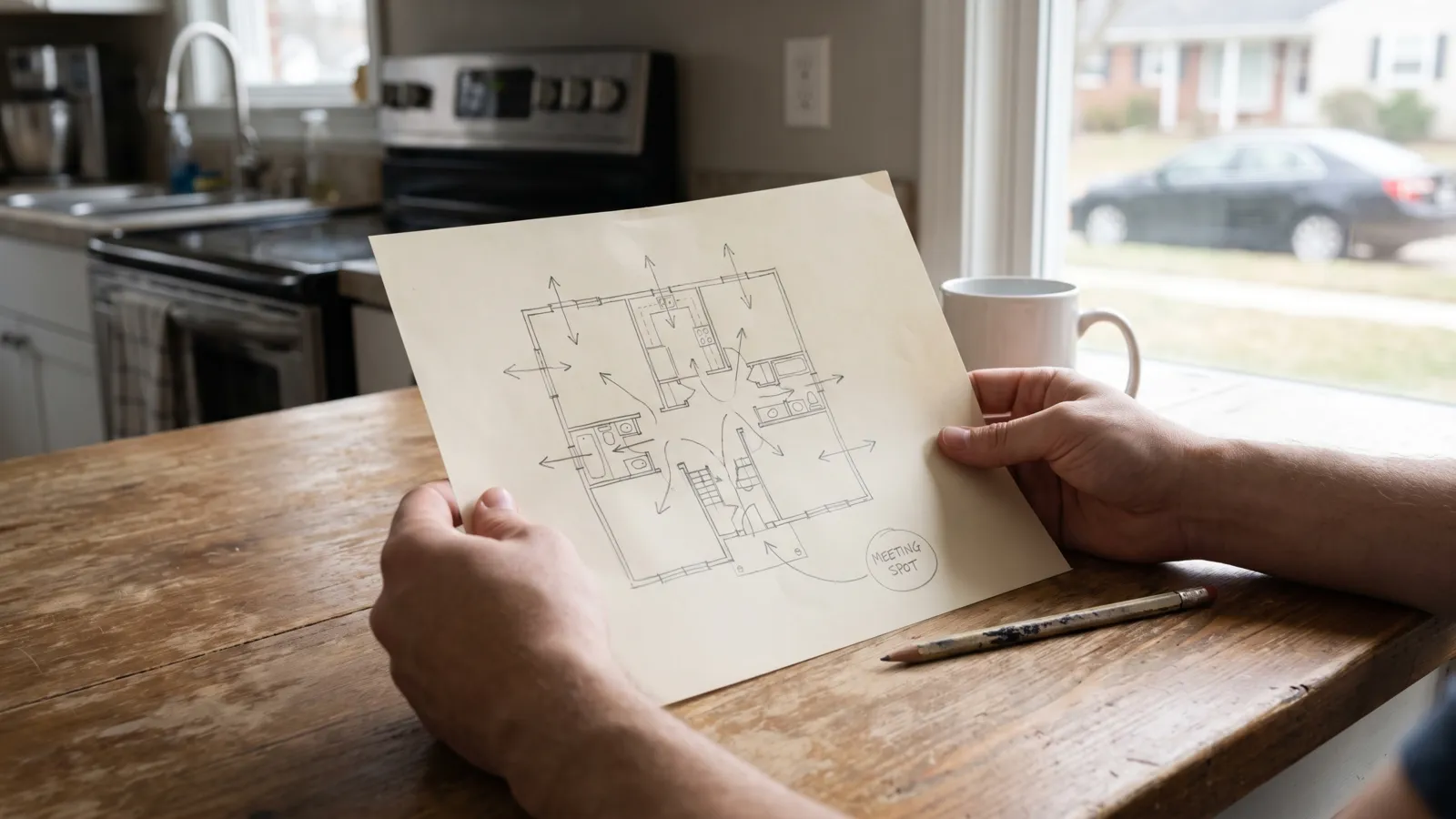
- Draw a map of your home with every door and window, and find two ways out of every room.
- Pick one meeting place outside, a safe distance from your home, and make sure everyone knows where it is.
- Practice a home fire drill at least twice a year, at different times of day, and aim to be outside in under 2 minutes.
- Get out, stay out, then call 911 from outside. Never go back inside for people, pets or things.
- A second way out of an upper-level room can be an escape ladder. Store it near the window and practice using it.
How much time you have to get out
A fire can become life-threatening in just two minutes, and a residence can be engulfed in flames in five minutes, according to Ready.gov. USFA says residents could have less than 2 minutes to escape a home fire once the smoke alarm sounds. The Red Cross puts it the same way: you may have as little as two minutes to escape.
Ready.gov explains why speed matters. In less than 30 seconds a small flame can turn into a major fire. Fire also starts bright but quickly produces black smoke and complete darkness, and it produces poisonous gases that make you disoriented and drowsy.
The CPSC says working smoke alarms are essential, but they do not save lives unless everyone knows how to get out of the home safely. Check your alarms too: see our smoke alarm placement guide.
Step 1: draw your plan and find two ways out of every room
USFA suggests you draw a map of your home that includes all doors and windows. Then find two ways out of every room, in case one exit is blocked or dangerous to use. Make sure doors and windows are not blocked.
Ready.gov says to check that windows are not stuck, that screens can be taken out quickly and that security bars can be properly opened. The Red Cross adds that security bars without release devices can trap you in a deadly fire. If you have security bars on your windows, be sure one window in each sleeping room has a release device.
- Draw a map of your home with every door and window
- Mark two ways out of every room
- Keep doors and windows clear and unblocked
- Check that windows open, screens come out and security bars release
- Practice your drill with everyone in the home
Escape ladders and upper floors
Ready.gov says a second way out can include an escape ladder for rooms on an upper level. The Red Cross suggests you consider escape ladders for sleeping areas on the second or third floor, learn how to use them, and store them near the windows. Our fire escape ladder comparison covers the options.
If a child may need to use a ladder, Ready.gov says to show them where you keep it and practice how to use it. USFA advises people with disabilities who live in a multistory home to sleep on the first floor, because being on the ground floor and near an exit makes escape easier.
Step 2: pick a meeting place and practice
Choose a safe meeting place outside, a safe distance from your home. USFA suggests a spot in front of your home. The CPSC says it should be away from the home but not necessarily across the street, such as under a specific tree or at the end of the driveway or front sidewalk, so that no one is hurt looking for someone who is already safe.
Ready.gov says to have a home fire drill at least twice a year, and to run through the plan at different times of the day or night, practicing different ways out. The Red Cross suggests practicing waking up to smoke alarms, low crawling and meeting outside. Ready.gov also suggests practicing feeling your way out of the house in the dark or with your eyes closed. Add the plan to your wider family emergency plan.
Ready.gov's drill is simple. First test the smoke alarms with your kids so they know the sound. Kids head to their bedrooms and wait, one adult sounds the smoke alarm and starts the timer, and everyone heads for the safety spot. If everyone is there in under two minutes you pass, and if not, give it another try.
If a fire starts: get out, stay out and call 911
The Red Cross keeps it simple: get out, stay out and call 911 or your local emergency phone number. Yell "Fire!" several times and go outside right away, leaving all your things where they are. If your building has elevators, use the stairs.
Make the call once you are outside. Ready.gov says to get to the safe meeting place, then call 911 and keep everyone close until firefighters arrive. The Red Cross says to go to your meeting place and then send one person to call the fire department.
Smoke, hot doors and closing doors behind you
Drop down to the floor and crawl low, under any smoke to your exit, because heavy smoke and poisonous gases collect first along the ceiling. Before opening a door, feel the doorknob and door. If either is hot, or smoke is coming around the door, leave it closed and use your second way out.
If you open a door, open it slowly and be ready to shut it quickly if heavy smoke or fire is present. If you must escape through smoke, the Red Cross says to close doors behind you. Ready.gov also advises sleeping with your bedroom door closed, and USFA notes that a closed door may slow the spread of smoke, heat and fire.
If you are trapped, or your clothes catch fire
If you cannot get out, Ready.gov says to close the door and cover vents and cracks around doors with cloth or tape to keep smoke out. Call 911 or the fire department, say where you are, and signal for help at the window with a light-colored cloth or a flashlight. The Red Cross also says to place a wet towel under the door.
If your clothes catch fire, stop immediately, drop to the ground and cover your face with your hands. Roll over and over or back and forth until the fire is out, because the Red Cross warns that running will only make the fire burn faster. Once the flames are out, cool the burned skin with water for three to five minutes. Then get medical help by calling 911.
Children, older adults, pets and apartment buildings
Ready.gov says to have a plan for young children under six who cannot get outside by themselves, and to talk about who will help each child get out safely. Children should know what to do when they hear a smoke alarm and there is no adult around. Teach them to never go back inside a burning building, to get low and crawl where the air is less smoky, and not to hide from firefighters.
USFA says people ages 65 and over have an increased risk of dying in a fire, and suggests older adults discuss their escape plan with family and neighbors. Contact your building manager or fire department if you need extra help escaping. If you use a walker or wheelchair, check all exits to be sure you can get through the doorways, and see our older adults preparedness guide.
If you cannot reach someone who needs help, leave the home, call 911 or the fire department, and tell the operator where the person is located. If pets are trapped inside, tell firefighters right away. In an apartment or high-rise building, USFA gives these steps:
- Leave your apartment and close the door behind you
- Pull the fire alarm on your way out to notify the fire department and your neighbors
- Use the stairs, and do not use the elevator unless directed by the fire department
- Go to your outside meeting place and stay there
- Call the fire department, and tell them if someone is trapped in the building
Never go back inside for people, pets or things. The Red Cross says only professional firefighters should enter a building that is on fire, even if family members or pets are inside, so tell the 911 operator where anyone is still inside.
Common questions
How long do I have to get out of a house fire?
USFA says residents could have less than 2 minutes to escape once the smoke alarm sounds. Ready.gov suggests making a written plan and practicing until you can get out in under 2 minutes.
How often should we practice a fire drill?
Ready.gov and the Red Cross both say at least twice a year. Run the drill at different times of the day and night so everyone practices different ways out.
Do I need a fire escape ladder?
Ready.gov says a second way out of an upper-level room can include one, and the Red Cross suggests considering ladders for sleeping areas on the second or third floor. If you get one, learn how to use it and keep it near the window.
Should I call 911 before I leave the house?
The official pages put getting out first. Go to your meeting place and then call, or send one person to call, as the Red Cross and Ready.gov describe. If you are trapped and cannot get out, Ready.gov says to close the door, call 911 and say where you are.
Where should our meeting place be?
Somewhere clearly outside and a safe distance from the house, such as a specific tree or the end of the driveway. Everyone, including children, should know where it is.
Should I fight a small fire before leaving?
The Red Cross says only if everyone has left or is leaving, the fire department has been called, the fire is small and not spreading, your back is to an exit, and there is not much smoke in the room. If the fire does not immediately die down, drop the extinguisher and get out.
Sources (13)
- Ready.gov: Practice Your Home Fire Escape Plan
- Ready.gov: Home Fires
- USFA: Home Fire Escape Plans
- USFA: Smoke Alarms
- USFA: Fire safety for children
- USFA: Fire safety for older adults
- USFA: Fire safety for people with disabilities
- Red Cross: What To Do if a Fire Starts
- Red Cross: Fire Safety for Kids
- Red Cross: Fire Safety Equipment
- Red Cross: Home Fire Safety
- Red Cross: Home Fire Escape Plan (PDF)
- CPSC: Smoke Alarms, Why, Where, and Which (Pub. 559)
Get one calm email when it matters
Seasonal checklists and gear price drops. No spam, unsubscribe any time.
Keep reading
 How to make a family emergency plan: steps, questions and a communication planHow to make a family emergency plan: Ready.gov's four steps, the questions to ask, a communication plan, meeti…
 Smoke alarm placement: where to put them, how to test them and when to replace themWhere to put smoke alarms: every level, inside each bedroom and outside sleeping areas, plus testing, batterie…
 Emergency preparedness for older adults: how to make a plan and a kitHow older adults can prepare for emergencies: assess needs, build a support network, plan for medicines and de…
 Carbon monoxide poisoning: symptoms, sources, alarms and what to doWhat CO poisoning feels like, who is most at risk, common sources in winter and outages, where to put CO alarm…