Best solar generators for power outages (2026)
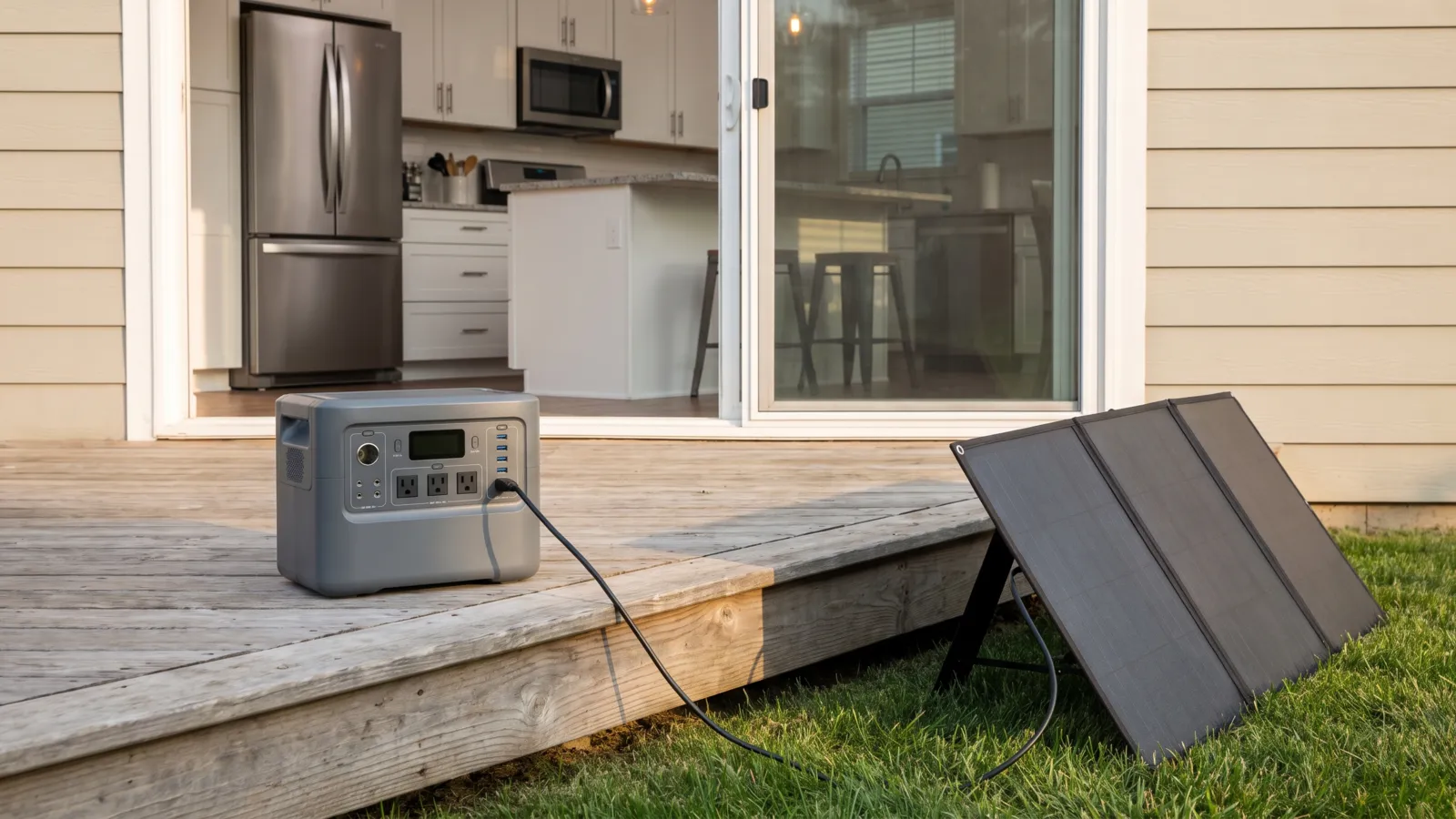
A solar generator is a portable power station sold with a solar panel: the battery runs your devices and the panel refills it in daylight, with no fuel and no exhaust. Buying the kit means the panel and cable are made for that station. Here are the kits worth buying, from small to large.
By PreparedStates editors · Updated October 22, 2026 · 6 products, prices indicative
Our picks
Jackery Solar Generator 1000 v2
A mid-size kit for a fridge and essentials
Anker SOLIX C1000 + 200W
Fast solar charging with a light panel
EcoFlow DELTA 3 MAX + 220W
2 kWh for a longer outage
All 6 compared
| Kit | Battery | Solar panel | AC output | Price |
|---|---|---|---|---|
1,070 Wh · 200 W · 1,500 W A mid-size kit for a fridge and essentials | 1,070 Wh | 200 W | 1,500 W | |
Our verdictOur verdictResearched Jackery's popular 1 kWh station with a matched 200 W panel: enough to run a fridge, lights and phones through an evening, then top up in the sun the next day. Best for A mid-size kit for a fridge and essentials Good
Worth knowing
Who shouldn't buy it: Don't buy it if you need to run 240V appliances. | ||||
1,056 Wh · 200 W · 1,800 W Fast solar charging with a light panel | 1,056 Wh | 200 W | 1,800 W | |
Our verdictOur verdictResearched Anker's 1,056 Wh C1000 takes up to 600 W of solar, so you can add panels later, and comes with a light 200 W bifacial panel. Best for Fast solar charging with a light panel Good
Worth knowing
Who shouldn't buy it: Don't buy it if you need 240V. | ||||
2,048 Wh · 220 W · 2,400 W 2 kWh for a longer outage | 2,048 Wh | 220 W | 2,400 W | |
Our verdictOur verdictResearched Twice the battery of the 1 kWh kits, with 2,400 W output: enough to keep a fridge and lights going through a night. One 220 W panel is a top-up at this size. Best for 2 kWh for a longer outage Good
Worth knowing
Who shouldn't buy it: Don't buy it if you need 240V. | ||||
2,042 Wh · 400 W · 2,200 W The most solar in one kit | 2,042 Wh | 400 W | 2,200 W | |
Our verdictOur verdictResearched 2,042 Wh with two 200 W panels, so it refills faster than the single-panel kits, and 2,200 W of output for a fridge, furnace fan and more. Best for The most solar in one kit Good
Worth knowing
Who shouldn't buy it: Don't buy it if you're short on space for panels. | ||||
1,024 Wh · 220 W · 1,800 W A 1 kWh kit with a bigger panel | 1,024 Wh | 220 W | 1,800 W | |
Our verdictOur verdictResearched A 1,024 Wh EcoFlow station with 1,800 W output and a 220 W panel, a little more panel than the 200 W kits. Best for A 1 kWh kit with a bigger panel Good
Worth knowing
Who shouldn't buy it: Don't buy it if you want the biggest battery for the money. | ||||
286 Wh · 45 W · 600 W Phones, lights and Wi-Fi on a budget | 286 Wh | 45 W | 600 W | |
Our verdictOur verdictResearched A small 286 Wh station and a 45 W panel: enough for phones, lights, a router or a fan, and light enough to carry anywhere. Best for Phones, lights and Wi-Fi on a budget Good
Worth knowing
Who shouldn't buy it: Don't buy it if you want to run a fridge. | ||||
ⓘ As an Amazon Associate, PreparedStates earns from qualifying purchases. We may earn a commission when you buy through our links. It never changes what we recommend. Amazon prices come from Amazon's own product data and can change at any time.
Before you buy
Size the battery first: it carries you through the night and cloudy days.
Then the panel: more panel watts refill faster, up to the station's solar input limit.
Kits take the guesswork out of connectors: the panel and cable are made for that station.
Panels need space to lay out facing the sun, and bigger ones are heavy and bulky to store.
We verify every product's specifications against at least two independent sources, re-check its US price and stock on a schedule where we can track it automatically, and cross-check safety-relevant claims against official guidance. Every review is labelled Researched or Used and reviewed by us: where we've bought a product, or been sent it free, and used it ourselves, its review says which; where we haven't, our verdict is a considered spec-and-evidence comparison, not a hands-on test — and commissions never change a ranking either way. Read our full methodology →
Related kit comparisons
Guides that go with this
A calm power outage checklist from Ready.gov and CDC: what to prepare, how to protect food, medicines and medi…
How long food stays safe in the fridge and freezer without power, what to throw out, and when you can refreeze…
Common questions
What is a solar generator?
A portable power station sold with one or more solar panels. The station's battery powers your devices; the panel recharges it in daylight.
How long does a solar panel take to recharge one?
Longer than the label suggests. Renogy estimates up to 500 Wh a day from a 200 W panel in average sun, so a 1 kWh station takes about two good days on one panel.
Can I use a solar generator indoors?
The station burns no fuel, so it gives off no carbon monoxide and can sit indoors; the panel goes outside in the sun.
Solar generator or gas generator?
Gas runs bigger loads for longer if you have fuel, but Ready.gov says generators must be used only outdoors, at least 20 feet from windows, doors and attached garages. A solar generator is silent, fume-free and needs no fuel, but stores less energy.