Is a home freeze dryer worth it? Harvest Right sizes, running costs and an owner's notes
What a Harvest Right freeze dryer really costs to run, which size and circuit you need, what it can and can't do for emergency food, and notes from two years of owning one.
By Tom Calder · Updated October 22, 2026 · Sourced to Harvest Right, the USDA Food Safety and Inspection Service and the U.S. Energy Information Administration, with notes from editor Tom Calder, who owned a Medium for two years
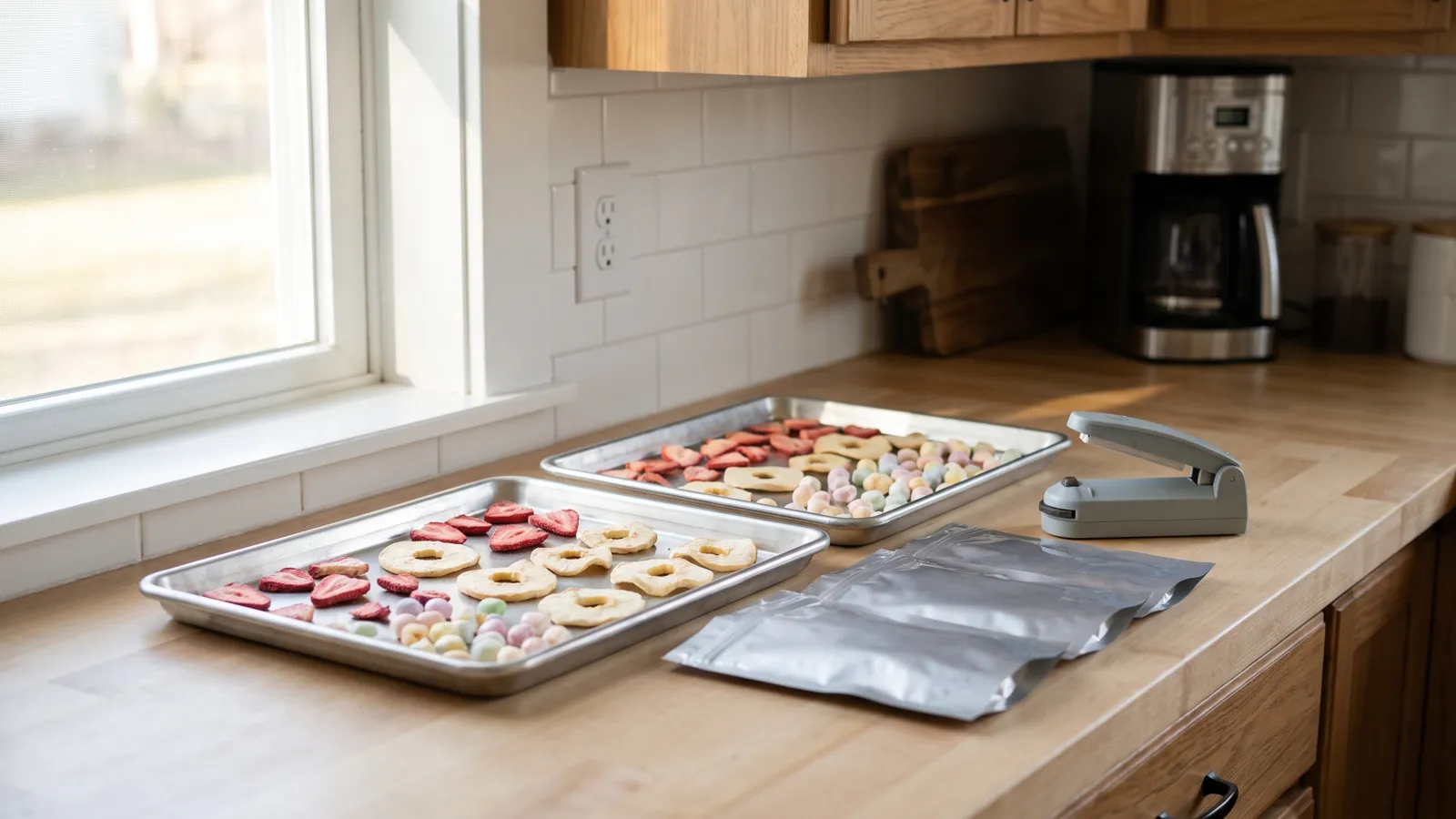
- A home freeze dryer turns fresh food and whole meals into shelf-stable food you seal in mylar bags. It builds a food store before an outage; it can't help during one, because each batch needs mains power for many hours.
- Harvest Right's home machines take 6 to 50 pounds of food a batch depending on size, and every size wants its own dedicated circuit.
- Most batches take 13 to 35 hours. On Harvest Right's own power figures and the U.S. average electricity price, a Small or Medium batch costs roughly $2.36 to $7.75 in electricity.
- It earns its keep with regular use: preserving harvests, bulk buys and leftovers. If you only want emergency food, ready-made kits are simpler.
- Our editor Tom Calder owned a Medium for two years: noise was bearable, upkeep was routine, and nothing went wrong.
What a home freeze dryer does
A freeze dryer freezes food hard, then pulls a vacuum so the ice turns straight to vapor, leaving food that is light, crisp and shelf stable once it is sealed. Harvest Right makes the best-known home machines, in Small, Medium, Large and XL sizes. Each comes with a vacuum pump that sits beside the machine, four to seven trays depending on size, and a starter set of mylar bags, oxygen absorbers and an impulse sealer for packaging.
For preparedness, the appeal is turning food you already eat into long-life food. Harvest Right claims shelf life of up to 25 years, and its own shelf-life article is more careful: some foods can last that long when properly freeze dried and stored in airtight containers with oxygen absorbers, away from moisture, heat and light. Treat 25 years as the best case, not the norm.
Which size, and the circuit each one needs
Harvest Right lists 6 to 10 pounds of fresh food per batch for the Small (4 trays), 10 to 15 for the Medium (5 trays), 18 to 27 for the Large (6 trays) and 40 to 50 for the XL (7 trays). Its yearly figures, from 1,800 pounds for the Small to 10,000 for the XL, assume four batches a week for 50 weeks, so read them as a ceiling.
Check your wiring before you choose. Harvest Right says the Small and Medium need a dedicated 15-amp circuit, the Large a dedicated 15-amp circuit on a NEMA 5-15 outlet, and the XL a dedicated 20-amp circuit on a NEMA 5-20 outlet. Its warranty excludes running the machine from an extension cord, so plan the location around the outlet. Harvest Right suggests the Medium for small families of 2 to 5 people. The Medium weighs 119 pounds and ships as a 209-pound package, curbside only. Our freeze dryer comparison puts all four sizes side by side.
What it costs to run
Harvest Right's FAQ says the Small and Medium draw 13 to 15 amps at peak and 9 to 11 amps on average, which it puts at 990 to 1,210 watts, and it says most batches take 13 to 35 hours (candy about two hours). It quotes $1.25 to $2.80 a batch for those sizes, about $2 to $3 for the Large and about $4 for the XL.
Those dollar figures look low against its own power numbers. The U.S. Energy Information Administration's average residential price was 18.31 cents per kWh in July 2026. At that price, 990 to 1,210 watts for 13 to 35 hours works out to roughly $2.36 to $7.75 a batch for a Small or Medium. Dense foods, sugary foods and a warm room all stretch a batch: Harvest Right says a 24-hour batch could take over 40 hours in a hot room.
Add consumables: mylar bags, oxygen absorbers and pump oil. The included Premier oil pump needs an oil change every 20 to 30 batches, which Harvest Right says takes about two minutes, and the oil can be filtered and reused. Harvest Right sells an oil-free pump that needs no oil changes, but it isn't included.
Freeze-dried candy, eggs, chicken and chili
Tom's most common batches were candy, eggs, cooked chicken and chili, which is a fair picture of what home machines get used for. Candy is the quick one, at about two hours. Harvest Right says beginners often start with fruit or candy, and that chocolate and high-fat or oily foods don't freeze dry well.
Be careful with food safety. Harvest Right says freeze drying doesn't kill bacteria; it makes them dormant, and adding water can reactivate them. Its rules for raw meat are to rehydrate it in cold water in the refrigerator and then treat it exactly like fresh raw meat, cooking it fully. The USDA's Food Safety and Inspection Service describes freeze drying as a commercial process and doesn't publish guidance for home machines, so the handling rules you'll find come from the maker.
Package each batch as soon as it is done: Harvest Right says to remove the trays while still warm and seal straight away, because cold freeze-dried food takes up moisture from the air quickly.
Two years with a Medium: an owner's notes
PreparedStates editor Tom Calder owned a Harvest Right Medium for two years, until 2025. It was the UK version, so its power figures don't apply here, but day-to-day life with the machine is the same. It lived in his dining room. The noise was bearable in the room, and with the door shut it could barely be heard, which matches Harvest Right's own description of a hum like a dishwasher.
It used the oil pump, with oil changes as the guide recommends; upkeep was easy. Over two years nothing went wrong with the machine. The routine to plan for is the one Harvest Right describes: defrost the chamber between every batch, check the door seal, and package food as soon as each batch finishes.
Who shouldn't buy one
Skip it if you'd only run it a few times a year. A freeze dryer pays its way through regular batches; Harvest Right's own break-even table for the Medium runs from about 7 months at one batch a week to 1.4 months at five, on assumptions it doesn't publish, and its claim that home freeze-dried food costs a third of store-bought comes with no workings.
Skip it if you just want emergency food now. A machine builds a store a batch at a time over months; a ready-made kit covers you today. Our emergency food supply comparison and freeze-dried meals comparison cost less up front.
Think twice if you can't give it a dedicated circuit, can't spare a spot with airflow (Harvest Right wants 45 to 75°F for best results), or don't want the packaging routine after every batch.
Warranty and returns
Harvest Right advertises a three-year limited warranty. The detail matters: the first year is full cover for the freeze dryer and its pump, while years two and three cover only the sealed refrigeration system, with the owner paying diagnostic charges and transport. Within 30 days of shipping you can return a machine for a refund less shipping and a 15% restocking fee. Our freeze dryer comparison lists all four sizes side by side.
Harvest Right says properly sealed freeze-dried food needs no electricity to stay preserved, but the machine itself needs mains power for many hours per batch. Plan your batches before storm season, not during it.
Common questions
Is a home freeze dryer worth it?
If you'll run it regularly, for harvests, bulk buys and meals, it can be. If you only want a few weeks of emergency food, ready-made freeze-dried kits cost less up front and are ready today.
How much does it cost to run a Harvest Right freeze dryer?
Harvest Right quotes $1.25 to $2.80 a batch for the Small and Medium. Using its own power draw and batch times at the U.S. average electricity price of 18.31 cents per kWh (July 2026), a Small or Medium batch works out to roughly $2.36 to $7.75.
Does a Harvest Right need a dedicated circuit?
Yes. Harvest Right says the Small and Medium need a dedicated 15-amp circuit, the Large a dedicated 15-amp circuit, and the XL a dedicated 20-amp circuit. Running it from an extension cord is excluded from the warranty.
How long does freeze-dried food last?
Harvest Right claims up to 25 years for some foods when they are properly freeze dried and stored in airtight packaging with oxygen absorbers, away from moisture, heat and light. Treat that as the best case.
Can I run a freeze dryer in a power outage?
Not practically: each batch needs mains power for many hours. The food it makes needs no power once sealed, so it belongs in your store before an outage.
Sources (7)
- Harvest Right: Home Freeze Dryer (sizes, specs, what's included)
- Harvest Right: FAQs (power, batch times, defrosting)
- Harvest Right: Freeze dryer cost to run
- Harvest Right: Warranty
- Harvest Right: Freeze drying meat
- USDA FSIS: Shelf-stable food safety
- U.S. Energy Information Administration: Average price of electricity to residential customers (Electric Power Monthly, Table 5.3)
Get one calm email when it matters
Seasonal checklists and gear price drops. No spam, unsubscribe any time.
Keep reading
 Emergency food storage: how much to store, what to buy and how to keep it safeHow much emergency food to store, from a 3-day kit to two weeks at home: no-cook foods, calories, special diet…
 Food safety in a power outage: how long food lasts and what to throw outHow long food stays safe in the fridge and freezer without power, what to throw out, and when you can refreeze…
 Power outage checklist: what to do before, during and afterA calm power outage checklist from Ready.gov and CDC: what to prepare, how to protect food, medicines and medi…
 Emergency kit checklist: what to include, how much to keep and where to store itA plain-English emergency kit checklist built on Ready.gov's basic kit and extra items, with how many days of …