Best whole house generators: home standby generators by size (2026)
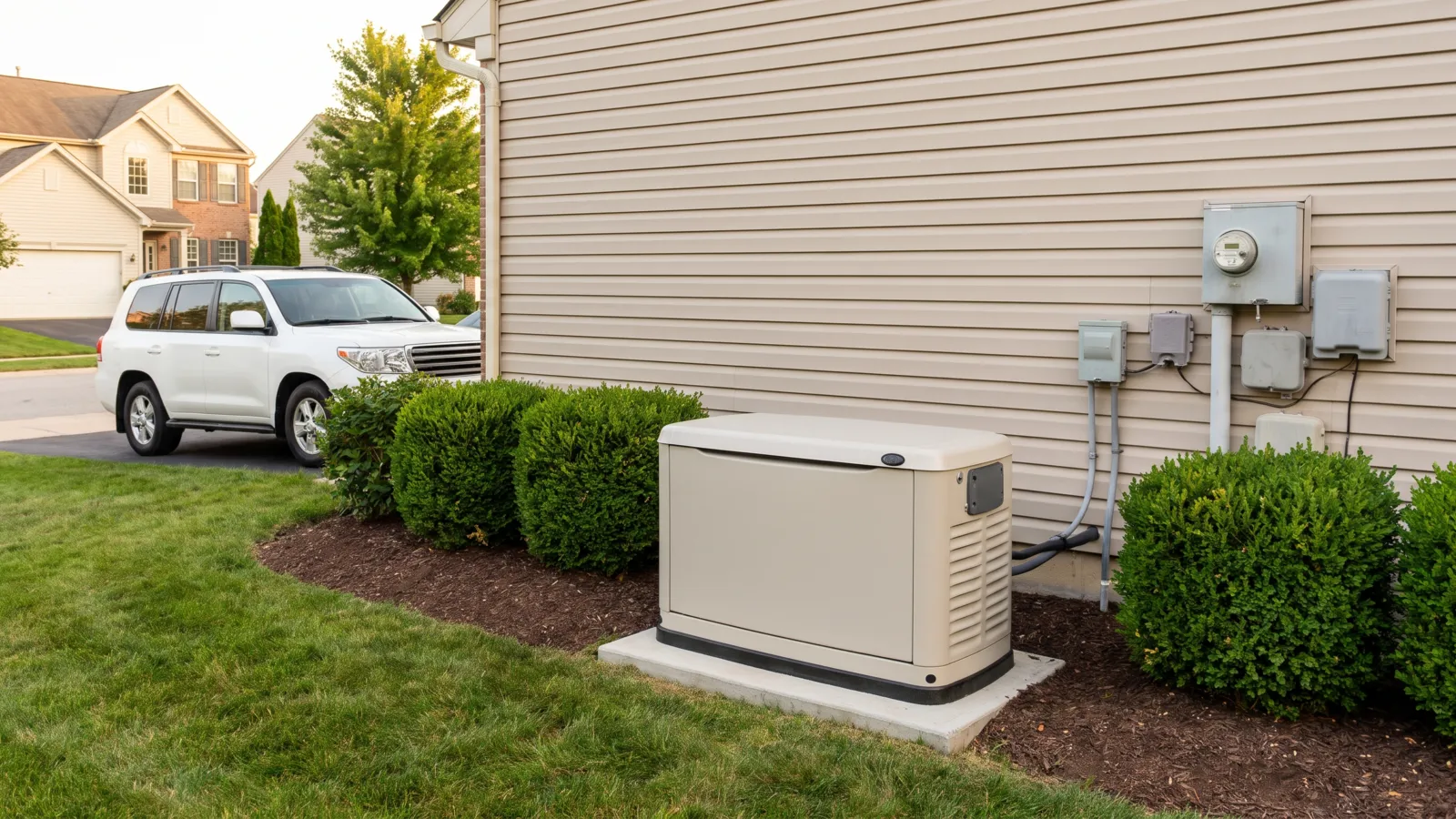
A whole house generator, or home standby generator, sits outside on a pad, runs on your natural gas line or a propane tank, and starts by itself within seconds of a power outage, moving your circuits over through an automatic transfer switch. This page compares the sizes Amazon sells and had in stock when we checked, 10 to 26 kilowatts, on what each can run, using appliance figures from DTE Energy. We haven't installed these ourselves; every spec is from the listing.
By Tom Calder · Updated October 24, 2026 · 5 products, prices indicative
Our picks by size
Generac 22kW
A whole home with central air
Generac 10kW
The essentials, automatically: fridge, furnace, well pump, lights and internet
Generac 14kW
Most of a mid-size home, minus central air
Generac 26kW
Large homes: central air plus electric appliances at once
All 5 compared
| Generator | Rated output (listing) | Transfer switch | Fuel | Weight | Warranty | Price |
|---|---|---|---|---|---|---|
1. Generac 10kW Whole Home Standby Generator with Transfer Switch (G0073210) Best for the essentials 10,000 W · Included (the listing doesn't give its amps) · Propane (LP) or natural gas · 384 lb · 5-year limited The essentials, automatically: fridge, furnace, well pump, lights and internet | 10,000 W | Included (the listing doesn't give its amps) | Propane (LP) or natural gas | 384 lb | 5-year limited | |
Our verdictOur verdictResearched The smallest Generac standby unit: 10 kW, which covers the essentials rather than the whole house. By DTE Energy's figures that's room for a fridge, a furnace fan, a well pump, lights and the internet together, but not a 3-ton central air conditioner, which DTE puts at 18,000 watts to start. It runs on your propane or natural gas supply and starts by itself within seconds of an outage. The listing includes a transfer switch but doesn't give its rating, so confirm it with your installer. Best for The essentials, automatically: fridge, furnace, well pump, lights and internet Good
Worth knowing
Who shouldn't buy it: Don't buy it if you need central air in an outage: look at the 22 or 26 kW. | ||||||
2. Generac 14kW Whole Home Standby Generator with 200-Amp Transfer Switch (7323) Best without central air 14,000 W · 200 amp, included · Propane (LP) or natural gas · 391 lb · 5-year limited Most of a mid-size home, minus central air | 14,000 W | 200 amp, included | Propane (LP) or natural gas | 391 lb | 5-year limited | |
Our verdictOur verdictResearched Fourteen kilowatts with a 200-amp transfer switch: enough for the essentials plus more of the house at once, such as a 50-gallon electric water heater, which DTE Energy puts at 4,500 to 5,000 watts, alongside the fridge, furnace and lights. Like the rest of the range it runs on propane or natural gas and starts itself within seconds of an outage. It still falls short of the 18,000 watts DTE gives for starting a 3-ton central air conditioner. Best for Most of a mid-size home, minus central air Good
Worth knowing
Who shouldn't buy it: Don't buy it if central air is a must in an outage: the 22 kW clears DTE's starting figure for a 3-ton unit. | ||||||
3. Generac 22kW Whole Home Standby Generator with 200-Amp Transfer Switch (7325) Best whole-home pick with central air 22,000 W · 200 amp, included · Propane (LP) or natural gas · 451 lb · 5-year limited A whole home with central air | 22,000 W | 200 amp, included | Propane (LP) or natural gas | 451 lb | 5-year limited | |
Our verdictOur verdictResearched Twenty-two kilowatts with a 200-amp transfer switch. On its listed rating it clears DTE Energy's 18,000-watt starting figure for a 3-ton central air conditioner with about 4,000 watts to spare for the fridge, lights and other loads running at the same time. The listing adds oil level sensors and cold-weather starting features, and like the rest of the range it starts itself within seconds of an outage on propane or natural gas. Best for A whole home with central air Good
Worth knowing
Who shouldn't buy it: Don't buy it if you don't need central air in an outage: the 14 kW covers the essentials for less. | ||||||
4. Generac 26kW Whole Home Standby Generator with 200-Amp Transfer Switch (7328) Best for large homes 26,000 W · 200 amp, included · Propane (LP) or natural gas · 524 lb · 5-year limited Large homes: central air plus electric appliances at once | 26,000 W | 200 amp, included | Propane (LP) or natural gas | 524 lb | 5-year limited | |
Our verdictOur verdictResearched The largest on this page: 26 kW and a 200-amp transfer switch, for a large home that wants central air and electric loads such as a water heater running together. On its listed rating, DTE Energy's figures for a 3-ton central air conditioner (18,000 watts to start) and a 50-gallon electric water heater (up to 5,000 watts) fit inside it with about 3,000 watts left for the essentials. It's also the heaviest at 524 pounds. Best for Large homes: central air plus electric appliances at once Good
Worth knowing
Who shouldn't buy it: Don't buy it if your house is mid-size: the 22 kW covers central air with room to spare. | ||||||
18,000 W · 200 amp, included · Propane (LP) or natural gas · 426 lb · 5-year limited A bigger home without central air, or with a small AC unit | 18,000 W | 200 amp, included | Propane (LP) or natural gas | 426 lb | 5-year limited | |
Our verdictOur verdictResearched Eighteen kilowatts and a 200-amp transfer switch. That's exactly DTE Energy's 18,000-watt starting figure for a 3-ton central air conditioner, which leaves no headroom for anything else running when it starts, and less still if its rating on your fuel is lower. So treat it as a big essentials-plus unit rather than counting on it to start central air. Best for A bigger home without central air, or with a small AC unit Good
Worth knowing
Who shouldn't buy it: Don't buy it if you want central air without fuss: the 22 kW has room to spare. | ||||||
ⓘ As an Amazon Associate, PreparedStates earns from qualifying purchases. We may earn a commission when you buy through our links. It never changes what we recommend. Amazon prices come from Amazon's own product data and can change at any time.
Before you buy
Size it to what must run at once.
DTE Energy puts a 3-ton central air conditioner at 6,000 running watts and 18,000 to start, a 50-gallon electric water heater at 4,500 to 5,000 watts, and a 1/2 HP well pump at 1,000 watts running and 3,000 to start. Our generator wattage calculator adds up the rest.
Check the rating on your fuel.
A standby generator can make less on natural gas than on propane: Kohler's listing, for example, rates its 26 kW unit at 24 kW on natural gas. Ask your installer for the figure on the fuel you'll use.
Check the transfer switch.
The 14, 18, 22 and 26 kW kits on this page list a 200-amp transfer switch; the 10 kW listing includes a switch but doesn't give its rating. Your electrician should confirm it suits your home's electrical service.
Plan the install before you buy
A site outdoors that meets the maker's clearance rules, a gas supply big enough for the generator, and a licensed electrician for the transfer switch.
We verify every product's specifications against at least two independent sources, re-check its US price and stock on a schedule where we can track it automatically, and cross-check safety-relevant claims against official guidance. Every review is labeled Researched or Used and reviewed by us: where we've bought a product, or been sent it free, and used it ourselves, its review says which; where we haven't, our verdict is a considered spec-and-evidence comparison, not a hands-on test — and commissions never change a ranking either way. Read our full methodology →
Related kit comparisons
Guides that go with this
How to use a portable generator safely in an outage: 20 feet from windows, never in a garage, CO alarms, outdo…
A calm power outage checklist from Ready.gov and CDC: what to prepare, how to protect food, medicines and medi…
How to plan for a power outage if you use electric medical devices or refrigerated medicine: questions to ask,…
Common questions
What size whole house generator do I need?
Add up what has to run at the same time and allow for the biggest starting load. DTE Energy puts a 3-ton central air conditioner at 18,000 watts to start, so a home that needs central air in an outage is looking at the 22 or 26 kW sizes on this page; without central air, 10 to 18 kW covers the essentials and more. Our generator wattage calculator does the sums.
How much does a whole house generator cost?
The generator's price is on its listing. Installation is quoted separately because it depends on your home: the pad, the gas line, the transfer switch and any permits. Licensed installers quote it, so get more than one quote before you buy.
Whole house generator or portable generator?
A standby generator starts by itself, runs on natural gas or propane and can power the whole house through an automatic transfer switch. A portable generator costs much less but you set it up outdoors yourself in each outage, fuel it with gasoline (or propane on dual-fuel models), and connect it with heavy-duty outdoor cords or a manual transfer switch fitted by a qualified electrician.
Can I install a standby generator myself?
No. OSHA says never to attach a generator to a home's electrical system unless a qualified electrician has properly installed it with a transfer switch, and the gas connection needs a qualified professional too.
Why is every generator on this page a Generac?
When we checked on October 24, 2026, Generac's were the only home standby generators that Amazon itself was selling and had in stock. Kohler's and Champion's listings had no buy button and Honeywell's was out of stock. We'll add other makers when they're available.