Mylar bags, oxygen absorbers and food-grade buckets for long-term food storage (2026)
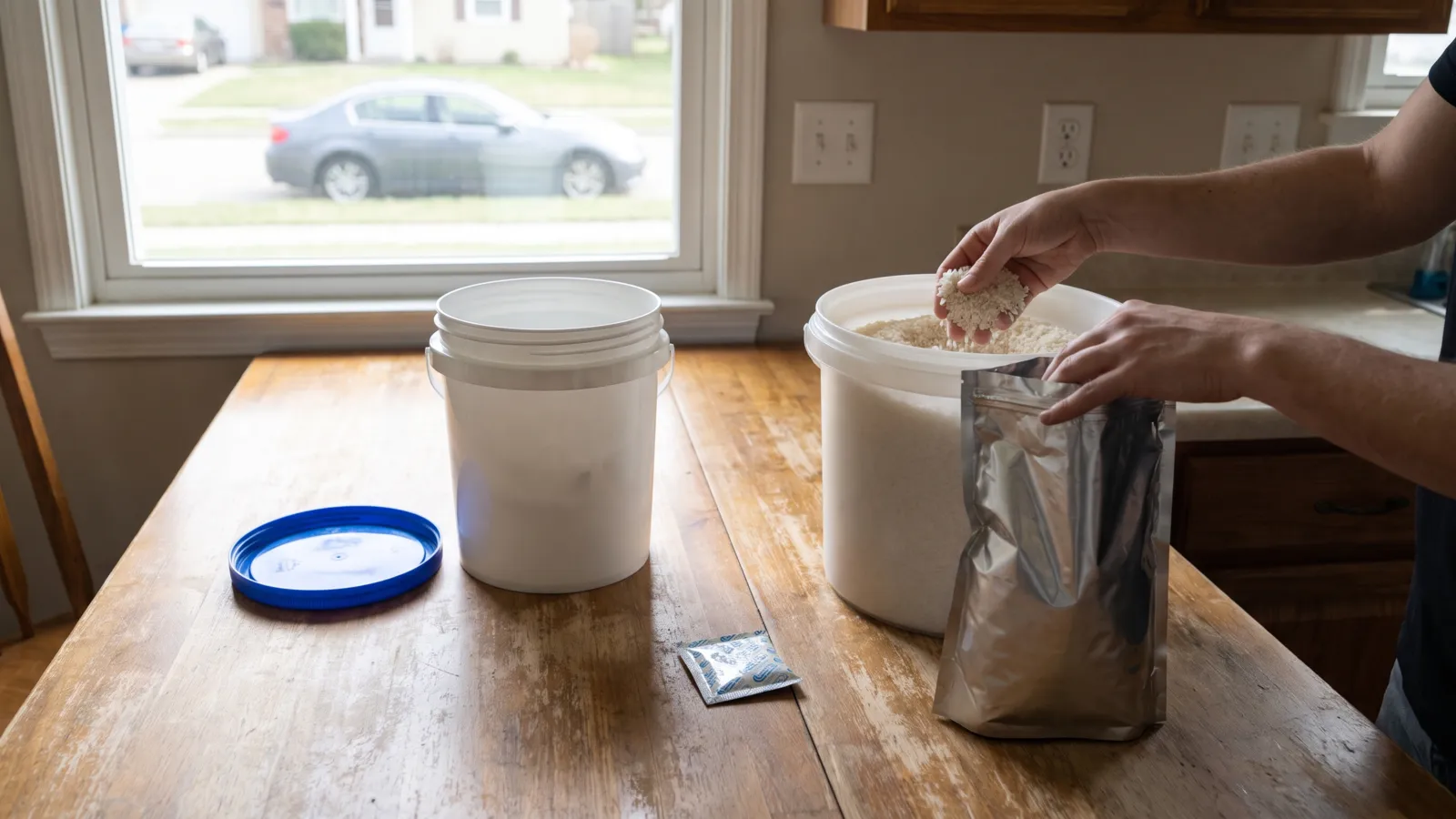
Dry staples last for decades when you keep out the four things that spoil them: oxygen, moisture, heat and pests. The usual way is Mylar bags with oxygen absorbers, sealed and packed inside food-grade buckets. Utah State University Extension says long-term packaging must keep out moisture, rodents and insects. This page compares the bags, absorbers, buckets and lids we list. We haven't used these ourselves; every spec is from the listing.
By Tom Calder · Updated October 24, 2026 · 5 products, prices indicative
Our picks
Wallaby 1-gallon Mylar (75)
Packing rice, beans and wheat into gallon portions
300cc oxygen absorbers (210)
Refills for your own bags, cans and bottles
5-gallon bucket + Gamma Seal lid
Rodent-proof outer storage for Mylar bags
Gamma Seal lid
Turning any food-grade bucket into an everyday bin
All 5 compared
| Product | What it is | Size | Packaging | Shelf life (maker) | Price |
|---|---|---|---|---|---|
Mylar bags with oxygen absorbers · 1 gallon, 75 bags · 10 mil, heat-sealable, open top · Depends on the food and storage Packing rice, beans and wheat into gallon portions | Mylar bags with oxygen absorbers | 1 gallon, 75 bags | 10 mil, heat-sealable, open top | Depends on the food and storage | |
Our verdictOur verdictResearched Seventy-five thick (10 mil), heat-sealable one-gallon Mylar bags with oxygen absorbers. Utah State University Extension calls PET-and-foil pouches, sold as Mylar, exceptional food containers because the foil layer dramatically cuts the oxygen and moisture getting in. Gallon bags fit inside a 5-gallon bucket for protection from rodents. Best for Packing rice, beans and wheat into gallon portions Good
Worth knowing
Who shouldn't buy it: Don't buy it if you want mixed sizes for spices and smaller portions: the PackFreshUSA kit has pints, quarts and gallons. | |||||
Mylar bags with matched oxygen absorbers and labels · 30 pint, 40 quart and 30 gallon bags · 7 mil · Depends on the food and storage A starter kit with the right absorber for each bag size | Mylar bags with matched oxygen absorbers and labels | 30 pint, 40 quart and 30 gallon bags | 7 mil | Depends on the food and storage | |
Our verdictOur verdictResearched One hundred Mylar bags in three sizes, pint, quart and gallon, each with an oxygen absorber sized for it (100cc, 300cc and 500cc) and a label. That takes the guesswork out of matching absorbers to bags, which is where beginners usually go wrong. The bags are thinner than Wallaby's at 7 mil, so keep them inside a bucket. Best for A starter kit with the right absorber for each bag size Good
Worth knowing
Who shouldn't buy it: Don't buy it if you're packing big amounts of one staple: gallon-only bags are simpler. | |||||
Food-grade HDPE bucket with screw-on Gamma Seal lid · 5 gallons · 90 mil HDPE, BPA free · Not applicable Rodent-proof outer storage for Mylar bags | Food-grade HDPE bucket with screw-on Gamma Seal lid | 5 gallons | 90 mil HDPE, BPA free | Not applicable | |
Our verdictOur verdictResearched A sturdy 5-gallon food-grade HDPE bucket with a Gamma Seal lid, the screw-on lid that makes a bucket easy to open and reseal every day. Utah State University Extension says long-term storage packaging must keep out moisture, rodents and insects, and that heavy-duty plastic bags alone aren't insect- and rodent-proof; Mylar bags inside a bucket like this cover both. Best for Rodent-proof outer storage for Mylar bags Good
Worth knowing
Who shouldn't buy it: Don't buy it if you already have food-grade buckets: just add Gamma Seal lids. | |||||
Screw-on airtight bucket lid · Fits 3.5 to 7 gallon buckets · Not applicable · Not applicable Turning any food-grade bucket into an everyday bin | Screw-on airtight bucket lid | Fits 3.5 to 7 gallon buckets | Not applicable | Not applicable | |
Our verdictOur verdictResearched The original screw-on Gamma Seal lid: snap the ring onto a 3.5 to 7 gallon bucket and the center screws on and off, airtight. It's the bucket you open every week, the rice or oats you're using, rather than the sealed reserve. Best for Turning any food-grade bucket into an everyday bin Good
Worth knowing
Who shouldn't buy it: Don't buy it if you need the bucket too: the bucket-and-lid set above. | |||||
Oxygen absorber packets · 210 x 300cc, in packs of 10 · Sealed packs of 10 · Use soon once a pack is opened Refills for your own bags, cans and bottles | Oxygen absorber packets | 210 x 300cc, in packs of 10 | Sealed packs of 10 | Use soon once a pack is opened | |
Our verdictOur verdictResearched A big stock of 300cc absorbers, packed 10 at a time so you only open what you'll use in one session. Utah State University Extension recommends food-safe oxygen absorbers to keep rice, beans and dried milk in good condition and to protect grains from insects. Work quickly once a pack is open: absorbers start working as soon as they meet air. Best for Refills for your own bags, cans and bottles Good
Worth knowing
Who shouldn't buy it: Don't buy it if you're just starting: a Mylar kit with matched absorbers is easier. | |||||
ⓘ As an Amazon Associate, PreparedStates earns from qualifying purchases. We may earn a commission when you buy through our links. It never changes what we recommend. Amazon prices come from Amazon's own product data and can change at any time.
Before you buy
Bags: Mylar-type bags (PET and foil) block oxygen and light; thicker bags (10 mil) resist punctures better than thin ones.
Absorbers: match the absorber size to the bag, and open a pack only when you're ready to seal.
A kit with matched sizes is easiest for beginners.
Buckets: put sealed bags inside food-grade buckets for rodent and insect protection.
Utah State says heavy-duty plastic bags alone aren't insect- and rodent-proof.
Lids: a screw-on Gamma Seal lid makes the bucket you use every day easy to open and reseal.
We verify every product's specifications against at least two independent sources, re-check its US price and stock on a schedule where we can track it automatically, and cross-check safety-relevant claims against official guidance. Every review is labeled Researched or Used and reviewed by us: where we've bought a product, or been sent it free, and used it ourselves, its review says which; where we haven't, our verdict is a considered spec-and-evidence comparison, not a hands-on test — and commissions never change a ranking either way. Read our full methodology →
Related kit comparisons
Guides that go with this
How to store food for months or a year: which staples last decades, how to pack them with Mylar and oxygen abs…
How much emergency food to store, from a 3-day kit to two weeks at home: no-cook foods, calories, special diet…
Common questions
Do I need oxygen absorbers?
For most long-stored dry foods, yes. Utah State University Extension recommends food-safe oxygen absorbers to preserve the quality of rice, beans and dried milk and to protect grains from insects. It notes that wheat doesn't need to be stored without oxygen unless insects are present.
Can I store food in Mylar without oxygen absorbers?
You can, but the oxygen left inside will slowly lower quality and won't stop insects. Absorbers are what make the long shelf lives in BYU's and Utah State's research possible.
Can I vacuum seal food for long-term storage instead?
Not as a substitute. Utah State University Extension says vacuum packaging is not a food preservation method by itself and can help botulism bacteria grow by removing oxygen; foods that needed refrigeration still do.
Where should I keep stored food?
Somewhere cool, dry and dark. Utah State says the best range is about 40 to 70°F, and cites BYU research in which wheat kept acceptable quality for 25 years in a cold basement but only 5 in a hot garage or attic.