Canning supplies for beginners: water bath canner, jars, lids and tools (2026)
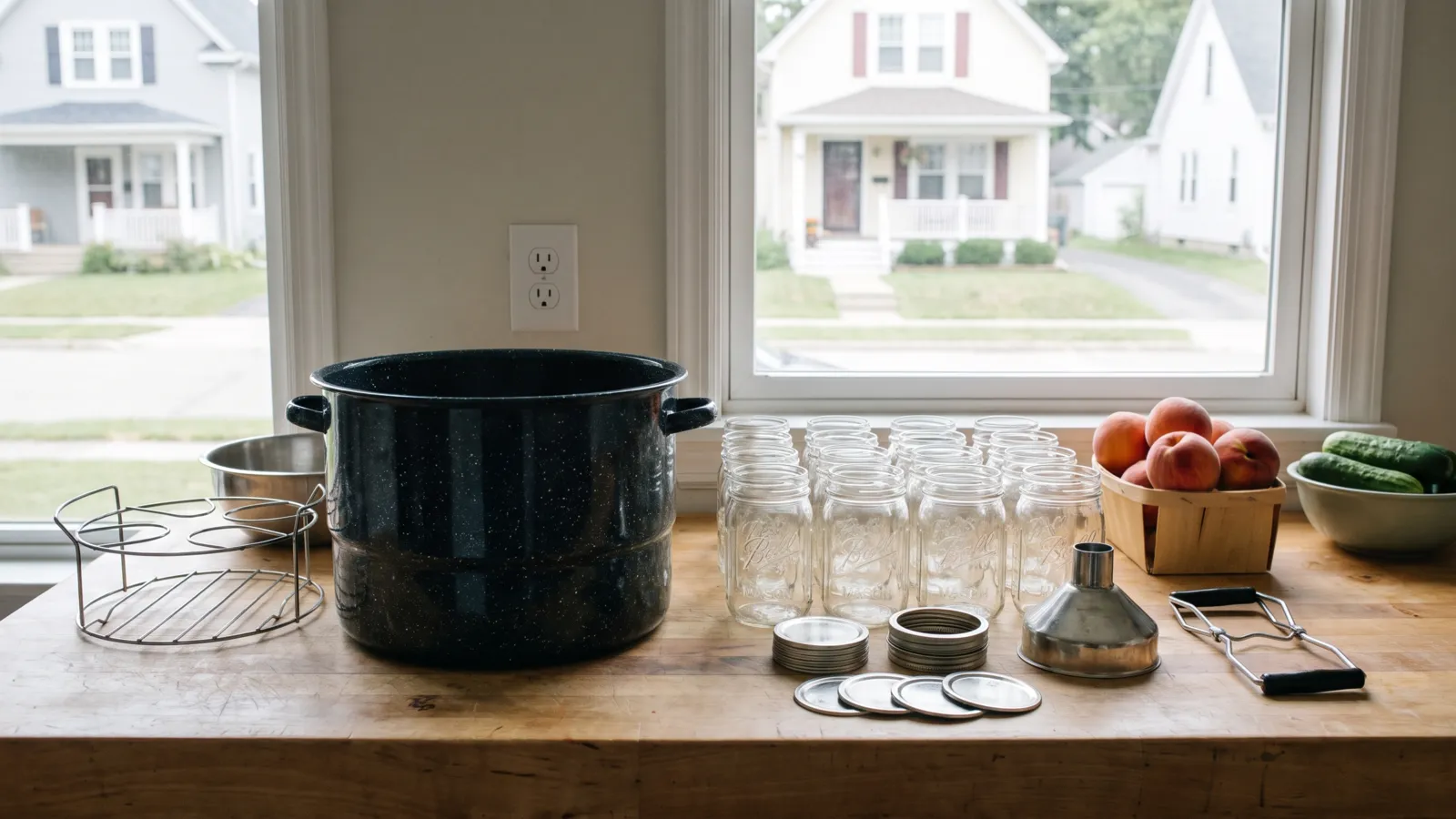
Home canning needs less than you might think: a canner, Mason-type jars, new lids for every batch and a few hand tools. The USDA guide says regular and wide-mouth Mason-type jars with self-sealing lids are the best choice, and that the jars can be reused many times with only new lids. This page covers the basics we list for water-bath canning, the method for fruit, jams, pickles and tomatoes with added acid. We haven't used these ourselves; every spec is from the listing.
By Tom Calder · Updated October 24, 2026 · 5 products, prices indicative
Our picks
Granite Ware water bath set
Jams, jellies, pickles, salsa and fruit: the high-acid foods
Ball quart jars (12)
Quarts: tomatoes, beans, soups and stock
Ball regular lids (96)
New lids for every batch
Norpro canning essentials
The hand tools a pressure canner doesn't come with
All 5 compared
| Item | What it is | Capacity | Jars it holds (maker) | Stovetops | Warranty | Price |
|---|---|---|---|---|---|---|
Boiling-water canner with rack and tools · 21.5 quarts · 7 quarts, 9 pints or 12 half-pints · Not for glass or induction cooktops · See the listing Jams, jellies, pickles, salsa and fruit: the high-acid foods | Boiling-water canner with rack and tools | 21.5 quarts | 7 quarts, 9 pints or 12 half-pints | Not for glass or induction cooktops | See the listing | |
Our verdictOur verdictResearched A classic speckled enamel water-bath canner, 21.5 quarts with a rack for 7 quarts, 9 pints or 12 half-pints, plus a jar lifter, magnetic lid lifter and jar wrench in the box. A boiling-water canner is only for acid foods such as fruit, jams, pickles and tomatoes with added acid; CDC says never use one for low-acid foods. The listing says it isn't suitable for glass or induction cooktops. Best for Jams, jellies, pickles, salsa and fruit: the high-acid foods Good
Worth knowing
Who shouldn't buy it: Don't buy it if you want to can vegetables, beans or meat: that needs a pressure canner, which can also do water-bath work. | ||||||
Mason-type canning jars with lids and bands · 32 oz each, 12 jars · Regular mouth · Not applicable · Not applicable Quarts: tomatoes, beans, soups and stock | Mason-type canning jars with lids and bands | 32 oz each, 12 jars | Regular mouth | Not applicable | Not applicable | |
Our verdictOur verdictResearched A dozen Ball regular-mouth quart jars with lids and bands, made in the USA. The USDA guide says regular and wide-mouth Mason-type jars with self-sealing lids are the best choice, and that the jars can be reused many times with new lids each time. Quarts suit tomatoes, green beans, stock and soup. Best for Quarts: tomatoes, beans, soups and stock Good
Worth knowing
Who shouldn't buy it: Don't buy it if you mostly make jam or salsa: pint and half-pint jars suit small batches. | ||||||
Mason-type canning jars with lids and bands · 16 oz each, 12 jars · Wide mouth · Not applicable · Not applicable Pints that are easy to fill and empty | Mason-type canning jars with lids and bands | 16 oz each, 12 jars | Wide mouth | Not applicable | Not applicable | |
Our verdictOur verdictResearched Twelve wide-mouth Ball pints with lids and bands. The wide mouth makes them easier to pack and to clean, and pints are the right size for most households for salsa, pickles, fruit and meat. Best for Pints that are easy to fill and empty Good
Worth knowing
Who shouldn't buy it: Don't buy it if you need quarts for tomatoes or stock: the Ball quarts above. | ||||||
Self-sealing canning lids · 96 lids · Regular mouth · Not applicable · Not applicable New lids for every batch | Self-sealing canning lids | 96 lids | Regular mouth | Not applicable | Not applicable | |
Our verdictOur verdictResearched Ninety-six genuine Ball regular-mouth lids. The USDA guide says Mason jars can be reused many times, needing only new lids each time, so lids are the part you keep buying. Bands can be reused. Best for New lids for every batch Good
Worth knowing
Who shouldn't buy it: Don't buy it if your jars are wide-mouth: buy wide-mouth lids. | ||||||
Canning tool set · 6 pieces · Not applicable · Not applicable · Not applicable The hand tools a pressure canner doesn't come with | Canning tool set | 6 pieces | Not applicable | Not applicable | Not applicable | |
Our verdictOur verdictResearched The small tools you need around the canner: a jar lifter for hot jars, a magnetic lid lifter, a wide funnel, tongs, a jar wrench and a bubble popper that doubles as a headspace measurer. The Granite Ware set already includes most of these, so this is for pressure canner buyers. Best for The hand tools a pressure canner doesn't come with Good
Worth knowing
Who shouldn't buy it: Don't buy it if you're buying the Granite Ware water bath set: it includes the main tools. | ||||||
ⓘ As an Amazon Associate, PreparedStates earns from qualifying purchases. We may earn a commission when you buy through our links. It never changes what we recommend. Amazon prices come from Amazon's own product data and can change at any time.
Before you buy
Start with the canner.
A water-bath canner with a rack is enough for fruit, jams, jellies, pickles and acidified tomatoes. For anything low-acid, see our pressure canners comparison.
Buy Mason-type canning jars.
The USDA guide calls regular and wide-mouth Mason-type jars with self-sealing lids the best choice; reused commercial jars break and fail to seal more often.
Buy new lids for every batch.
The USDA guide says jars can be reused many times with only new lids, and screw bands can be reused when washed, dried and stored dry.
Get a jar lifter, a funnel and a headspace tool.
Hot jars are slippery, and the right headspace helps jars seal.
We verify every product's specifications against at least two independent sources, re-check its US price and stock on a schedule where we can track it automatically, and cross-check safety-relevant claims against official guidance. Every review is labeled Researched or Used and reviewed by us: where we've bought a product, or been sent it free, and used it ourselves, its review says which; where we haven't, our verdict is a considered spec-and-evidence comparison, not a hands-on test — and commissions never change a ranking either way. Read our full methodology →
Related kit comparisons
Guides that go with this
How to start home canning safely: which foods need a pressure canner and which a water bath, the jars and lids…
How much emergency food to store, from a 3-day kit to two weeks at home: no-cook foods, calories, special diet…
Common questions
What do I need to start canning?
A canner (water bath for acid foods, pressure for low-acid foods), Mason-type jars, new self-sealing lids and bands, a jar lifter, a funnel and a headspace tool, plus a tested recipe such as those in the USDA Complete Guide to Home Canning.
Can I reuse canning lids?
No. The USDA guide says Mason jars may be reused many times with careful handling, requiring only new lids each time. Screw bands may be used many times when they're removed, washed, dried and stored in a dry place.
Can I use old mayonnaise or pasta sauce jars?
For acid foods only, and expect losses. The USDA guide says most commercial pint and quart mayonnaise or salad dressing jars may be used with new two-piece lids for acid foods, but to expect more seal failures and jar breakage, and it doesn't recommend them in a pressure canner. Regular and wide-mouth Mason-type jars are its best choice.
Which foods can I water-bath can?
Acid foods with a pH of 4.6 or lower, the USDA guide's definition: most fruit, jams and jellies, pickles, and tomatoes with added lemon juice or citric acid as a tested recipe directs. Vegetables, meat, poultry and seafood need a pressure canner.