Long-term food storage: how to build a 3-month or 1-year supply
How to store food for months or a year: which staples last decades, how to pack them with Mylar and oxygen absorbers, where to keep them, and how to rotate, from BYU and USDA.
By Tom Calder · Updated October 24, 2026 · Sourced to BYU, Utah State University Extension and USDA
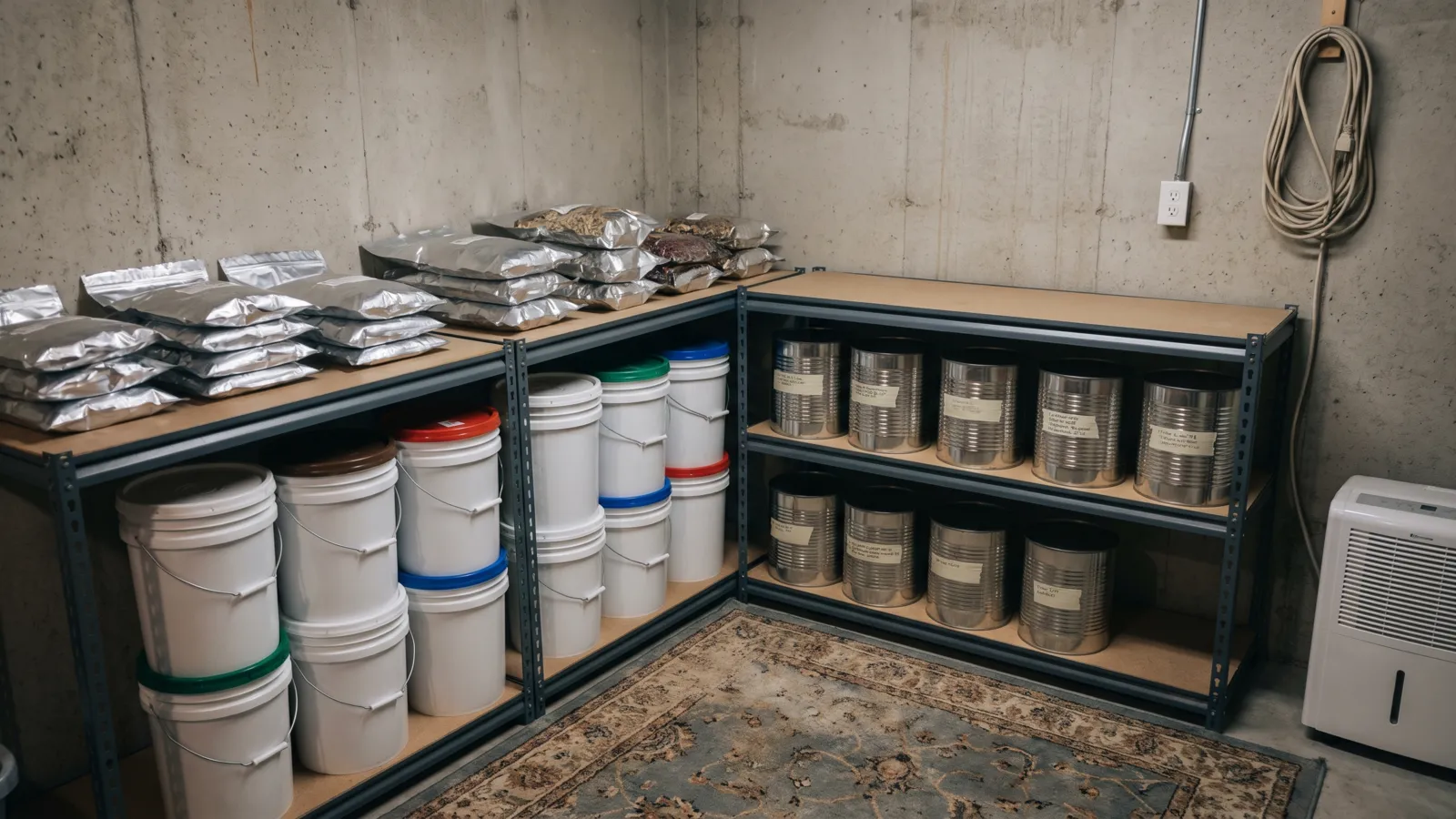
- Build in two layers: a pantry of everyday foods you rotate, and a deep reserve of dry staples that keep for decades.
- BYU's plan for one adult for a year centers on wheat, white rice, oats, pasta and beans, plus dry milk, sugar, salt, oil and a vitamin C source.
- Pack dry staples in Mylar bags or #10 cans with oxygen absorbers, inside food-grade buckets, and only dry foods: never seal moist food without oxygen.
- Keep it cool: Utah State says 40 to 70°F, and wheat in BYU's research kept 25 years in a cool basement but 5 in a hot garage.
- Rotate it: BYU suggests cooking one day a week from stored food.
Two layers: a pantry you rotate, and a deep reserve
Ready.gov's emergency advice is to store at least a several-day supply of non-perishable food, and its lists cover days to a couple of weeks. A longer supply, months or a year, works best in two layers. The first is a pantry of the canned and boxed foods you already eat, bought a little extra at a time and used in rotation. The second is a reserve of dry staples, packed to keep for decades, that you dip into slowly.
For the reserve, BYU's Department of Nutrition, Dietetics, and Food Science publishes a plan whose kinds and amounts of food likely provide adequate calories and protein for an adult for one year. Our food storage calculator scales it for your household and for 1, 3, 6 or 12 months.
What to store: the staples that last
BYU's year for one adult starts with grains: about 132 pounds of wheat, 65 of white rice, 29 of rolled oats and 21 of pasta, mostly in #10 cans, and 62 pounds of legumes such as beans, split peas and lentils. Add 60 pounds of nonfat dry milk, 70 of sugar or other sweeteners, 8 of iodized salt, oils and nut butters, dried fruit and vegetables, and baking basics like baking powder and yeast.
BYU says the pounds of grains are interchangeable to suit your needs and preferences, so a family that won't eat whole wheat can store more rice, oats and pasta. It also says a source of vitamin C must be stored, because consuming less than 10 mg a day can cause scurvy within a few months; freeze-dried strawberries or vitamin C tablets cover it. Fats need storing too, but rotating often, because oils keep about a year.
Wheat is the longest-lasting grain but needs a grain mill to use. White rice is the easiest. Our bulk food storage page compares wheat, rice, beans and dry milk in #10 cans and buckets.
How to pack it: oxygen, moisture and pests
Long shelf lives depend on the packaging. Utah State University Extension says long-term packaging must prevent moisture and rodent and insect damage, and that heavy-duty plastic bags on their own aren't insect- and rodent-proof. It calls PET-and-foil pouches, sold as Mylar, exceptional food containers, because the foil layer dramatically reduces the oxygen and moisture getting through.
The usual method is to fill Mylar bags or #10 cans, add food-safe oxygen absorbers, which Utah State recommends to preserve rice quality and protect it from insects, seal them, and store the bags inside food-grade buckets. Wheat is the exception: Utah State says it doesn't need to be stored without oxygen unless insects are present. Our food storage containers page compares bags, absorbers and buckets.
- Dry foods only: grains, beans, rice, pasta, sugar, dry milk
- Mylar bags or #10 cans with oxygen absorbers
- Sealed bags inside food-grade buckets
- A label with the contents and date
Where to keep it: cool beats everything
Temperature decides how long food lasts more than anything else. Utah State says the best range is cool to moderate, about 40 to 70°F, and cites BYU research in which wheat kept acceptable quality for 25 years stored cold, in a basement, and only 5 years stored hot, in a garage or attic. It also says direct sunlight is detrimental to foods.
USDA's Food Safety and Inspection Service gives the same advice for canned and shelf-stable foods: a cool, dry place, below 85°F, and never above or beside the stove, under the sink, in a damp garage or basement, or anywhere with temperature extremes. In practice that's an interior closet, under a bed or a cool, dry basement, not the garage.
Shelf lives: why 2 years and 30 years can both be right
Published shelf lives vary widely because packaging and temperature vary. USDA's storage chart gives rice and dried pasta 2 years, low-acid canned goods 2 to 5 years and high-acid canned goods 12 to 18 months, for ordinary store packaging. BYU's estimates for the same staples in airtight, moisture-proof, low-oxygen containers run to 25 or 30 years and more.
Utah State's research fills in the middle. It says rice at a constant 70°F with oxygen absorbers will store well for up to 10 years, and in cooler storage sealed in oxygen-free containers for up to 30. Dried beans in #10 cans or Mylar with the oxygen removed keep 10 or more years, and samples stored up to 30 years still scored well with a taste panel for emergency use. Nonfat dry milk is the short one: 3 months to 3-5 years, mostly depending on temperature.
Rotate it, so nothing goes to waste
A reserve you never eat is money on a shelf. BYU suggests preparing meals one day a week using only stored food, which rotates a supply about every 7 years, and notes that food that still tastes acceptable when you open it can still be used. For the pantry layer, USDA says to check it every few weeks and use the canned goods you've had for a while, and Ready.gov says to replace expired items as needed.
Oxygen absorbers and Mylar are for dry foods such as grains, beans, sugar and dry milk. Utah State University Extension warns that removing oxygen helps botulism bacteria grow, and that vacuum packaging is not a preservation method by itself: a food that needed refrigerating before you packed it still does.
Common questions
How long does rice last in storage?
It depends on packaging and temperature. USDA's chart gives rice 2 years in ordinary packaging. Utah State University Extension says white rice at a constant 70°F with oxygen absorbers keeps well for up to 10 years, and in cooler storage, sealed without oxygen, up to 30 years.
How long do canned goods last?
USDA's chart gives low-acid canned goods, such as canned meat, soups, vegetables and beans, 2 to 5 years, and high-acid canned goods, such as tomatoes, fruit and pickles, 12 to 18 months, stored in a cool, dry place below 85°F.
How much food do I need for a year?
BYU's plan for one adult includes about 132 lb of wheat, 65 lb of white rice, 29 lb of oats, 21 lb of pasta and 62 lb of legumes, plus dry milk, sugar, salt, oils and dried fruit and vegetables. Our food storage calculator scales it for your household.
Do I need oxygen absorbers for long-term storage?
For most dry staples, yes. Utah State University Extension recommends food-safe oxygen absorbers to preserve quality and protect against insects. Wheat is the exception: it doesn't need to be stored without oxygen unless insects are present.
Where is the best place to store long-term food?
Somewhere cool, dry and dark, about 40 to 70°F by Utah State's figures, such as a basement or an interior closet. Avoid garages and attics: in BYU's research, wheat kept 25 years cold and only 5 years hot.
Sources (10)
- BYU: An Approach to Longer-Term Food Storage (June 2024)
- Utah State University Extension: Packaging foods for storage
- Utah State University Extension: Food storage conditions
- Utah State University Extension: Storing white rice
- Utah State University Extension: Storing wheat
- Utah State University Extension: Storing dry beans
- Utah State University Extension: Storing dried milk
- USDA FSIS: Shelf-stable food safety
- Ready.gov: Food
- Ready.gov: Build a kit
Get one calm email when it matters
Seasonal checklists and gear price drops. No spam, unsubscribe any time.
Keep reading
 Emergency food storage: how much to store, what to buy and how to keep it safeHow much emergency food to store, from a 3-day kit to two weeks at home: no-cook foods, calories, special diet…
 Non-perishable food list: what to stock for an emergencyA non-perishable food list from Ready.gov: canned meats, fruit and vegetables, bars, cereal, peanut butter, dr…
 Home canning for beginners: the USDA way to can safelyHow to start home canning safely: which foods need a pressure canner and which a water bath, the jars and lids…
 How much water to store for an emergency: per person, per pet and for how longHow much water to store for an emergency: 1 gallon per person per day, pets, which containers to use, when to …