Ham radio for emergencies: how to get your license
How to get an FCC ham radio license for emergency communication: the no-code Technician exam, volunteer examiners, a first radio, and the FCC's rules on cheap radios.
By Tom Calder · Updated October 24, 2026 · Sourced to the FCC
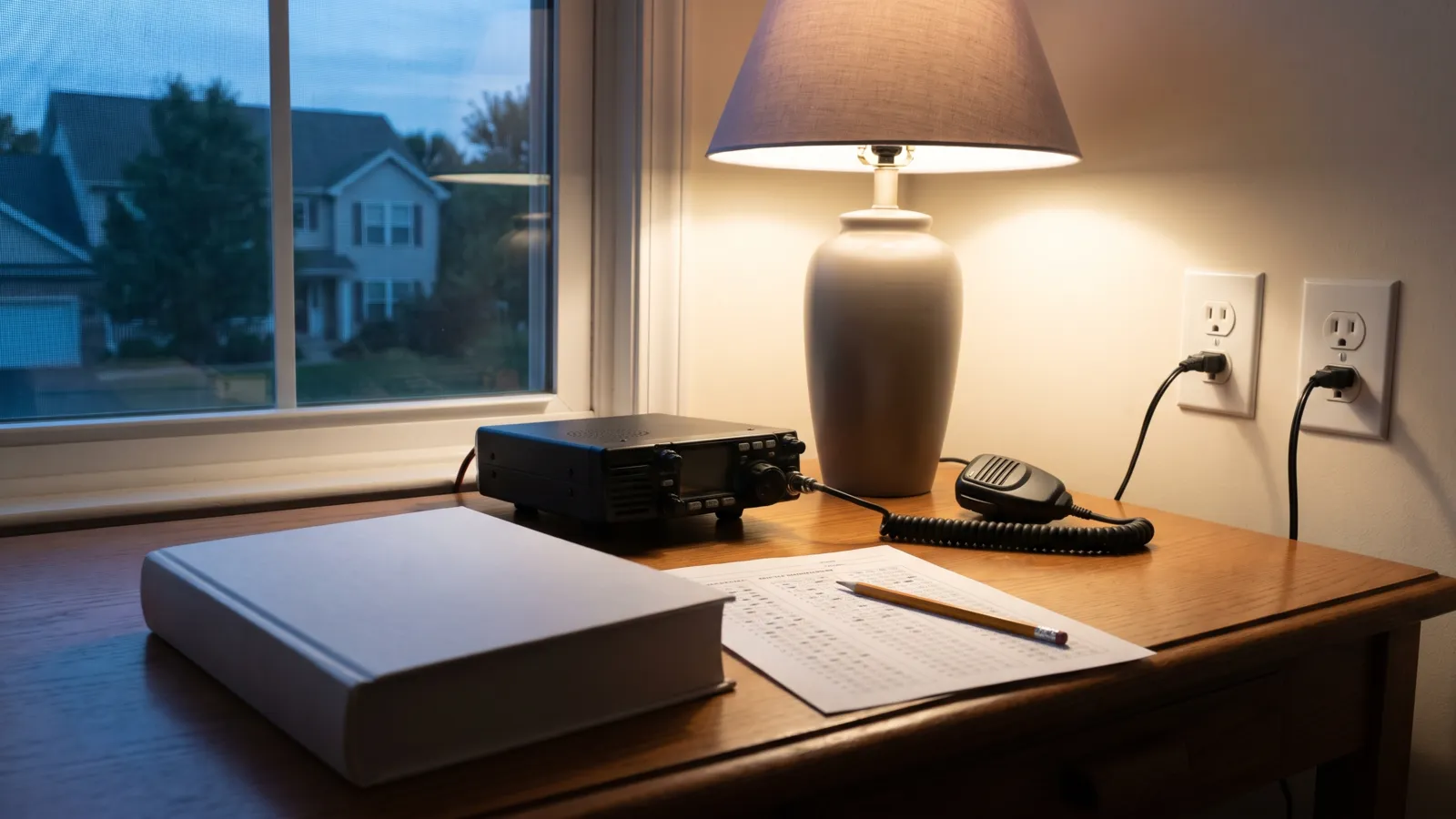
- Amateur (ham) radio works without cell towers or the internet, which makes it useful when other networks fail.
- To transmit you need an FCC license. The FCC says you must pass an exam given by a team of volunteer examiners first.
- Most newcomers start with the no-code Technician license, which needs one written exam element.
- To book an exam, contact a Volunteer Examiner Coordinator (VEC).
- Use only legal radios on amateur frequencies; the FCC has warned about cheap radios that transmit where they shouldn't.
Why ham radio for emergencies
When the power is out and cell networks are overloaded, licensed amateur radio operators can still talk to each other, directly or through local repeaters. Handheld radios reach across town; with more power and antennas, operators reach across the country. Many emergency plans and community groups rely on volunteer hams for backup communication.
Listening needs no license. A handheld can monitor local repeaters and weather, but to transmit you need an FCC amateur license.
The licenses
The FCC says there are three classes of amateur license, from highest to lowest: Amateur Extra Class, General Class and Technician Class. Each authorizes privileges matching the qualifications required, and the operator class reflects the skill and knowledge you show during an examination to volunteer examiners in your community.
Most new amateur radio operators start with the no-code Technician Class license, the FCC says. Technician needs only written exam Element 2; General adds Element 3, and Amateur Extra adds Element 4. Some newcomers begin at General, and a few go straight to Amateur Extra.
How to take the exam
The FCC says that before you receive a license grant, you must pass an examination administered by a team of volunteer examiners (VEs), who determine the operator class you qualify for. To request an examination, contact a Volunteer Examiner Coordinator (VEC). VECs organize exam sessions, in person and in many cases online.
Study first. Exam questions come from public question pools, and many free and low-cost courses, books and practice tests cover the Technician pool in a few weeks of evenings.
Your first radio
Most new Technicians start with a dual-band handheld covering the 2 meter and 70 centimeter bands, which reach local repeaters. Our ham radios page compares beginner handhelds on power, battery life and ruggedness.
If you'd rather not take an exam at all, GMRS radios need an FCC license but no test, and FRS radios need no license, at shorter range.
Power for a long outage
A handheld radio is only useful while its battery lasts. Keep a spare battery charged, and plan a way to recharge it without wall power: many handhelds charge over USB, so a power bank or a small power station with a solar panel keeps you on the air through a multi-day outage.
Write down the local repeater frequencies and your family's plan on paper too. When the radio is your only link, you don't want to be searching for settings, and a printed card works when phones don't.
Stay on the right side of the FCC
Not every inexpensive radio is legal to use everywhere. In a 2018 enforcement advisory, the FCC said a growing number of retailers sell low-cost two-way VHF/UHF radios that don't comply with its rules, and that some can be modified to transmit on public safety and other land mobile channels they aren't authorized for. It said such radios must be authorized by the FCC before being imported, sold or operated, unless they operate exclusively on amateur frequencies.
The practical rule: transmit only on amateur frequencies, with your license, and never on public safety, GMRS or FRS channels with an amateur radio.
A radio in a drawer won't help in an emergency if you've never used it. Check in to a local net, learn your repeaters, and keep batteries charged. Many communities have amateur radio emergency groups that welcome new licensees.
Common questions
Do I need a license to use a ham radio?
To transmit, yes. The FCC says you must pass an examination administered by a team of volunteer examiners before receiving a license. Listening needs no license.
How do I get a ham radio license?
Study the Technician question pool, then contact a Volunteer Examiner Coordinator (VEC) to book an exam. The FCC says most new operators start with the no-code Technician Class license, which requires written Element 2.
Is there a Morse code test?
No. The FCC describes the Technician license as the no-code Technician Class license.
Can I use a Baofeng without a license?
Not to transmit on amateur frequencies, and never on public safety or other channels it isn't authorized for. The FCC's 2018 advisory warned that many low-cost radios can transmit where they shouldn't.
Get one calm email when it matters
Seasonal checklists and gear price drops. No spam, unsubscribe any time.
Keep reading
 How to make a family emergency plan: steps, questions and a communication planHow to make a family emergency plan: Ready.gov's four steps, the questions to ask, a communication plan, meeti…
 Emergency kit checklist: what to include, how much to keep and where to store itA plain-English emergency kit checklist built on Ready.gov's basic kit and extra items, with how many days of …
 Hurricane preparedness checklist: what to do before, during and after a stormHurricane season dates, watch vs warning, how to find your evacuation zone, storm surge, supplies, and what to…
 Tornado preparedness: watch vs warning, where to shelter and what to do afterTornado watch vs warning, where to shelter in a house, apartment, mobile home or car, how to get NOAA Weather …