Emergency preparedness for apartment dwellers: what to store, what to skip, and stairs
How to prepare in an apartment: what fits in a small space, what you cannot use indoors, stairs and elevators, your building manager and renters flood insurance.
By Tom Calder · Updated October 30, 2026 · Sourced to Ready.gov, the US Fire Administration (FEMA), CDC, CPSC and FloodSmart
- An apartment changes three things: how much you can store, what you can safely use for heat, light and cooking, and how you get out. The basic kit is the same as any home's.
- Ready.gov's water rule is 1 gallon per person per day for several days. By our arithmetic, a few cases of bottled water under a bed or in a closet meet it.
- Generators, charcoal grills and camp stoves are outdoor-only, and an apartment seldom has a safe outdoor spot. Plan on batteries and power banks instead.
- In a fire, use the stairs: the US Fire Administration says not to use the elevator unless directed by the fire department.
- Most renters insurance does not cover floods. FloodSmart says renters can buy a separate flood policy, which usually starts 30 days after purchase.
What is different about an apartment
Ready.gov says that "single story vs multi-story or high-rise buildings have different types of alarm systems, shelter and evacuation considerations," and that if a building has no plans, you may need to work with the building manager to develop them. So the first job is learning how your building works, not buying things.
The kit itself does not change. Use our emergency kit checklist and power outage checklist and scale them to the space you have.
What to store, and where it fits
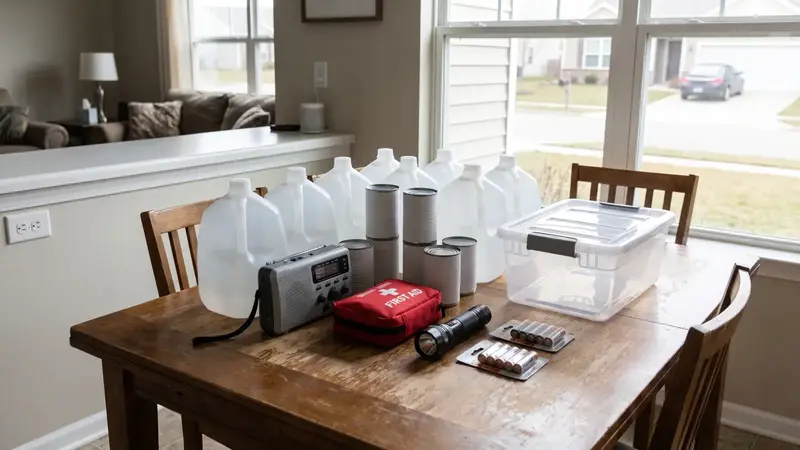
Ready.gov: "Store at least one gallon of water per person per day for several days, for drinking and sanitation." For two people for three days that is 6 gallons. Ready.gov says to buy commercially bottled water and store it in the sealed original container in a cool, dark place, and to replace water that has not been commercially bottled every six months. We could not find official wording about small-space storage, so this part is our suggestion: flat cases fit under beds, in the bottom of a closet or behind a couch, and a few smaller packs are easier to carry down stairs than one large container.
For food, the CDC's family kit list says a several-day supply of long-lasting food such as dried fruit, protein or fruit bars and canned food, with a manual can opener. You probably have much of it already. Our non-perishable food list shows what keeps.
- Water: 1 gallon per person per day for several days, in cases you can carry
- No-cook food, a manual can opener, and any medicines you take
- A battery flashlight for each person, spare batteries, a power bank and a battery or hand-crank radio
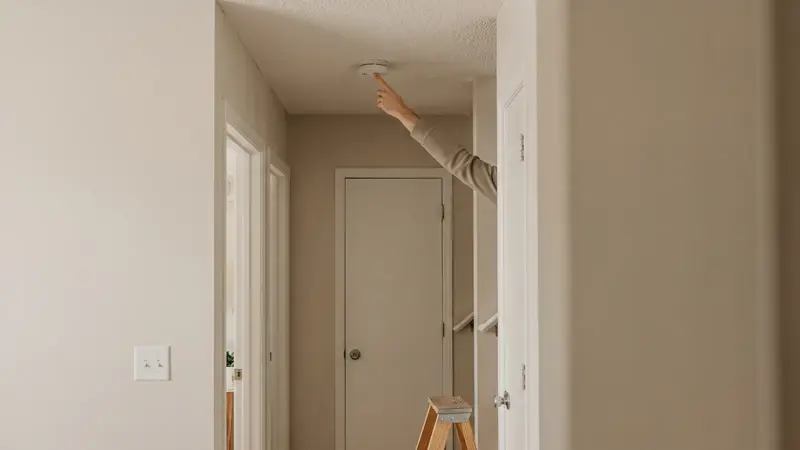
- A battery-powered or battery-backup carbon monoxide alarm and working smoke alarms
- A first aid kit; Ready.gov's full basic kit list at ready.gov/kit also includes a whistle
- Copies of important documents, and a go-bag by the door if you may leave on foot
What you cannot use, and what to do instead
These are official lines. CDC: "Never use a generator, pressure washer, or any gasoline-powered engine inside your home, basement, or garage or less than 20 feet from any window, door, or vent." CDC: "Never use a charcoal grill, hibachi, lantern, or portable camping stove inside a home, tent, or camper." Ready.gov: "Do not use a gas stove or oven to heat your home." Ready.gov also says generators, camp stoves and charcoal grills should always be used outdoors and at least 20 feet away from windows.
In most apartment buildings that rules out a generator altogether, and we did not find a federal page that says whether a balcony counts as outdoors. An older CPSC release on gas grills says never to use a grill indoors, to use it at least 10 feet from your house or any building, and not in a garage, breezeway, carport, porch, or under a surface that can catch fire; for charcoal it says: "Charcoal should never be used indoors, even if ventilation is provided." Leases, building rules and local fire codes also vary, so check yours before you bring fuel into the building. CPSC adds: never store a spare gas container under or near the grill or indoors.
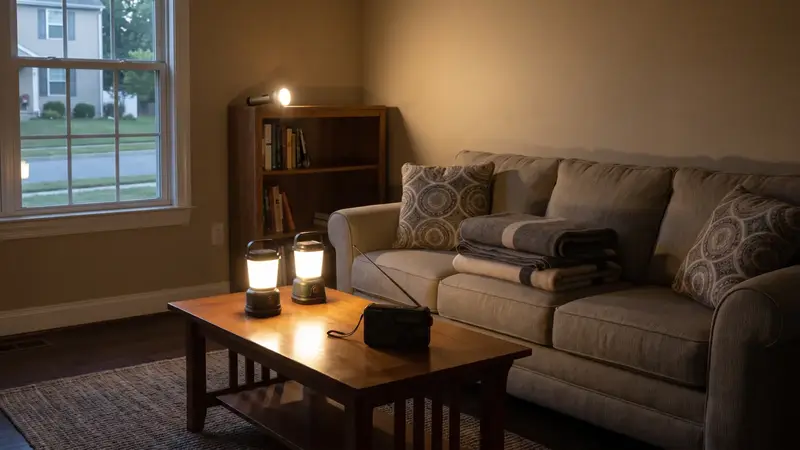
What works instead is simple: power banks for phones, battery lanterns, a battery radio, and no-cook food. If your building has a safe, permitted outdoor cooking area, that is the place for a camp stove, and even then it is outdoors only. See generator safety and carbon monoxide poisoning.
Stairs, elevators and fire
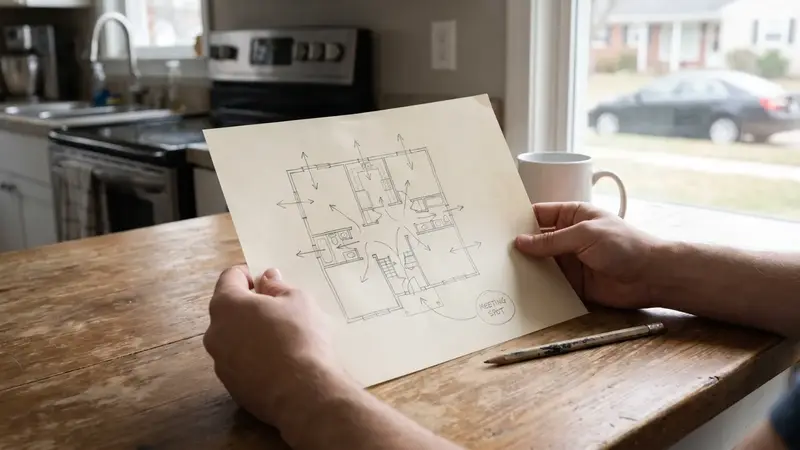
The US Fire Administration (part of FEMA) says, for a fire: leave your apartment and close the door behind you, pull the fire alarm on your way out, and "use the stairs to get out. Do not use the elevator unless directed by the fire department." Then go to your outside meeting place and tell the fire department if someone is trapped. It also says residents could have less than 2 minutes to escape once the smoke alarm sounds.
Ready.gov's high-rise points are to know where the closest emergency exit is, know another way out in case your first choice is blocked, decide whether to stay put, shelter in place or get away, and stay to the right in stairwells so emergency workers can come up. Ready.gov's explosion page also says: "Do not use elevators." The USFA apartment handout suggests counting the doors between your apartment and the nearest fire exit so you can find it in the dark.
We found no official wording on elevators in a plain power outage. Our suggestion is to assume the elevator may not run, and to think now about how you would get down. If stairs are hard for you or a family member, tell the building manager and a neighbor ahead of time. Ready.gov's apartment advice is to decide who will check on elderly or disabled neighbors. See our home fire escape plan and smoke alarm placement.
Your landlord or building manager
Ask the building manager for the building's evacuation and shelter-in-place plans, where the alternate exits are, and what supplies you would need if you had to shelter there. Ready.gov lists these among the things to find out. The USFA says to speak to your apartment manager if you see a damaged smoke alarm, a broken fire extinguisher or a burned-out emergency light, and not to prop open exit or stairway doors, since they slow the spread of heat and smoke.
Landlord duties during an outage, such as heat, elevators and backup power, are set by state and local law and by your lease, and there is no federal rule we can point to. Check your lease, your state or city housing agency and your local emergency management office. Our state pages link to each state's office.
Renters insurance and floods
FloodSmart, the National Flood Insurance Program's site, says that most homeowners and renters insurance does not cover flood damage, and that only a flood insurance policy will help you recover after a flood. The NFIP offers policies for renters, which protect your belongings, such as furniture, clothes, televisions and computers, for up to $100,000 of damage. Coverage goes into effect 30 days after purchase, with a few exceptions, so, in our view, a policy bought on the day a storm is forecast will not help. FloodSmart also says your landlord's flood insurance will not cover your own belongings.
Whether it is worth buying depends on your flood risk; our flood preparedness guide covers how to check it.
Your neighbors are part of the plan
Ready.gov's advice for apartments and condominiums is to talk to your neighbors about working together in an emergency, find out whether anyone has specialized equipment or expertise such as medical knowledge, decide who will check on elderly or disabled neighbors, and make back-up plans for children in case you cannot get home. In a building with a shared stairwell and shared walls, this is the part that makes the biggest difference and costs the least. Add the numbers of two neighbors to your family emergency plan.
You do not need a bigger home or a big stockpile to be prepared in an apartment. Water, some no-cook food, a flashlight, a power bank, working smoke and CO alarms and a plan for the stairs cover the core of Ready.gov's basic kit. Its full list at ready.gov/kit adds a first aid kit, a whistle and a few small items. The one thing worth checking for a rental is whether you have working CO and smoke alarms; if not, ask your building manager.
Common questions
What should apartment dwellers keep in an emergency kit?
The same basics as any household: 1 gallon of water per person per day for several days, long-lasting food and a manual can opener, flashlights, a power bank, a battery radio, medicines and copies of documents. Choose cases and packs you can store in a closet and carry down stairs.
Can I use a generator or grill on my apartment balcony?
We found no federal page on balconies. Official guidance says generators, camp stoves and charcoal grills belong outdoors, at least 20 feet from windows, and never indoors. An older CPSC release says to keep grills at least 10 feet from a building and not on a porch or under a surface that can catch fire. Most apartments cannot meet that, and leases and local fire codes may ban them. Use batteries instead.
Should I use the elevator in a fire?
No. The US Fire Administration says to use the stairs and not the elevator unless the fire department directs you to.
Does renters insurance cover flood damage?
Usually not. FloodSmart says most homeowners and renters insurance does not cover floods. Renters can buy a separate NFIP flood policy, which usually takes effect 30 days after purchase.
Sources (12)
- Ready.gov: Plan for locations
- Ready.gov: Water
- Ready.gov: Power outages
- US Fire Administration: Home fire escape plans
- US Fire Administration: Apartment fire safety
- CDC: What to do during a power outage
- CDC: Emergency kit checklist for pregnant women, infants and children
- CPSC: Grill safety tips
- FloodSmart: Buy a flood insurance policy
- FloodSmart: Flood insurance for renters
- Ready.gov: Explosions
- Ready.gov: Build a kit
Get one calm email when it matters
Seasonal checklists and gear price drops. No spam, unsubscribe any time.
Keep reading
 Emergency kit checklist: what to include, how much to keep and where to store itA plain-English emergency kit checklist built on Ready.gov's basic kit and extra items, with how many days of …
 Power outage checklist: what to do before, during and afterA calm power outage checklist from Ready.gov and CDC: what to prepare, how to protect food, medicines and medi…
 Home fire escape plan: how to make one, practice it and get out safelyHow to make a home fire escape plan: two ways out of every room, an outside meeting place, escape ladders, dri…
 Smoke alarm placement: where to put them, how to test them and when to replace themWhere to put smoke alarms: every level, inside each bedroom and outside sleeping areas, plus testing, batterie…