NOAA Weather Radio and hand-crank radios in a power outage: how they work and what to look for
How NOAA Weather Radio works, why a hand-crank radio is not always a weather radio, and what to look for: SAME codes, battery backup, tone alert. You may not need one.
By Tom Calder · Updated October 30, 2026 · Sourced to the National Weather Service (NOAA), Ready.gov and the American Red Cross
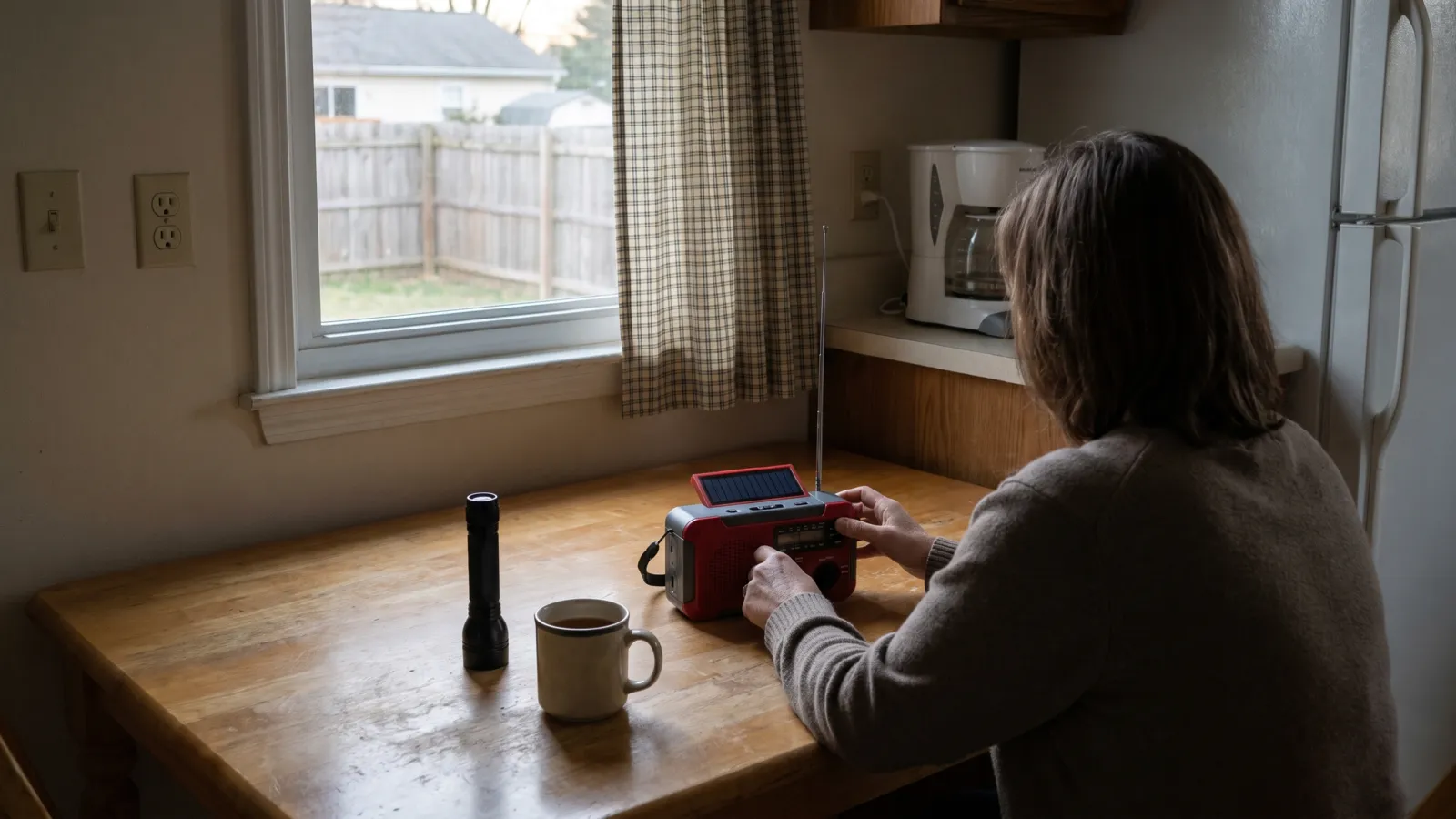
- NOAA Weather Radio All Hazards is a nationwide network of radio stations run by the National Weather Service. It broadcasts official warnings, watches and forecasts 24 hours a day, and because it is a broadcast, a receiver that runs on batteries does not depend on your internet, cell service or home power (our explanation).
- You need a radio that can pick up the signal. An ordinary AM/FM hand-crank radio will not do it unless it also has a NOAA Weather Radio band.
- Ready.gov's kit list names both: a battery-powered or hand crank radio, and a NOAA Weather Radio with tone alert.
- Look for a tone alert, SAME programming for your county, and battery power. One NWS office's FAQ says receivers run from $25 up to $100 or more.
- If you already have a phone with emergency alerts on, a radio is a backup, not a requirement. It earns its place when the power, cell towers or internet are down.
What NOAA Weather Radio is
The National Weather Service describes NOAA Weather Radio All Hazards (NWR) as "a nationwide network of radio stations broadcasting continuous weather information directly from the nearest National Weather Service office." It "broadcasts official Weather Service warnings, watches, forecasts and other hazard information 24 hours a day, 7 days a week."
Working with the FCC's Emergency Alert System, it is an "All Hazards" network: besides weather it carries warnings and post-event information for other emergencies. The NWS says the network includes more than 1000 transmitters, covering all 50 states, adjacent coastal waters, Puerto Rico, the U.S. Virgin Islands, and the U.S. Pacific Territories.
How it works in a power outage
NWR is a broadcast. Your radio receives a signal from the nearest transmitter, so it does not rely on your home internet, your router or cell service. The NWS says it requires "a special radio receiver or scanner capable of picking up the signal," broadcast on seven frequencies in the VHF band between 162.400 and 162.550 MHz.
The NWS says the signal typically reaches about a 40 mile radius from the transmitter over level terrain, and that terrain, antenna and receiver quality affect this. Before you buy, check your county's coverage on the NWS site. The NWS also lists transmitters that are degraded or offline, for reasons such as a power outage or antenna damage, so a radio is a strong backup but not a guarantee. Keep a second source, such as a battery-powered AM/FM radio and your phone.
Hand-crank radio versus weather radio
These are two different things. A hand-crank radio is named for how it is powered, and a weather radio for what it receives: the NWR signal. The NWS says NWR "requires a special radio receiver or scanner capable of picking up the signal," so our advice is to check that a crank radio's listing says it receives NOAA Weather Radio before you rely on it for warnings.
Ready.gov's basic kit lists "Battery-powered or hand crank radio and a NOAA Weather Radio with tone alert." The Red Cross kit list says "NOAA Weather Radio, if possible." A radio that does both jobs, with a crank or extra batteries to keep it going, covers both items. Our weather radio and hand-crank radio comparisons show how current models differ.
What to look for
One NWS office's FAQ says the most desirable feature is an alarm tone. It lets you leave the radio on but silent, listening for a special tone that is sent before watch and warning messages. It also advises looking for SAME (Specific Area Message Encoding): such a receiver can turn itself on from silent mode when the digital code for your pre-selected area is broadcast. SAME tones are sent before most short-fused weather warnings, and some watches.
The same FAQ adds that a good receiver should be able to operate on batteries when electrical services are interrupted, ideally with an AC adapter and a battery compartment, and should tune to all seven frequencies. It says receivers range in cost from $25 up to $100 or more depending on quality and features. Most newer SAME radios allow more than one county to be entered, which helps if you live near a county line.
Setting it up: your SAME code and a weekly test
You program the radio with a SAME code for each county you want. The NWS publishes the codes by state at weather.gov/nwr/counties, and one NWS office's FAQ also gives a toll-free voice line, 1-888-NWR-SAME (1-888-697-7263).
To check it works, the same FAQ says every NWS office schedules a weekly test for each of its transmitters. That office's own tests are normally on Wednesdays between 11 AM and noon local time, and are postponed if severe weather is occurring or threatened. Check your own office's schedule. Check the batteries whenever you test it.
Do you need one?
Not necessarily. If your phone alerts are on, a weather radio is a backup. It is most useful if you want a warning that still works when towers, power or the internet are down. See our live alerts page for current NWS warnings.
Pair it with other power outage basics from our power outage checklist and the emergency kit checklist.
A weather radio is a modest, useful item, not a necessity. If your phone alerts are on and you have a battery-powered radio at home, you are already close to what Ready.gov and the Red Cross list. Buy a NOAA radio if you want a dedicated, always-on warning that does not rely on the internet, and check that it has a tone alert and battery power.
Common questions
Does a hand-crank radio get NOAA Weather Radio?
Only if it includes a NOAA Weather Radio (weather band) receiver. The NWS says NWR needs a special receiver or scanner for its signal. A crank radio that is AM/FM only will not pick it up, so check the product's listing.
How does NOAA Weather Radio work without power or internet?
It is a radio broadcast from National Weather Service transmitters. Your battery-powered receiver picks up the signal directly, so it does not rely on your internet or cell service. The NWS notes that individual transmitters can be offline, for example during a power outage.
What is SAME on a weather radio?
SAME stands for Specific Area Message Encoding. One NWS office's FAQ says a SAME radio can turn itself on from silent mode when the digital code for your pre-selected geographic area is broadcast, and that most new SAME radios allow more than one code.
How much does a weather radio cost?
One NWS office's FAQ says receivers range from $25 up to $100 or more, depending on quality and features.
Get one calm email when it matters
Seasonal checklists and gear price drops. No spam, unsubscribe any time.
Keep reading
 Power outage checklist: what to do before, during and afterA calm power outage checklist from Ready.gov and CDC: what to prepare, how to protect food, medicines and medi…
 Emergency kit checklist: what to include, how much to keep and where to store itA plain-English emergency kit checklist built on Ready.gov's basic kit and extra items, with how many days of …
 Will the US power grid fail this winter? What NERC's winter assessment says, by regionWill the US power grid fail this winter? What NERC's latest winter assessment says for ERCOT, PJM, California …
 Ham radio for emergencies: how to get your licenseHow to get an FCC ham radio license for emergency communication: the no-code Technician exam, volunteer examin…