How long does a power outage usually last? EIA figures and what to plan for
What federal data says about how long outages last in the US, how it varies by state, and what to do in the first hours, the first day and a long outage.
By Tom Calder · Updated October 30, 2026 · Sourced to EIA, CDC and Ready.gov
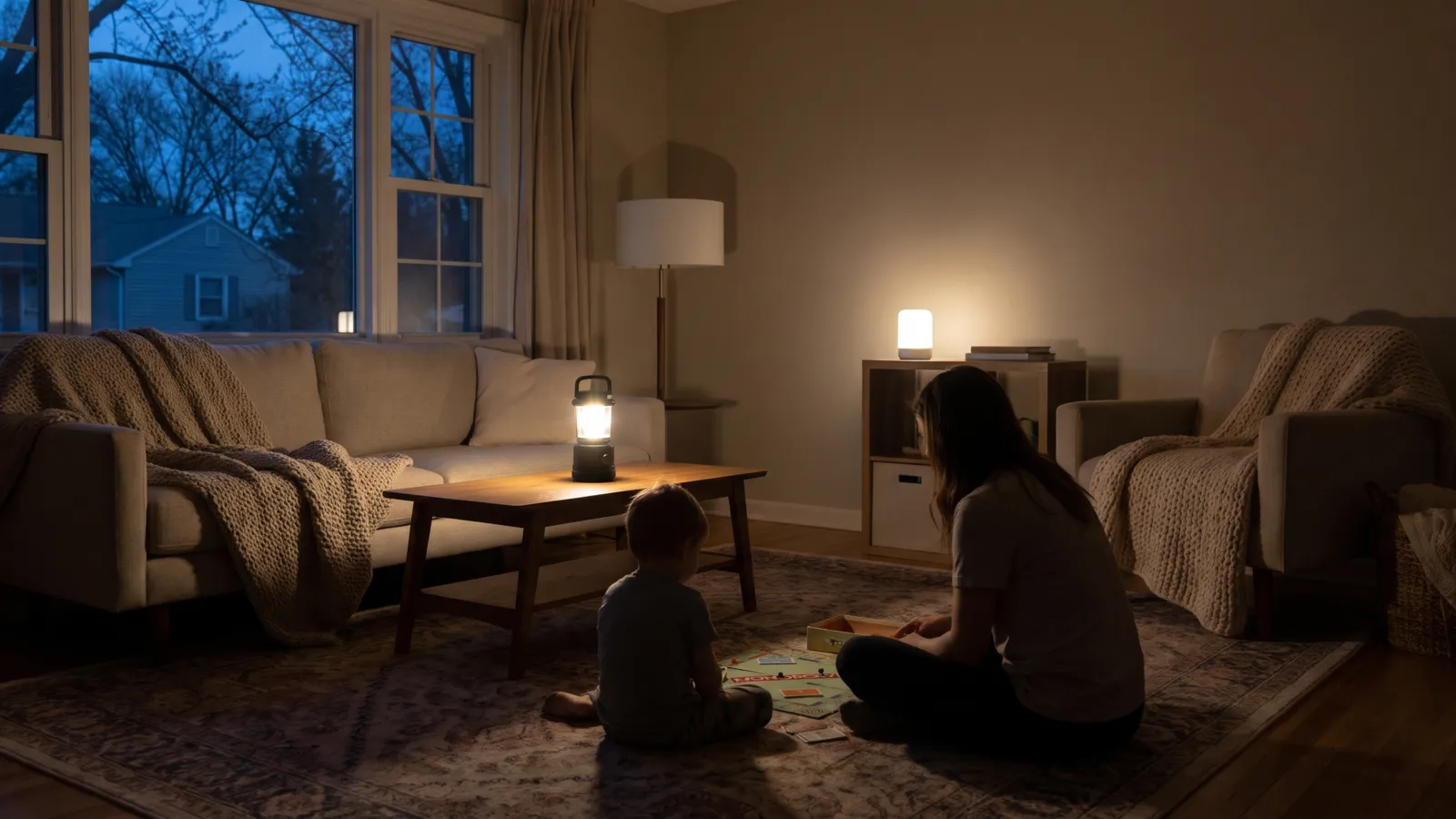
- EIA's latest figures (2025): the average US customer lost power for about 4.4 hours across the year, and about 2 hours once major storms are left out.
- When the lights do go out, the average restoration took about 3 hours 16 minutes in 2025. That is an average, and a big storm can run far longer.
- It varies by state: from under an hour a year for the average customer in the District of Columbia to nearly 17 hours in West Virginia in 2025.
- Plan in steps: the first 4 hours, the first day, then two days and beyond. Most of it costs nothing.
- You do not need to buy anything to get through a few hours. Buy gear only for the longer outages that are likely where you live.
The short answer: usually a few hours, sometimes days
There is no single number, so here are the federal figures. The U.S. Energy Information Administration (EIA) collects outage data from utilities. In its Electric Power Annual, the average US customer was without power for 262.6 minutes in 2025, which is about 4.4 hours across the whole year, and had 1.34 interruptions.
Those totals include major events such as hurricanes and winter storms. Leave major events out and the average was 120.8 minutes, or about 2 hours, with 1.05 interruptions. EIA says interruptions that are not triggered by major events routinely average about two hours per year. The long ones come with big storms.
EIA's own write-up of 2024 shows how much storms matter. That year major events such as hurricanes Beryl, Helene and Milton accounted for 80% of the hours without electricity, and EIA said customers in South Carolina averaged nearly 53 hours of interruptions. Plan for the short outage as the usual case and the multi-day outage as the one you should be able to handle.
How long a single outage lasts, on average
The yearly total mixes how often power fails with how long each failure lasts. EIA also reports the second number on its own, called CAIDI, the average number of minutes it takes to restore service. For the US in 2025 it was 196.3 minutes, or about 3 hours 16 minutes, counting major events. Without major events it was 114.7 minutes, about 1 hour 55 minutes.
Read these as utility-reported averages across millions of customers. Your own outage may be shorter or much longer, and an average cannot tell you about the storm that takes down a whole region at once. In Ready.gov's words, extended power outages may impact the whole community and the economy.
Not every utility reports to the same standard. EIA's tables combine utilities that follow the IEEE standard with some that do not, and cover about 95% of customers, so treat the figures as a guide and not a promise.
How it varies by state
Averages hide a wide spread. EIA's 2025 figures for the average customer's total time without power, counting major events, ranged from 50 minutes in the District of Columbia and about 70 minutes in Arizona and Florida to 1,013 minutes (about 17 hours) in West Virginia. Michigan averaged about 11 hours.
The ranking moves a lot from year to year. Florida's 2025 figure was about 70 minutes, while its 2024 figure was about 22 hours, after hurricanes Helene and Milton. Texas was about 3.7 hours in 2025 and about 21 hours in 2024, after Hurricane Beryl. One storm can decide a state's year.
Our power outages page shows EIA's yearly figures by state and utility. Look at your own state before you decide how much to prepare. A state page under /states adds live National Weather Service alerts.
Plan by duration
Think in steps instead of one big plan. Each step builds on the last, and the first two cost almost nothing.
Up to 4 hours. Keep the refrigerator and freezer doors closed. Ready.gov says the refrigerator will keep food cold for about four hours and a full freezer for about 48 hours. Use flashlights, not candles. CDC says to use battery-powered flashlights and lanterns rather than candles, gas lanterns or torches to minimize the risk of fire. Charge phones from a power bank if you have one. CDC also says: "Never leave the motor running in a vehicle parked in an enclosed or partially enclosed space, such as a garage."
The first day. A full freezer, kept closed, holds its temperature for about 48 hours, but the refrigerator's four hours have passed, so use a cooler with ice for what you want to keep. Our guide to food safety in a power outage covers what to keep and what to throw out. Have a plan for medicines: CDC says that when the power is out for a day or more, throw away any medication that should be refrigerated, unless the drug's label says otherwise, and see medical devices in a power outage if anyone depends on powered equipment.
Two days and beyond. A full freezer reaches its 48-hour limit, and heat or cold becomes the main concern. Ready.gov says to go to a community location with power if heat or cold is extreme, and to check with local officials about heating and cooling locations open near you. Our guide to staying warm without power covers winter, and the power outage checklist covers the rest. Water matters too: see how much water to store.
Much longer outages. For a staged plan that goes past a week, see the 90-day blackout plan. It is built so you do the free steps first.
Safety lines for any outage
Generators and fuel-burning heaters can cause carbon monoxide poisoning, so these lines are worth reading even for a short outage. They are the agencies' wording, not ours.
Ready.gov: "Use a generator, but ONLY outdoors and away from windows. Do not use a gas stove or oven to heat your home. It increases your risk of carbon monoxide poisoning."
CDC: "Never use a generator, pressure washer, or any gasoline-powered engine inside your home, basement, or garage or less than 20 feet from any window, door, or vent." CDC also says to "use a battery-powered or battery backup CO detector in your home" when using a generator.
CDC on electrical hazards: "Never touch a fallen power line." If you believe someone has had electric shock, CDC says to call or have someone else call 911 or emergency medical help. For carbon monoxide poisoning symptoms, CDC says to call 911 or your local Poison Control Center at 1-800-222-1222. See our generator safety and carbon monoxide guides for more.
What you do not need to buy
For an outage of a few hours, you need a flashlight, a charged phone and closed refrigerator doors. You likely own all three. For a day, add a cooler and ice, drinking water you already have, and a plan for medicines.
Spending starts to make sense when your state's history, or your household's needs, point to outages of a day or more. That is the case for a power station for phones, a CPAP or a small fridge, a carbon monoxide alarm (Ready.gov says to install working carbon monoxide detectors on every level of your home), or flashlights and lanterns. We compare these on their own pages, and the pages also say when not to buy. Ready.gov's list of things to do first includes taking an inventory of the items you need that rely on electricity, which costs nothing.
Where to get real-time information
Your utility's outage map and phone line give the most useful estimate of when power returns. Estimates can change as crews find more damage. Our alerts page shows live National Weather Service alerts, and our power outages page shows the yearly record. If you rely on a medical device, talk to your medical provider about a power outage plan before an outage, not during one, as Ready.gov advises.
Common questions
How long do most power outages last?
On average, EIA reports that in 2025 the average US customer's outage was restored in about 3 hours 16 minutes counting major events, and about 1 hour 55 minutes without them. Storm outages can last days.
How many hours a year does the average American lose power?
About 4.4 hours in 2025 (262.6 minutes), or about 2 hours (120.8 minutes) without major events, according to EIA.
Which state has the most time without power?
It changes each year. In EIA's 2025 figures West Virginia had the most total time without power at about 17 hours per customer. In 2024, South Carolina's was nearly 53 hours after Hurricane Helene.
How long does food last in a power outage?
Ready.gov says the refrigerator keeps food cold for about four hours and a full freezer for about 48 hours, if the doors stay closed. See our food safety guide for what to throw out.
Do I need a generator or power station for a short outage?
No. For a few hours you need a flashlight, a charged phone and closed refrigerator doors. Gear only matters for outages of a day or more, or for medical equipment.
Should I be worried about a long outage?
Be prepared, not worried. EIA's figures show most outage hours come with major storms, and a staged plan, starting with the free steps, covers them.
Sources (5)
- EIA: Electric Power Annual, Table 11.3 Reliability Metrics, 2025 and 2024
- EIA: Electric Power Annual, Table 11.4 SAIDI Values by State, 2015 to 2025
- EIA Today in Energy: Hurricanes in 2024 led to the most hours without power in 10 years
- Ready.gov: Power Outages
- CDC: What to Do to Protect Yourself During a Power Outage
Get one calm email when it matters
Seasonal checklists and gear price drops. No spam, unsubscribe any time.
Keep reading
 Power outage checklist: what to do before, during and afterA calm power outage checklist from Ready.gov and CDC: what to prepare, how to protect food, medicines and medi…
 How to prepare for a 90-day power outage: a staged plan for your homeHow to prepare for a 90-day power outage, in stages: water, food, heat, fuel and medicines for 2, 4 or 6 peopl…
 Food safety in a power outage: how long food lasts and what to throw outHow long food stays safe in the fridge and freezer without power, what to throw out, and when you can refreeze…
 How to stay warm without power in winter, safelyStay warm in a winter power outage safely: keep heat in, dress in layers, never heat with an oven or grill, kn…