Will a portable power station run my refrigerator? Watts, surge and hours, explained
Will a portable power station run your refrigerator? How fridge wattage works at 120V, why starting surge matters, how many hours to expect, and when you need none.
By Tom Calder · Updated October 30, 2026 · Sourced to the Department of Energy, Ready.gov, USDA's FoodSafety.gov, the CDC, CPSC and the American Red Cross
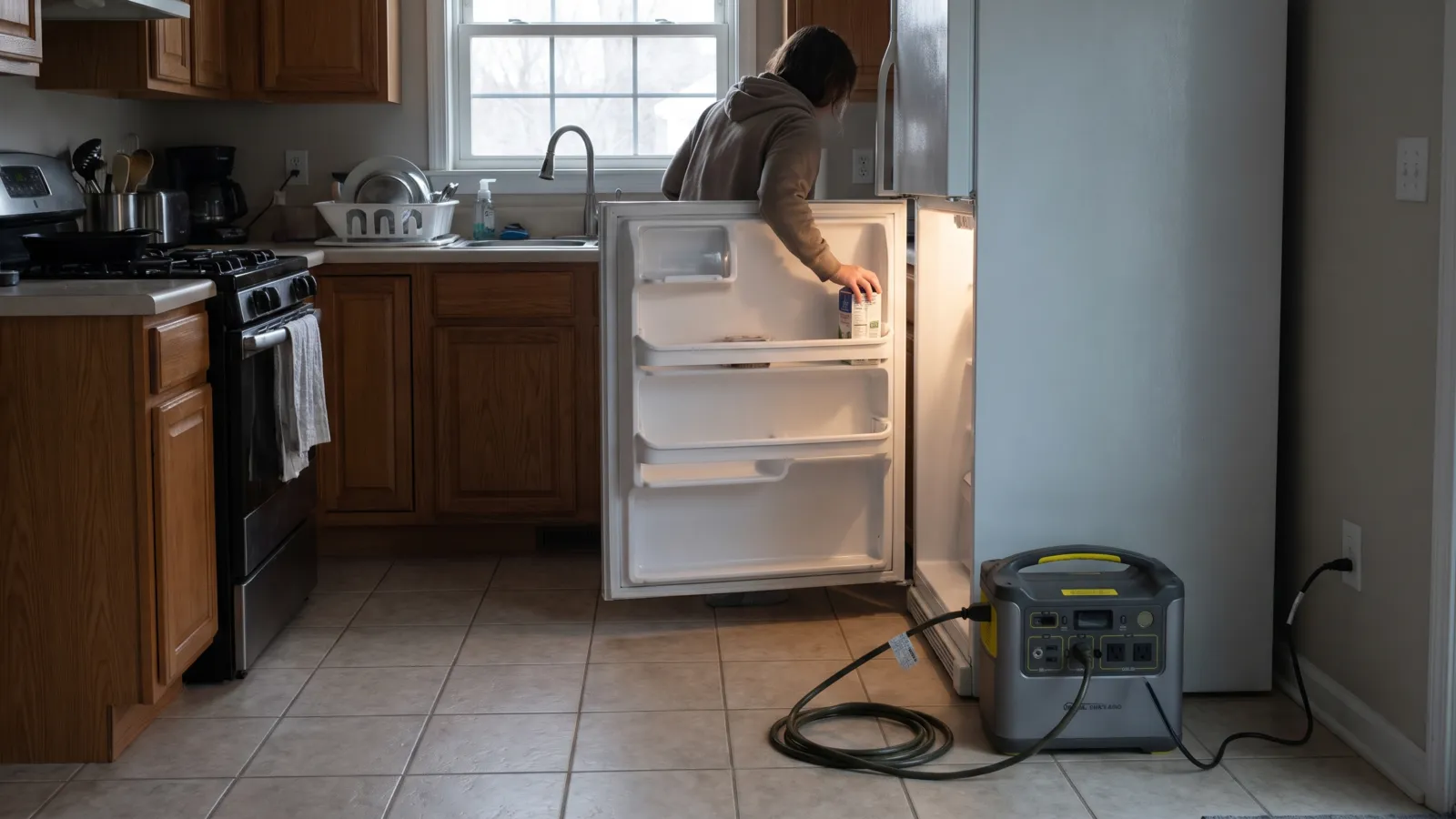
- Often yes, for a while. A full-size refrigerator draws far less over a day than its nameplate suggests because it cycles on and off, but it needs a power station whose AC output and surge rating cover the moment the compressor starts.
- Check three numbers: the watts on your fridge's nameplate, the station's continuous AC watts and surge watts, and its capacity in watt-hours. Our power station runtime tool does the sum for you.
- DOE's example 18.1 cubic-foot top-freezer refrigerator uses 363.5 kWh a year, about 1 kWh a day (our division). That is our arithmetic on DOE's figure; yours may be higher.
- You may not need power at all: USDA says a closed refrigerator keeps food safe about 4 hours, and a full freezer about 48 hours.
- Run any gasoline generator outdoors, at least 20 feet from windows, doors and attached garages.
The short answer
Most US household appliances run on 120 volts, which is what a power station's AC outlets supply. A refrigerator is one of the easier large appliances to back up, because it spends most of the day idle. The two things that trip people up are the short burst of power when the compressor starts, and how many hours the battery lasts. Both are worked out from numbers you can read off your own appliance.
How much power a refrigerator uses
The Department of Energy says the wattage of most appliances "is usually stamped on the bottom or back of the appliance, or on its nameplate," and that "the wattage listed is the maximum power drawn by the appliance." Look on the fridge itself or in its owner's manual. DOE says that if the wattage is not listed, you can estimate it by finding the electrical current draw in amperes and multiplying by the voltage, and most US appliances use 120 volts.
DOE also explains that "refrigerators, although turned 'on' all the time, actually cycle on and off as needed to maintain interior temperatures," and to estimate the hours a refrigerator actually operates at its maximum wattage, you "divide the total time the refrigerator is plugged in by three." So a fridge plugged in for 24 hours runs at its listed wattage for about 8. DOE adds that wattage values vary with product age and features.
Starting surge: the number people forget
A compressor needs more power for a moment when it starts than while it runs. The Department of Energy's Grid Deployment Office notes that a home will often need more capacity than its peak load "to accommodate the starting wattage required for household appliances." The Red Cross says some machines draw "up to 3 times as much power when starting up."
There is no official surge-watt table for refrigerators, so use the maker's figure if your fridge manual or a service label has one. Then compare it with the surge (peak) rating on the power station, not just its continuous AC watts. Our what will it run pages and the runtime tool use cautious surge figures for refrigerators, drawn from generator charts, and say so.
How many hours to expect
Power is watts; a battery's capacity is watt-hours. DOE's example 18.1 cubic-foot, top-freezer refrigerator with automatic defrost lists annual energy use of 363.5 kWh for an ENERGY STAR model and 404 kWh for a less efficient one. Divided by 365 days, that is about 1.0 kWh and about 1.1 kWh a day. That arithmetic is ours, not DOE's, and a larger or older fridge, or one with its door opened often, uses more.
Batteries do not deliver their full rating through the inverter that makes 120V AC. Applying our runtime tool's formula (90% usable capacity, 85% inverter efficiency and about 10 watts for the unit itself) to DOE's figure of about 41.5 watts on average, a 1,000 watt-hour station runs roughly 15 hours and a 2,000 watt-hour station roughly 30. That is our arithmetic, not an agency figure. The runtime tool itself uses Energy Star's range of 34 to 84 watts for a full-size fridge and shows about 8 to 17 hours per 1,000 watt-hours. For your own fridge, a plug-in energy meter reading kWh over a day gives the best number, as DOE notes for devices that do not run constantly.
Read the arithmetic as a guide, not a promise: ice in the freezer, keeping the door shut and unplugging the fridge between runs all change it.
You may not need power for the fridge at all
Ready.gov: "Keep freezers and refrigerators closed. The refrigerator will keep food cold for about four hours. A full freezer will keep the temperature for about 48 hours. Use coolers with ice if necessary. Monitor temperatures with a thermometer. Throw out food if the temperature is 40 degrees or higher." The Red Cross adds that a freezer holds for about 24 hours if it is half full and the door stays closed.
USDA's FoodSafety.gov says to discard refrigerated perishable food such as meat, poultry, fish, eggs and leftovers after 4 hours without power, and its chart lists perishable foods to throw out after more than 2 hours at 40°F or above. For an outage of a few hours, a closed door and a thermometer cost nothing. A station mainly helps when an outage is likely to last longer than about 4 hours. Our food safety in a power outage guide has the full chart.
Using the station safely
Keep the cords and the equipment safe. The Red Cross says to "plug appliances directly into the generator, or use a heavy duty, outdoor-rated extension cord that is rated (in watts or amps) at least equal to the sum of the connected appliance loads." Ready.gov says: "Always connect the generator to appliances with heavy-duty extension cords" and "Keep the generator dry and protected from rain or flooding. Touching a wet generator or devices connected to one can cause electrical shock."
Fuel-burning generators are the carbon monoxide risk. CPSC: "Never use portable generators inside homes or garages, even if doors and windows are open. Use generators outside only, at least 20 feet away from homes with exhaust facing away." CDC: "When using a generator, use a battery-powered or battery backup CO detector in your home." We found no federal guidance specific to battery power stations, so follow its manual for placement and ventilation, and see generator safety if you are comparing the two.
If your outages last a few hours, you do not need a power station for the refrigerator: keep the door closed, and use coolers and ice. If you are in a place with day-long outages, or you keep medicine or breast milk cold, a station sized to your fridge's real draw may be worth having. Check the numbers above before you look at prices, and see our power station comparison for what is on the market.
Common questions
Can a power station run a refrigerator?
Usually, yes, if its continuous AC watts cover the fridge's running watts and its surge rating covers the compressor starting. Check the nameplate on your fridge and the station's specification, then use a runtime tool for the hours.
How many watts does a refrigerator use?
The nameplate shows the maximum wattage; DOE says to read it. A fridge cycles, running at that wattage for roughly a third of the time per DOE's rule of thumb. DOE's example 18.1 cubic-foot fridge is 363.5 kWh a year.
How long will a power station run my fridge?
Divide the station's usable watt-hours by your fridge's daily use in watt-hours. Our own arithmetic on DOE's example fridge (about 41.5 W on average) gives roughly 15 hours from 1,000 Wh once inverter losses are included; our runtime tool, which uses Energy Star's 34 to 84 W range, shows about 8 to 17 hours. Use the tool for your own numbers.
How long does food last in a fridge without power?
About 4 hours if you keep the door closed, per Ready.gov and USDA. A full freezer holds about 48 hours and a half-full one about 24. Throw out perishable food that has been at 40°F or above for more than 2 hours.
Is it safe to run a generator in the garage?
No. CPSC and CDC say never to run a portable generator inside a home or garage, even with doors and windows open, and to keep it well away from the house: CDC says more than 20 feet from any windows, doors and vents, and CPSC says at least 20 feet from homes.
Sources (9)
- Department of Energy: Estimating appliance and home electronic energy use
- Department of Energy FEMP: Purchasing energy-efficient residential refrigerators
- DOE Grid Deployment Office: Microgrid overview (PDF)
- American Red Cross: Safe generator use
- Ready.gov: Power Outages
- American Red Cross: Power outage
- USDA FoodSafety.gov: Food safety during a power outage
- CPSC: Carbon Monoxide Information Center
- CDC: Carbon monoxide poisoning basics
Get one calm email when it matters
Seasonal checklists and gear price drops. No spam, unsubscribe any time.
Keep reading
 Food safety in a power outage: how long food lasts and what to throw outHow long food stays safe in the fridge and freezer without power, what to throw out, and when you can refreeze…
 Portable generator safety: where to run it, carbon monoxide and cordsHow to use a portable generator safely in an outage: 20 feet from windows, never in a garage, CO alarms, outdo…
 Power outage checklist: what to do before, during and afterA calm power outage checklist from Ready.gov and CDC: what to prepare, how to protect food, medicines and medi…
 How to prepare for a 90-day power outage: a staged plan for your homeHow to prepare for a 90-day power outage, in stages: water, food, heat, fuel and medicines for 2, 4 or 6 peopl…