Power station for a CPAP: how many watts you need and what to ask first
What a CPAP draws, from ResMed and Philips manuals, how to size a portable power station for a night, and the medical-device cautions from the FDA and Ready.gov.
By Tom Calder · Updated October 30, 2026 · Sourced to ResMed and Philips manuals, the FDA and Ready.gov
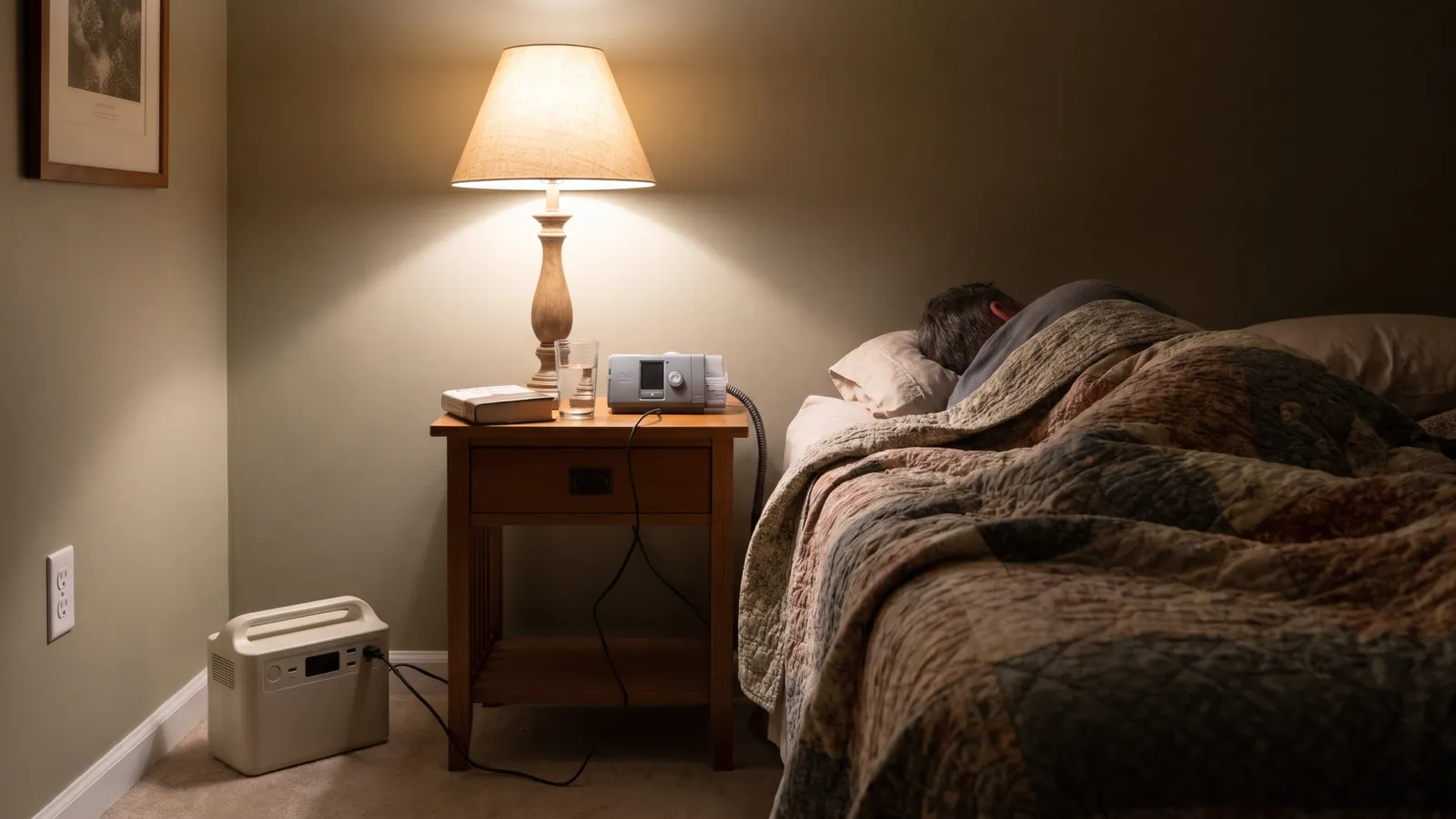
- Ask first: Ready.gov says to talk to your medical provider about a power outage plan for medical devices powered by electricity, and the FDA says to read your device instructions or call the maker to find out if it can use batteries or a generator.
- Check your own machine's label or manual. ResMed lists its AirSense 11 power supply at 56.1W typical and 73.2W peak; Philips says its DreamStation 2 Advanced needs an 80W supply to run the humidifier.
- A rough night's energy is watts times hours, plus losses (our arithmetic, not a maker's figure): 56.1W over 8 hours is about 449 watt-hours before losses.
- If you already own a CPAP battery or a power station, you may not need to buy anything. Try it at home before an outage.
- Ready.gov says generators and fuel should always be used outdoors and at least 20 feet away from windows, doors and attached garages.
Start with your doctor and your machine's manual
Ready.gov tells you to talk to your medical provider about a power outage plan for medical devices powered by electricity. The FDA's tips for medical devices say to read your user instructions or call your distributor or device manufacturer to find out if your device can be used with batteries or a generator.
Whether you can safely skip a night of therapy is a question for your doctor. We cannot answer it, and this guide is not medical advice. Your manual and your care team come first.
Our medical devices in a power outage guide lists the questions the FDA suggests asking, and our CPAP battery comparison covers batteries made for specific machines.
How many watts a CPAP uses
The best number is the one printed on your machine's label or in its manual. Two examples from manufacturer manuals we read on Oct. 30, 2026:
ResMed's AirSense 11 user guide lists a 65W power supply unit with a DC output of 24 V at 2.71A, typical power consumption of 56.1W (111.5VA) and peak power consumption of 73.2W (137.6VA). Philips' DreamStation 2 CPAP Advanced / Auto CPAP Advanced user manual lists AC power consumption of 100–240 VAC, 50/60 Hz, 2.0-1.0 A, and says that an 80W power supply is required to support humidification.
Those are the power supply and system ratings the makers publish. How much your machine actually draws on a given night depends on your pressure, whether the heated humidifier is on and other settings, and we did not find an official figure for each case. Ask your equipment supplier for your model.
- ResMed AirSense 11: typical 56.1W, peak 73.2W (power supply rated 65W)
- Philips DreamStation 2 Advanced: 80W supply needed to support humidification
- Anything else: check the label on the machine or its power supply
Sizing a power station for one night
A portable power station's capacity is listed in watt-hours (Wh). The arithmetic is ours, not a manufacturer's: watts times hours gives watt-hours. At the AirSense 11's listed typical 56.1W, a night of 8 hours works out to about 449 Wh (56.1 x 8). At the listed peak of 73.2W it is about 586 Wh (73.2 x 8).
Our note, not a maker's figure: real runtime is likely shorter than that arithmetic, because a power station loses some energy converting its battery power to AC, and capacity is not fully usable. Plan with a margin, and for several nights multiply. If your machine's real draw is lower, for example with the humidifier off, you will get more hours, but check with your supplier before changing settings.
A CPAP battery made for your machine (see our CPAP battery backup comparison) connects with a DC cable and has a runtime stated by its maker for your machine; use that figure. A general-purpose portable power station can also run a phone, a light and a router. Our power station vs generator guide explains the trade-off. Check your exact machine against the battery or power station maker's compatibility list, and test it at home for a full night before you need it.
Connecting it: use the maker's cables
ResMed lists an Air11 DC/DC converter among the spares and accessories for the AirSense 11. Ask your care provider about it. Philips says a Philips Respironics DC power cord can be used to operate the DreamStation 2 in a stationary recreational vehicle, boat or motor home, and that a Philips Respironics DC battery adapter cable, with that cord, allows operation from a 12 VDC free-standing battery.
Philips also says to only use a Philips Respironics DC power cord and battery adapter cable, because use of any other system may cause damage to the device, and that when DC power is obtained from a vehicle battery the device should not be used while the vehicle's engine is running. Contact your home care provider to find the right cord for your exact machine.
After the power returns, the FDA says to check that the settings on your medical device have not changed, because medical devices often reset to a default mode when power is interrupted.
Tell your utility, and know your options
The FDA says to notify your electric company and fire department to let them know you have a medical device that needs power (its examples are a ventilator and an apnea monitor). Ready.gov says you can ask your power provider to put you on a list for priority power restoration. It also says many city and county emergency management agencies maintain voluntary registries for people with disabilities; ask your local emergency management office.
The FDA also says: if you depend on your device to keep you alive, seek emergency services immediately. Your doctor is the one to say whether that applies to you.
Generators: carbon monoxide rules
If your device's maker says it can run from a generator, use it only outdoors. Ready.gov says generators and fuel should always be used outdoors and at least 20 feet away from windows, doors and attached garages, and to install working carbon monoxide detectors on every level of your home. It says carbon monoxide is a colorless, odorless gas that can kill you, your family and pets.
The FDA says: never run a generator, pressure washer, or any gasoline-powered engine inside a basement, garage, or other enclosed structure, even if the doors or windows are open, unless the equipment is professionally installed and vented. It also says never to run a motor vehicle, generator, pressure washer, or any gasoline-powered engine outside an open window or door where exhaust can vent into an enclosed area.
Read our generator safety guide and compare carbon monoxide alarms.
Do you need to buy one?
Not necessarily. If outages where you live are rare and short, and your doctor says a missed night is acceptable, a plan may be enough. If you already have a CPAP battery, or a power station bought for other reasons, check that it covers your machine's listed watts for a night and try it before you rely on it.
If you do buy, size for your own machine's rating, match it to your machine's cables, and think about how many nights you want to cover. Our comparison pages show current options, but your doctor and equipment supplier know your machine.
Ready.gov says generators and fuel should always be used outdoors and at least 20 feet away from windows, doors and attached garages. The FDA says never to run a generator, pressure washer, or any gasoline-powered engine inside a basement, garage, or other enclosed structure, even if the doors or windows are open, unless the equipment is professionally installed and vented.
Common questions
How many watts does a CPAP use?
It depends on the machine and settings. ResMed lists typical power consumption of 56.1W and peak of 73.2W for the AirSense 11 power supply system, and Philips says its DreamStation 2 Advanced needs an 80W power supply to support humidification. Check the label on your own machine.
Can I run my CPAP from a portable power station?
Ask your machine's maker or your equipment supplier. The FDA says to read your user instructions or call your distributor or device manufacturer to find out if your device can be used with batteries or a generator. Use the maker's DC cable or converter where one is made for your machine.
How big a power station do I need for one night?
Watts times hours gives watt-hours (our arithmetic): 56.1W over 8 hours is about 449 Wh, before conversion losses. Use your own machine's rating and leave a margin.
Can I use a car battery or a vehicle to power it?
Philips says that when DC power is obtained from a vehicle battery, the DreamStation 2 Advanced should not be used while the vehicle's engine is running, and to use only its own DC power cord and battery adapter cable. Ask your maker about your machine.
What should I check after the power comes back?
The FDA says to check that the settings on your medical device have not changed, because medical devices often reset to a default mode when power is interrupted.
Get one calm email when it matters
Seasonal checklists and gear price drops. No spam, unsubscribe any time.
Keep reading
 Power outage plan for electric medical devices and refrigerated medicinesHow to plan for a power outage if you use electric medical devices or refrigerated medicine: questions to ask,…
 Power station vs generator: which one suits your home in an outage?A portable power station is a battery; a generator burns fuel. What that means for carbon monoxide, fuel stora…
 Portable generator safety: where to run it, carbon monoxide and cordsHow to use a portable generator safely in an outage: 20 feet from windows, never in a garage, CO alarms, outdo…
 Power outage checklist: what to do before, during and afterA calm power outage checklist from Ready.gov and CDC: what to prepare, how to protect food, medicines and medi…