Medical baseline programs and 211: tell your utility if you rely on powered medical equipment
If you rely on powered medical equipment, how to tell your utility, what medical baseline and priority lists do and don't promise, and how 211 can help find aid.
By Tom Calder · Updated October 30, 2026 · Sourced to Ready.gov, the CDC, HHS, the FCC, the American Red Cross and state utility regulators
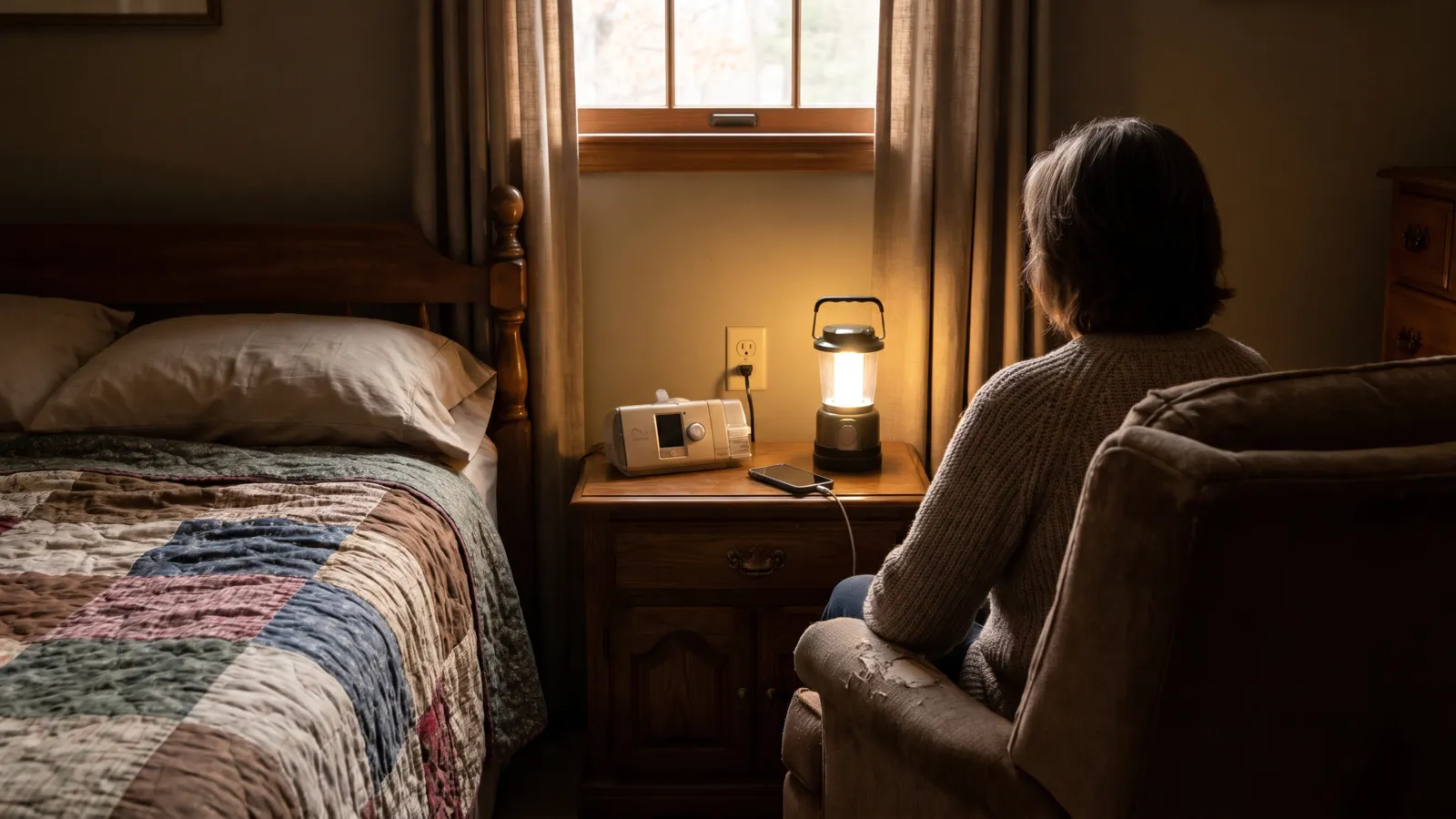
- If someone at home depends on electric medical equipment, tell your power company. Ready.gov says you can ask your provider to put you on a list for priority power restoration.
- "Medical baseline" is a California billing program: extra energy at the lowest rate. Other states use other names: in Texas, Critical Care and Chronic Condition customers get notice of service interruptions and shutoff protections; in Ohio, medically at-risk customers can go on a "critical customer list."
- No list guarantees power. Texas says designation "does not guarantee the uninterrupted supply of electricity." Ohio says the same and advises a backup plan.
- Dial 211 to be referred to local help, including utility assistance. You do not need to buy anything to register.
- Talk to your doctor about a plan for devices and refrigerated medicines, and decide in advance where you would go if the power stays off.
Why tell your utility
Ready.gov: "If you use medical equipment in your home that requires electricity, talk to your doctor or health care provider about what you may be able to do to keep it running during a power outage. You can also ask your power provider to put you on a list for priority power restoration." Its guidance for people with support needs adds: "Ask your local energy utility for priority access in the event of power loss because power restoration is life-sustaining for someone in the home."
The CDC blog suggests first checking whether your 911 dispatch supports Smart911 registration. If not, it says to notify your local police and fire department and utility companies if you rely on a home-use medical device, and notes that "some electricity providers keep a 'priority reconnection service' list of power-dependent customers." Our medical devices in a power outage guide covers the backup side.
What "medical baseline" means in California
The California Public Utilities Commission describes Medical Baseline as a billing program: "Medical Baseline consumers are billed for natural gas and electricity use at their utility company's lowest residential rate." People who rely on life support equipment, or have certain serious conditions, can have extra allowances billed at that rate. The CPUC page also notes that PG&E, SCE and SDG&E all offer advanced notices of power outages, and says to contact your utility for more information.
The page does not say that Medical Baseline puts you first in line for restoration. If you are in California, ask your utility two questions: what the program gives you on the bill, and what it does for outage notices and restoration.
How other states handle it
Texas: its Public Utility Commission rule defines a Critical Care Residential Customer as a residential customer with a person permanently living in the home who a physician has diagnosed as "dependent upon an electric-powered medical device to sustain life." The designation lasts two years. A Chronic Condition Residential Customer has a serious medical condition requiring an electric-powered device or electric heating or cooling; that designation lasts 90 days, or, if a physician diagnoses a life-long condition, "the shorter of one year or until such time as the person with the medical condition no longer resides in the home." In both cases "the commission-approved application form must be submitted to the TDU by a physician" (the TDU is the transmission and distribution utility, the company that runs the wires). This is the rule text as archived in March 2025; check the PUC's current rule before relying on it. The rule is about notice and shutoff protection, and does not promise faster restoration.
Ohio: the Office of the Consumers' Counsel says customers classified as medically at risk "can be placed on a critical customer list with their utility company," and that a separate medical certificate, good for 30 days and usable up to three times in a rolling 12-month period, "can be used to prevent a utility disconnection or to reconnect service if the customer has been disconnected for no more than 21 days." That certificate is about shutoffs, not outage priority. For details, it says to contact your utility, or the PUCO Consumer Call Center at 1-800-686-7826.
Pennsylvania's PUC publishes Medical Certificate Guidance for customers and medical professionals, about submitting certificates "to avoid termination of service or to restore service." That is protection from shutoff for nonpayment, not outage priority. Elsewhere, search your state public utility commission's site and your utility's site for "medical," "life support" or "critical care"; names vary.
No list guarantees power
Texas rule: "Designation as a Critical Load Customer, Critical Care Residential Customer, or Chronic Condition Residential Customer does not guarantee the uninterrupted supply of electricity." Ohio's Consumers' Counsel: "Being on the critical customer list does not guarantee uninterrupted service or immediate service restoration in the event of an outage, so one should always have a backup plan in place."
So treat registration as one layer. The Red Cross says to take an inventory of your electrical needs and consider "both back up and non-power alternatives" for medical devices and refrigerated medicine, and to "evacuate if your home is too hot or too cold, or if you have medical devices that need power." Ready.gov: "Have alternate plans for refrigerating medicines or using power-dependent medical devices."
What 211 does
The FCC says dialing 211 provides a shortcut to health and human service agencies: "By simply dialing 211, those in need of assistance can be referred, and sometimes connected to, appropriate agencies and community organizations." Calls and texts are routed to a local or regional calling center, 211 covers all 50 states, the District of Columbia and Puerto Rico, and its resources include utility assistance.
Call 211 to ask which utility programs and local medical-equipment resources exist near you. For an emergency, call or text 911 instead. The FCC lists 911 for "health and safety emergencies and threats to life and property."
What about HHS emPOWER?
HHS's emPOWER Program provides data and mapping tools so communities can protect at-risk Medicare beneficiaries who rely on electricity-dependent equipment. Public health authorities and their partners use its data and tools, not households: its individual-level dataset "can only be officially requested by a public health authority." You do not sign up for it, so it does not replace telling your own utility.
You do not need to buy anything to register, and the paperwork may be a form signed by your doctor, as in Texas. But a registration is not a backup. If your device cannot run on its own battery for as long as an outage might last, the plan that matters is where you would go and who would drive you.
Common questions
What is a medical baseline program?
In California it is a billing program: customers who rely on life support equipment or have certain conditions get extra gas and electricity allowances at their utility's lowest residential rate. It is a different thing from an outage priority list.
How do I get on a priority power restoration list?
Ask your utility. Ready.gov says you can ask your power provider to put you on a list for priority restoration. In Texas a physician must submit the form. Names and rules vary by state and company.
Will I get power back first if I register?
Not guaranteed. Texas and Ohio regulators both say designation does not guarantee uninterrupted service or immediate restoration. Keep a backup plan for your equipment and medicines.
What does dialing 211 do?
It connects you to a local or regional calling center that refers callers to health and human services, including utility assistance. The FCC says it covers all 50 states, DC and Puerto Rico.
Is HHS emPOWER something I sign up for?
No. It supplies data to emergency managers and health officials about Medicare beneficiaries who rely on powered equipment. Households tell their utility directly.
Sources (12)
- Ready.gov: People with disabilities and others with access and functional needs
- CDC: Prep Your Health, Power Sources (blog)
- California Public Utilities Commission: Medical Baseline
- Public Utility Commission of Texas: Substantive Rule 25.497 (PDF)
- Ohio Office of the Consumers' Counsel: 30-day medical certificate
- Pennsylvania Public Utility Commission: utility assistance programs
- American Red Cross: Power outage
- Ready.gov: Power Outages
- FCC: Dial 211 for essential community services
- FCC: Nationally assigned 3-digit numbers (N11) (PDF)
- HHS emPOWER Program
- HHS emPOWER: FAQs
Get one calm email when it matters
Seasonal checklists and gear price drops. No spam, unsubscribe any time.
Keep reading
 Power outage plan for electric medical devices and refrigerated medicinesHow to plan for a power outage if you use electric medical devices or refrigerated medicine: questions to ask,…
 Emergency preparedness for older adults: how to make a plan and a kitHow older adults can prepare for emergencies: assess needs, build a support network, plan for medicines and de…
 Power outage checklist: what to do before, during and afterA calm power outage checklist from Ready.gov and CDC: what to prepare, how to protect food, medicines and medi…
 Food safety in a power outage: how long food lasts and what to throw outHow long food stays safe in the fridge and freezer without power, what to throw out, and when you can refreeze…