Build an extreme heat kit
Ready.gov says not to rely on a fan as your primary cooling device. Tell us who lives with you and get Ready.gov's kit list sized to your household, with the heat steps from Ready.gov and CDC: a way to keep cool or a cooling center to go to, light clothing, water to carry, and power outage extras.
1. Your household
2. How long to plan for
3. What you face where you live
Water: 1 gallon per person per day (CDC). Food: FDA uses 2,000 calories a day as a general guide for adults. Pets need water too: ask your vet how much.
The basic kit
Ready.gov's basic supplies list.
- Water6 gallons for 2 people over 3 days1 pack of our pick covers 6 gallonsOur pick: WaterBrick 3.5-gal (4-pack) ↗Compare water storage containers →
- Non-perishable food3 days for 2 people (about 12,000 calories for the adults)Our pick: Datrex 3600 ↗Compare ration bars and mres →
- Battery-powered or hand-crank radio and a NOAA Weather Radio with tone alertOur pick: Midland WR400 ↗Compare weather radios →
- First aid kitOur pick: SurviveX Large ↗Compare first aid kits →
- Extra batteriesOur pick: eneloop AA (8) ↗Compare rechargeable batteries →
- Whistle to signal for help
- Dust mask to help filter contaminated airOur pick: 3M Aura 9205+ ↗Compare n95 masks for smoke →
- Plastic sheeting, scissors and duct tape to shelter in place
- Moist towelettes, garbage bags and plastic ties for personal sanitationOur pick: Reliance Luggable Loo ↗Compare emergency toilets →
- Wrench or pliers to turn off utilities
- Manual can opener for food
- Local maps
- Cell phone with chargers and a backup batteryOur pick: Anker 20,000mAh (built-in cable) ↗Compare power banks →
Additional supplies for your household
From Ready.gov's additional items, and its pages for pets and people with disabilities.
- Soap, hand sanitizer and disinfecting wipes to disinfect surfaces
- Prescription medications
- Non-prescription medications such as pain relievers, anti-diarrhea medication, antacids or laxatives
- Prescription eyeglasses and contact lens solution
- Cash or traveler's checks
- Important family documents such as copies of insurance policies, identification and bank account recordsOur pick: SentrySafe file box ↗Compare fireproof document safes →
- Sleeping bag or warm blanket for each person2 neededOur pick: SOL Emergency Bivvy ↗Compare emergency blankets and sleeping bags →
- Complete change of clothing appropriate for your climate and sturdy shoes2 needed
- Fire extinguisherOur pick: First Alert PRO5 ↗Compare fire extinguishers →
- Matches in a waterproof container
- Feminine supplies and personal hygiene items
- Mess kits, paper cups, plates, paper towels and plastic utensils
- Paper and pencil
For power outages
From Ready.gov and CDC.
- Carbon monoxide detectors with battery backup in central locations on every level of your homeOur pick: Kidde 10-year digital CO alarm ↗Compare carbon monoxide detectors →
- A cooler and frozen gel packs, in case you have to move food out of the refrigeratorOur pick: Coleman 70 qt ↗Compare coolers for power outages →
For extreme heat
From Ready.gov and CDC. A fan is not a cooling plan: Ready.gov says not to rely on one as your primary cooling device.
- A way to keep cool: air conditioning, or your nearest cooling center or air-conditioned place (dial 2-1-1 or ask your local health department or emergency management agency)
- Loose, lightweight, light-colored clothing
- A water bottle to carry, and plenty of fluids
- Drapes or shades to cover windows
- A plan to check on family, older adults and neighbors, and for someone to check in on you
Gear to consider for your hazards
Not part of the official lists: our comparisons, if you want them.
Get what's left
Tick off what you already have. Our Amazon picks for the 13 gear items still on your list can go into one Amazon cart, where you see the prices and can remove anything.
As an Amazon Associate we earn from qualifying purchases. When two products are close, commission can decide which one we pick. A clearly better product always wins.
Download your plan
This list as a printable PDF, sized to your household: how much water and food to store, Ready.gov's checklist to tick off, and our pick for each line.
Sized to the household above.
Download your plan (PDF)Free, no sign-up. A QR code on it brings you back to this list.
Share this list
A reminder to check your kit
Seasonal checklists and a nudge to swap out stored water and expired food. No spam.
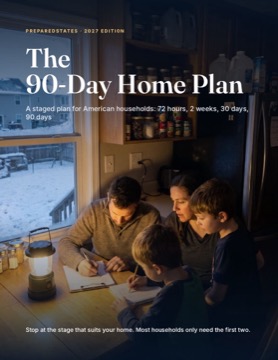 Want it as a plan?The 90-Day Home Plan: water, food, power and heat, stage by stage64 pages to print and tick off. Stop at whichever stage suits your home: most only need the first two.See the plan, $14.99 →
Common questions
Is a fan enough to keep me cool in a heat wave?
No. Ready.gov says not to rely on a fan as your primary cooling device, and the CDC says that above 90°F a fan can increase body temperature.
Where can I find a cooling center?
The CDC says you can dial 2-1-1 or contact your local health department or emergency management agency. Ready.gov suggests community places such as libraries and shopping malls.
What is the difference between heat exhaustion and heat stroke?
In the CDC's flyer, heat exhaustion involves heavy sweating and cold, pale, clammy skin with a fast, weak pulse. Heat stroke involves a body temperature of 103°F or higher and hot, red, dry or damp skin, and the CDC says to call 911 right away.
How much water does the kit builder plan for?
One gallon per person per day, the figure CDC and Ready.gov use, for drinking and sanitation. Children, nursing mothers and people who are sick may need more, and so may anyone in a hot climate. Pets need water too: ask your vet how much.
How many days should my kit cover?
The American Red Cross suggests a 3-day supply for evacuation and a 2-week supply for home. Ready.gov's list says several days. Pick 3 days for a go-bag and 2 weeks for supplies at home. For a longer pantry, 1 or 3 months, the builder scales water and food the same way, and our food storage calculator lists the staples for up to a year.
How much food is that?
Ready.gov asks for at least a several-day supply of non-perishable food. FDA uses 2,000 calories a day as a general guide, so the builder shows that total for the adults in your home. Children's needs vary with age.