How the US responds to a disaster: local, then state, then FEMA, and what it means for you
Who does what when disaster strikes: local officials, the state, the Stafford Act and FEMA. Why the first days are on you, and what federal help does and does not do.
By Tom Calder · Updated November 2, 2026 · Sourced to FEMA, Ready.gov, the SBA and USA.gov
- Disasters are handled from the ground up. FEMA says: "When a disaster strikes, local government officials review the damage to determine the extent of the incident and its impact. If the state, Tribal Nation, or territory determine they need federal assistance, they submit a request for a federal disaster declaration."
- FEMA does not run the response on its own. It "coordinates the federal response to disasters that receive a Presidential disaster declaration," and all such declarations "are made solely at the discretion of the President of the United States through the Robert T. Stafford Disaster Relief and Emergency Assistance Act."
- Even after a declaration, "state and local officials lead recovery efforts." FEMA's household help "is not a substitute for insurance and cannot compensate for all losses caused by a disaster."
- The gap between the event and organized help is what household preparedness fills. Ready.gov's plan page starts from the same place: "Your family may not be together if a disaster strikes, so it is important to know which types of disasters could affect your area."
- Most emergencies never get a federal declaration. USA.gov: "Presidentially declared disasters are eligible for help from FEMA. If your area is not eligible, state agencies and other organizations may offer assistance."
Local first: your city, county and 911
The first responders to any emergency are local: the fire department, police, EMS, the county emergency management office and the utilities. FEMA describes the starting point: "When a disaster strikes, local government officials review the damage to determine the extent of the incident and its impact." Evacuation orders, shelter openings, boil water advisories and road closures all come from local and state officials, not from Washington.
That is why the alerts that matter in the first hours are local ones: the county's alert system, Wireless Emergency Alerts, and the National Weather Service's warnings. Our emergency alerts on your phone guide covers how to receive them, and the alerts page shows the active NWS warnings for each state.
Then the state, the governor and the request for help
When the damage is beyond what local government can handle, the state steps in with its own emergency management agency, the National Guard and state resources. FEMA says: "If the state, Tribal Nation, or territory determine they need federal assistance, they submit a request for a federal disaster declaration." Each state page on this site links the state's emergency management agency and shows FEMA's expected annual loss figures for that state.
Our guide to storm damage and who pays covers the household end of the same chain: insurance first, then state programs, then federal help if a declaration comes.
The federal step: the Stafford Act and FEMA
The legal switch is the Stafford Act. FEMA: "All emergency and major disaster declarations are made solely at the discretion of the President of the United States through the Robert T. Stafford Disaster Relief and Emergency Assistance Act. There are two types of disaster declarations provided for in the Stafford Act: emergency declarations and major disaster declarations. The type of declaration affects what types of assistance may be available." FEMA's summary of the Act says it "authorizes the President to issue major disaster and emergency declarations that activates federal assistance to states, local governments, tribal nations, individuals, and certain nonprofit organizations. It also allows the Small Business Administration to offer disaster loans."
FEMA's own description of its role is coordination, not command: "FEMA coordinates the federal response to disasters that receive a Presidential disaster declaration. We work closely with officials in states, Tribal Nations, and territories as they respond to disasters and make requests for federal support." And after the declaration: "state and local officials lead recovery efforts and can request FEMA personnel to support at state-led disaster recovery centers."
What federal help actually does for a household
Two programs matter to households. FEMA's Individuals and Households Program "provides financial and direct services to eligible individuals and households affected by a disaster, who have uninsured or under-insured necessary expenses and serious needs. IHP assistance is not a substitute for insurance and cannot compensate for all losses caused by a disaster. The assistance is intended to meet your basic needs and supplement disaster recovery efforts." It can pay for temporary housing and help repair a primary residence.
The second is a loan. The SBA says homeowners "may apply for up to $500,000 to replace or repair their primary residence," and renters and homeowners "may borrow up to $100,000 to replace or repair personal property," for losses "not fully covered by insurance or other sources." Both programs apply only in a declared disaster area. For everything else, USA.gov points to state agencies and other organizations. FEMA also notes that "at the request of the state, FEMA may set up a Disaster Recovery Center," where you can apply for assistance and get answers in person.
What this means for your household
The system is built so that the first hours and days of a disaster are handled locally, and much of that is handled by households themselves. Roads may be closed, the power may be out, stores may be shut and the people who would normally help may be dealing with their own homes. The declaration that unlocks federal money comes after the damage assessment, not before the storm.
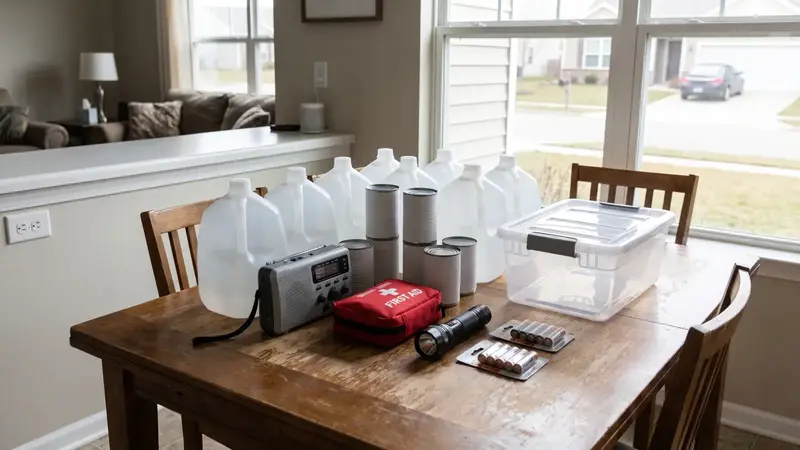
Ready.gov's planning page starts with that reality: "Your family may not be together if a disaster strikes, so it is important to know which types of disasters could affect your area. Know how you'll contact one another and reconnect if separated." It asks four questions: "How will I receive emergency alerts and warnings? What is my shelter plan? What is my evacuation route? What is my family/household communication plan?" Our family emergency plan guide walks through them, and the emergency kit checklist and kit builder cover the supplies: water, food and a weather radio are the core.
What the system is not
It is not a promise that help arrives within hours, and it is not a replacement for insurance. It is also not a reason for alarm. The layering is deliberate: local responders know the ground, states hold the larger resources, and the federal government funds and coordinates the biggest events. For the ordinary emergencies that never make the national news, the house fire, the three-day outage, the flooded street, the response is the fire department, the utility and your own plan.
Prepare for the first 72 hours as if no one is coming, because in a large disaster that is often true, and then let the system do its work. Our prepping for beginners guide is the calm starting point.
You cannot buy your way into a faster federal response, and no product on this site changes how a declaration works. What you can do is cover the gap the system is built around: the first days, when help is local and stretched. That is a plan, a kit, insurance that matches your actual risk, and knowing where your state's emergency management agency and alerts come from. None of it is expensive, and most of it is free.
Common questions
Who is in charge when a disaster happens?
Local officials first. FEMA says local government reviews the damage, and the state, Tribal Nation or territory requests a federal declaration if it needs federal assistance. Even after a declaration, state and local officials lead recovery efforts.
What does FEMA actually do?
FEMA says it coordinates the federal response to disasters that receive a Presidential disaster declaration and works with states, Tribal Nations and territories as they respond and request federal support.
What is the Stafford Act?
The Robert T. Stafford Disaster Relief and Emergency Assistance Act. FEMA says all emergency and major disaster declarations are made through it, and it authorizes the President to activate federal assistance and allows the SBA to offer disaster loans.
Will FEMA pay to rebuild my house?
Not in full. FEMA says its Individuals and Households Program is not a substitute for insurance and cannot compensate for all losses; it meets basic needs for people with uninsured or under-insured expenses. SBA loans of up to $500,000 for a primary residence cover losses not fully covered by insurance.
What if my emergency is not a declared disaster?
USA.gov says presidentially declared disasters are eligible for FEMA help, and if your area is not eligible, state agencies and other organizations may offer assistance. Your insurer and local services handle the rest.
Get one calm email when it matters
Seasonal checklists and gear price drops. No spam, unsubscribe any time.
Keep reading
 How to make a family emergency plan: steps, questions and a communication planHow to make a family emergency plan: Ready.gov's four steps, the questions to ask, a communication plan, meeti…
 Emergency kit checklist: what to include, how much to keep and where to store itA plain-English emergency kit checklist built on Ready.gov's basic kit and extra items, with how many days of …
 Emergency alerts on your phone: WEA, IPAWS and NOAA Weather Radio, and how to check they are onHow Wireless Emergency Alerts, IPAWS, the Emergency Alert System and NOAA Weather Radio work, why you may not …
 Prepping for beginners: how to start, step by stepA calm beginner's guide to prepping from Ready.gov, CDC and the Red Cross: know your risks, make a plan, build…