Can a power station run a gas furnace? Blower watts, the transfer switch and the electrician
A gas furnace needs 120V for its blower and controls. What it draws, how long a 1,000 or 2,000 Wh station runs it, and why only an electrician-fitted transfer switch is safe.
By Tom Calder · Updated November 2, 2026 · Sourced to Goodman's furnace installation instructions, DTE Energy's appliance guide, OSHA, CPSC, CDC, Ready.gov, the American Red Cross and EIA
- Electrically, yes. A gas furnace burns gas for heat but needs 120V power for its blower, draft inducer and controls. DTE Energy's appliance guide puts a central furnace fan at 450 watts (1/3 HP) or 600 watts (1/2 HP) running, with a starting factor of 3, so the station needs about 1,800 watts of surge and 600 watts continuous.
- The hard part is the connection. Goodman's installation instructions require the furnace on its own fused branch circuit with a disconnect at the furnace, so it is wired in, not plugged in. OSHA: never attach a generator to a building's electrical system unless a qualified electrician has installed it with a transfer switch.
- Using our runtime tool's formula on DTE's figures, a 1,000 watt-hour station runs the blower for about 1¼ to 1⅔ hours nonstop, and a 2,000 watt-hour station about 2½ to 3⅓ hours. The blower cycles with the thermostat, so real heating time is longer. That arithmetic is ours.
- Never backfeed. CPSC: never try to power the house wiring by plugging a generator into a wall outlet. The same applies to a power station.
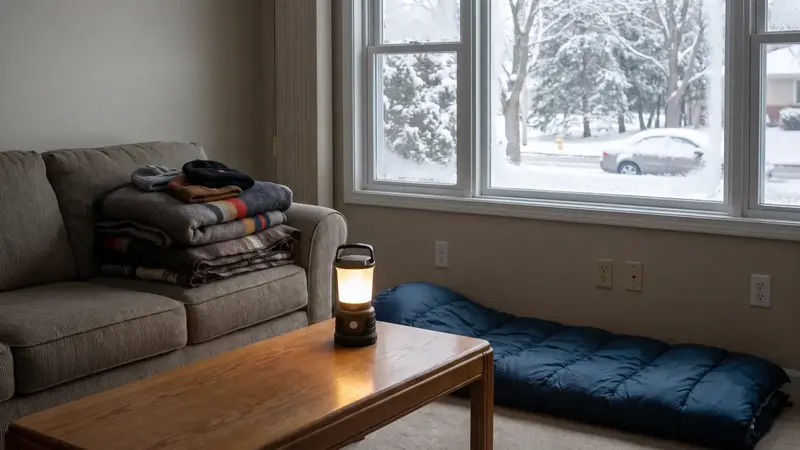
- If your outages last a few hours, blankets, layers and a closed-off room cost nothing and need no wiring. See stay warm without power.
Why the furnace stops when the power does
A gas furnace makes heat by burning gas, but everything that moves that heat into the house is electric: the blower that pushes warm air through the ducts, the small draft inducer fan that vents the burner, the igniter and the control board that runs the sequence. Goodman's installation instructions for its gas furnaces say the furnace "must have a 115 VAC power supply properly connected and grounded," with proper polarity maintained "for correct operation." No power, no sequence, no heat, however much gas is in the line.
The good news is that the load is modest. DTE Energy, the Michigan utility, lists a central furnace fan at 450 running watts for a 1/3 horsepower motor and 600 watts for a 1/2 horsepower motor, with a starting factor of 3. The furnace's own rating plate gives your model's amps; multiply by 120 for watts. A 1,000 watt-hour power station with 1,800 watts of AC output, which is a common mid-size specification, is in range on paper. Our power station runtime tool uses the same DTE figures.
The wiring is the problem, not the wattage
A furnace is not an appliance you unplug and move. Goodman's instructions require the installer to "use a separate fused branch electrical circuit containing properly sized wire, and fuse or circuit breaker," and say that "an electrical disconnect must be provided at the furnace location" with line voltage wiring entering the furnace's junction box. They also require that "line polarity must be observed when making field connections": the furnace's control board checks that hot and neutral are the right way round, and Goodman's troubleshooting table lists reversed 115-volt polarity as a reason the furnace fails to operate. A home-made adapter that gets this wrong leaves you cold.
The wrong way is to plug the power station into a wall outlet and hope the house wiring carries it to the furnace. CPSC's generator safety alert: "NEVER try to power the house wiring by plugging the generator into a wall outlet, a practice known as 'backfeeding.' This is extremely dangerous and presents an electrocution risk to utility workers and neighbors served by the same utility transformer." A battery power station is a generator for this purpose: it puts 120V onto wiring that line crews assume is dead.
The right way is a transfer switch. OSHA's fact sheet on portable generators: "Never attach a generator directly to the electrical system of a structure (home, office, trailer, etc.) unless a qualified electrician has properly installed the generator with a transfer switch." The Red Cross says the same and names the standard: "have an electrician install a power transfer switch in accordance with the National Electrical Code (NEC), which is published by the National Fire Protection Association, as well as all applicable state and local electrical codes."
What the electrician actually fits
There are two common arrangements, and your electrician will tell you which your panel, furnace and local code allow. The first is a manual transfer switch beside the panel that moves the furnace circuit, and often a few others, between the utility and an outdoor power inlet. You wheel the power station to the inlet, plug in with a generator cord, and throw the switch. Our transfer switch comparison covers the switches and inlet boxes on the market, and the same hardware works for a gasoline generator later.
The second is a small transfer switch, or a cord-and-plug connection, at the furnace itself, using the disconnect that Goodman's instructions already require at the furnace location. That keeps the job to one circuit. Whether a plug connection is permitted for a furnace in your jurisdiction is the electrician's call under the NEC and local code; it is not something to decide from a forum thread.
Either way, get a permit where one is required, keep the paperwork, and ask the furnace installer or maker whether running the furnace from a battery affects the warranty. The Goodman instructions we read say nothing either way about battery or generator supply.
How long a battery keeps the blower running
Power is watts; a battery's capacity is watt-hours, and not all of it reaches the furnace. Our runtime tool assumes 90% of the battery is usable, the inverter that makes 120V AC is 85% efficient, and the station itself uses about 10 watts. On DTE's 450 to 600 watt figures, that gives a 1,000 watt-hour station about 1¼ to 1⅔ hours with the blower running nonstop, and a 2,000 watt-hour station about 2½ to 3⅓ hours. That arithmetic is ours, not the utility's or a maker's.
The blower does not run nonstop. It runs while the thermostat calls for heat, then rests, so the heating you get from one charge depends on how cold it is outside and how well the house holds heat. If the furnace fires half the time, roughly double the figures above. Set the thermostat lower than usual, close off rooms you are not using and the battery goes further. A furnace with a variable-speed ECM blower may draw less than DTE's figures on low speed; the rating plate and a plug-in energy meter on the inlet give you a real number.
Then compare that with how long your outages actually last. EIA's reliability data says interruptions not caused by major events "routinely average about two hours per year," while major storms do the damage: in 2024, hurricanes Beryl, Helene and Milton accounted for 80% of the hours without electricity, and customers in South Carolina averaged nearly 53 hours. A 2,000 watt-hour station buys an evening of heat; it does not buy a week. See how long does a power outage last.
Starting surge, pure sine wave and the auto-off setting
Check three specifications on the station. Continuous AC watts must cover the blower's running watts with room to spare: 600 watts is DTE's figure for a 1/2 horsepower fan. Surge watts must cover the start: DTE's starting factor of 3 means 1,350 to 1,800 watts for a moment, and the Red Cross notes that some machines "draw up to 3 times as much power when starting up." Capacity in watt-hours sets the hours.
Choose a station whose AC output is listed as pure sine wave, which is the normal specification on current models, because furnace control boards and ECM motors are electronics, not simple resistive loads. And look in the manual for the station's energy-saving or auto-off setting. Between furnace cycles the load drops to the control board alone, a few watts, and some stations switch the AC outlets off when the load stays small. Turn that setting off for the furnace, or you will wake up to a cold house with a half-full battery.
If you use a generator instead
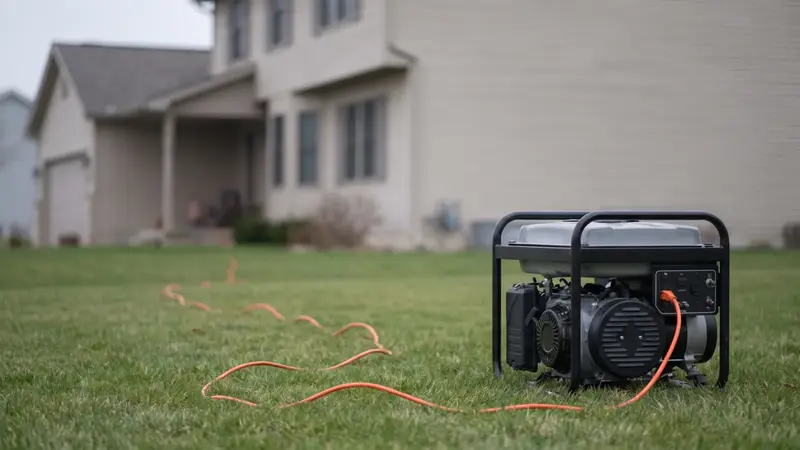
The same transfer switch serves a gasoline, propane or dual-fuel generator, and a generator is the usual answer for outages that last days. The safety lines are not negotiable. Ready.gov: "Generators and fuel should always be used outdoors and at least 20 feet away from windows, doors and attached garages." CPSC: "NEVER use a generator inside homes, garages, crawlspaces, sheds, or similar areas, even when using fans or opening doors and windows for ventilation. Deadly levels of carbon monoxide can quickly build up in these areas and can linger for hours, even after the generator has shut off."
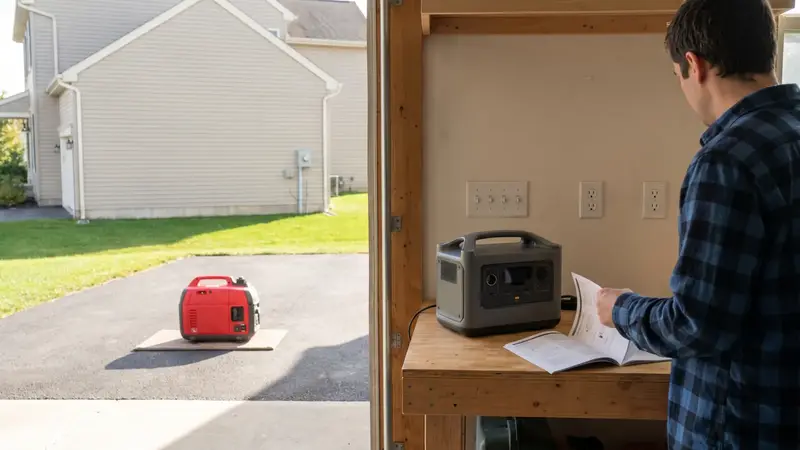
CDC: "When using a generator, use a battery-powered or battery backup CO detector in your home." CPSC says CO alarms should be placed on every level of the home and outside sleeping areas, battery operated or with battery backup. A battery power station makes no exhaust, which is its real advantage for the furnace; it can sit inside, following its manual. See generator safety, power station vs generator and our generator sizing tool, which has a furnace blower scenario.
The battery is the easy part of this. What makes it work is an electrician-fitted transfer switch or inlet, a permit where one is needed, and a word with your furnace installer about the warranty. If you would not pay for the wiring, do not buy the power station for the furnace: buy it for the refrigerator, the Wi-Fi and phones, or a CPAP, and keep warm the low-tech way. And if your outages are short and rare, which EIA's data says most are, a closed-off room, layers and blankets cover an evening for nothing. Our winter storm kit preset lists what Ready.gov asks for.
Common questions
Will a portable power station run my gas furnace?
Electrically, yes: DTE Energy lists a central furnace fan at 450 to 600 running watts with a starting factor of 3, within reach of a mid-size station with 1,800 watts of surge. But the furnace is on its own wired circuit with a disconnect, per Goodman's installation instructions, so it needs an electrician-installed transfer switch or inlet before a station can feed it.
Can I just plug my furnace into a power station?
Not as installed. Furnaces are hard-wired on a separate fused branch circuit. Whether an electrician can convert yours to a cord-and-plug connection, or whether a transfer switch at the furnace or panel is required, depends on the National Electrical Code and your local code. Never plug a power station or generator into a wall outlet to feed the house: CPSC calls that backfeeding and says it risks electrocuting utility workers and neighbors.
How long will a 1,000 watt-hour power station run a furnace?
About 1¼ to 1⅔ hours with the blower running nonstop, on DTE's 450 to 600 watt figures and our runtime tool's formula (90% usable capacity, 85% inverter efficiency, 10 watts for the station). Because the blower cycles with the thermostat, the heat you get from one charge is longer, often roughly double. A 2,000 watt-hour station gives about 2½ to 3⅓ hours nonstop.
Do I need an electrician or an HVAC technician?
The transfer switch, inlet and any change to the furnace's supply wiring are electrical work for a qualified, licensed electrician, which is what OSHA and the Red Cross call for. Ask your furnace installer or the maker about the warranty, and have the furnace serviced as usual.
Will running my furnace from a power station void the warranty?
The Goodman installation instructions we read say nothing about battery or generator supply either way. Ask the installer or maker in writing before you spend on the wiring, and keep the electrician's permit paperwork.
Can a power station run a heat pump or electric furnace?
Usually not from a portable station. Heat pumps and electric furnaces run on 240 volts and draw thousands of watts; that is home-backup-battery or standby-generator territory. See our home backup batteries comparison and the generator sizing tool for 240-volt loads.
Sources (9)
- Goodman: Installation instructions for *M(H,S)8, *D(H,S)8, *HS8 and GME8 gas furnaces (IO-359J, PDF)
- DTE Energy: Appliance usage guide and GenerLink worksheet (PDF)
- OSHA: Using portable generators safely (OSHA 3286, PDF)
- CPSC: Portable generators safety alert (PDF)
- CPSC: Stay warm safely with generators, furnaces and space heaters (2025 release)
- American Red Cross: Safe generator use
- Ready.gov: Power outages
- CDC: What to do to protect yourself during a power outage
- EIA: Major events drove longer US power interruptions in 2024 (Today in Energy)
Get one calm email when it matters
Seasonal checklists and gear price drops. No spam, unsubscribe any time.
Keep reading
 How to stay warm without power in winter, safelyStay warm in a winter power outage safely: keep heat in, dress in layers, never heat with an oven or grill, kn…
 Portable generator safety: where to run it, carbon monoxide and cordsHow to use a portable generator safely in an outage: 20 feet from windows, never in a garage, CO alarms, outdo…
 Power station vs generator: which one suits your home in an outage?A portable power station is a battery; a generator burns fuel. What that means for carbon monoxide, fuel stora…
 Will a portable power station run my refrigerator? Watts, surge and hours, explainedWill a portable power station run your refrigerator? How fridge wattage works at 120V, why starting surge matt…