What size portable power station do you need? A US sizing guide for 120V appliances
Sizing a portable power station for a US home: watts vs watt-hours, starting surge, what a refrigerator, CPAP, Wi-Fi and furnace blower draw at 120V, and when you need none.
By Tom Calder · Updated November 2, 2026 · Sourced to the Department of Energy, Energy Star's certified-product data, DTE Energy, Champion, ResMed, the American Red Cross, CDC, CPSC, OSHA, Ready.gov and EIA
- Three numbers decide it: the watts your appliances draw at once (continuous AC output), the extra they draw for a moment when a motor starts (surge), and watt-hours (capacity), which set the hours. Our power station runtime tool and what will it run pages do the arithmetic for the stations we list.
- Not all of the battery reaches the outlet. Our tool assumes 90% of capacity is usable, the inverter that makes 120V AC is 85% efficient, and the station uses about 10 watts itself, so a 1,000 watt-hour station delivers roughly 765 watt-hours. That is our working rule, not a maker's promise.
- About 300 watt-hours covers phones, lights, a weather radio and Wi-Fi for an evening. About 1,000 watt-hours runs a full-size refrigerator for roughly 8 to 17 hours or a CPAP without a humidifier for several nights. About 2,000 watt-hours doubles that and gives a gas furnace blower about 2½ to 3⅓ hours of nonstop running, with wiring by an electrician.
- Heat is the thing a power station does badly: DTE Energy lists a space heater at 500 to 1,500 watts, and on high a 1,000 watt-hour station runs one for about half an hour by our arithmetic.
- Most outages are short: EIA says interruptions not caused by major events average about two hours a year. Many households need a power bank and a flashlight, not a power station.
Watts, watt-hours and the numbers on the nameplate
A power station's box shows two headline figures. Watt-hours (Wh) are the size of the battery: how much energy it stores. Watts (W) are how fast it can deliver that energy through the AC outlets, with a higher surge or peak figure for a moment when a motor starts. An appliance's draw is in watts too, so hours are roughly watt-hours divided by watts, less the losses below.
The Department of Energy says the wattage of most appliances "is usually stamped on the bottom or back of the appliance, or on its nameplate," and that "the wattage listed is the maximum power drawn by the appliance." Many US nameplates show amps rather than watts; multiply amps by 120, the voltage at a standard US outlet, for watts. DOE adds that the sample wattages it publishes "are samples only; actual wattage of products varies depending on product age and features." For anything that cycles, a plug-in energy meter reading kilowatt-hours over a day beats any chart, and it is the best money you will spend before a power station.
The losses: why 1,000 watt-hours is not 1,000
Three things sit between the battery and your appliance. Makers rate capacity on the cells, and the station's own electronics keep a margin at the bottom; the inverter that turns battery DC into 120V AC wastes some energy as heat; and the station's display, fans and electronics draw a little the whole time it is on. Our runtime tool uses 90% depth of discharge, 85% inverter efficiency and 10 watts of self-consumption, which puts the usable AC energy of a 1,000 watt-hour station at about 765 watt-hours. Makers quote different figures, and real results vary with temperature and load, so treat this as a planning rule.
Two ways to lose less. Charge phones, tablets and a laptop from the station's USB ports rather than through a wall charger plugged into the AC outlet, because that skips the inverter. And use the station's DC outlet with the device maker's own DC cord for a CPAP: ResMed's battery guide gives its machines' draw at 12V DC for exactly that reason.
Starting surge: the number people forget
Anything with a compressor or a motor draws more for a moment when it starts. The Red Cross says to choose a generator that produces more than you need "because some machines draw up to 3 times as much power when starting up." DTE Energy's appliance guide, which our sizing tools use, lists a refrigerator or freezer at 750 running watts with a starting factor of 3, so 2,250 watts to start; Champion's generator chart gives 400 running and 2,200 starting watts. A sump pump is 1,000 running and 3,000 starting watts on DTE's figures.
Those are deliberately cautious generator-sizing figures, and a modern refrigerator usually draws much less once running. But the surge rating on the station is the one to compare them with, not its continuous watts. A 300 watt-hour station with a 300 watt inverter will not start a refrigerator at all, whatever its capacity. Mid-size stations with 1,800 watts of AC output and a higher surge figure are the floor for a fridge, and our what will it run pages check each listed station against these loads.
What the big loads really draw
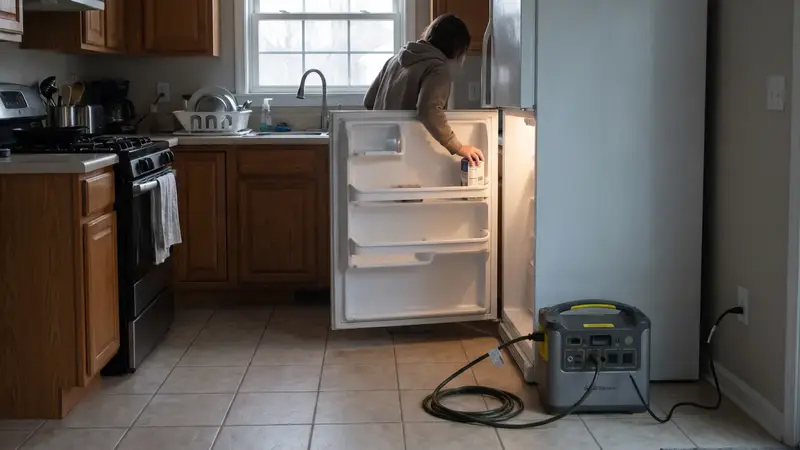
Refrigerator. Over a day the average is far below the nameplate because it cycles: DOE says refrigerators "actually cycle on and off as needed to maintain interior temperatures," and to estimate running hours "divide the total time the refrigerator is plugged in by three." Energy Star's certified full-size refrigerators run from about 297 kWh a year at the 10th percentile to a federal maximum near 739 kWh, which is 34 to 84 watts on average, our division. On our formula a 1,000 watt-hour station gives about 8 to 17 hours and a 2,000 watt-hour station about 16 to 35 hours. Full working in will a power station run my refrigerator.
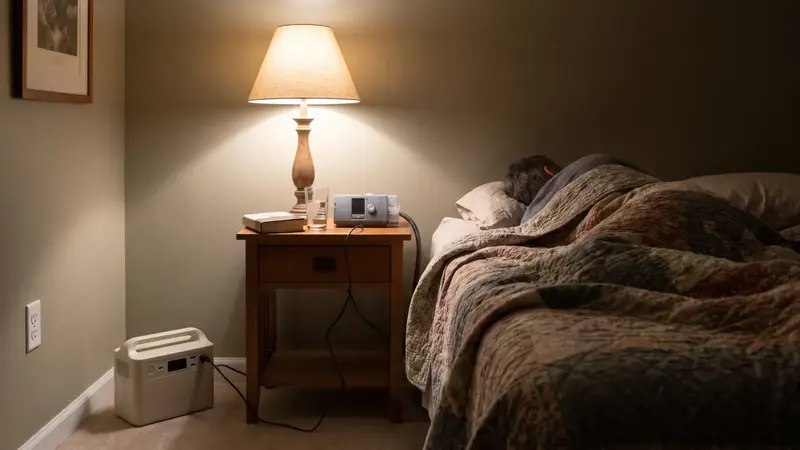
CPAP. ResMed's battery guide lists the AirSense 10 with SlimLine tubing and no humidifier at 0.70 to 1.66 amps at 12V DC across its pressure range, which is 8.4 to 19.9 watts, our multiplication. On our formula that is roughly 25 to 55 hours from 1,000 watt-hours, or several nights. Add the heated humidifier and heated tube and ResMed's figures rise to 4.71 to 5.61 amps, 56 to 67 watts, which cuts a 1,000 watt-hour station to roughly 10 to 12 hours. Our CPAP guide and the CPAP runtime page have the detail, and the CPAP battery comparison covers purpose-built packs.
Gas furnace blower. DTE Energy lists a central furnace fan at 450 watts (1/3 HP) or 600 watts (1/2 HP) with a starting factor of 3. A 2,000 watt-hour station runs it about 2½ to 3⅓ hours nonstop by our arithmetic, longer in practice because the blower cycles. The furnace is hard-wired, so this needs an electrician-fitted transfer switch or inlet: see can a power station run a gas furnace.
Heat and cooking. DTE lists a space heater at 500 to 1,500 watts and a microwave at 600 to 1,500 watts; Champion's chart gives a microwave 800 running and 2,000 starting watts. A 1,000 watt-hour station runs a 1,500 watt heater for about half an hour and a 2,000 watt-hour station for about an hour, our arithmetic. That is why power stations are for keeping food cold, breathing machines running and phones charged, not for heating a room. For warmth, see stay warm without power.
The small loads. Netgear's energy disclosure puts its cable modem routers at about 10.6 to 18.1 watts idle, so Wi-Fi runs about 8 hours on a 300 watt-hour station and all day on 1,000 by our formula. Energy Star's 60-watt-equivalent LED bulbs draw 7.5 to 10 watts each, and a rechargeable LED lantern saves the station entirely. Phones and a weather radio are a few watts; a power bank covers them without a station at all.
Three sizes, mapped to real outages
About 300 watt-hours, 300 watts. Phones, a tablet, a few lights, the Wi-Fi for an evening, a weather radio. It will not start a refrigerator. This is the size for a household whose outages are the few-hour kind that EIA's data says are typical: interruptions not caused by major events "routinely average about two hours per year." A large power bank does most of this job for less.
About 1,000 watt-hours, 1,800 watts. The first size that runs a refrigerator, for roughly 8 to 17 hours, and a CPAP without a humidifier for several nights. It is the sensible size for a household that wants one unit for the fridge, the medical device and the phones through a day-long storm outage. Most of the stations in our power station comparison sit here.
About 2,000 watt-hours, 2,000 watts and up. A refrigerator for a day or more, a CPAP with humidifier for several nights, a furnace blower for an evening once it is wired, or a chest freezer alongside the fridge. Past this, think about whether you are really sizing for days: EIA's 2024 data says major events such as hurricanes Beryl, Helene and Milton were 80% of the hours without electricity, and South Carolina customers averaged nearly 53 hours. Days of outage are generator or home backup battery territory, with solar panels to recharge; see power station vs generator and how long does a power outage last.
Whatever the size, the station needs to be charged when the lights go out. Keep it topped up and plugged in if the manual allows, and recharge it between uses: a station that sat at 20% in a closet since last winter is a 200 watt-hour station. Check the manual for the auto-off setting too, since many stations switch the outlets off when the load stays small, which can cut a CPAP in the night.
What a power station will not do, and when not to buy one
It will not heat the house. It will not run a 240-volt well pump, central air conditioner, electric range or electric water heater. It will not power the furnace, a hard-wired sump pump or anything else on the house wiring without an electrician-fitted transfer switch: OSHA says never to attach a generator to a building's electrical system "unless a qualified electrician has properly installed the generator with a transfer switch," and CPSC's warning against backfeeding through a wall outlet applies to a battery station just as it does to a gasoline generator.
You may not need it for the refrigerator at all. CDC: "Your refrigerator will keep food safe for up to 4 hours without power if you don't open the door," and "a full freezer will keep food safe for 48 hours (24 hours if half-full) without power if you don't open the door." For the few-hour outage, a closed door and a thermometer cost nothing. Our power outage kit preset lists what Ready.gov actually asks for, and our power outage tracker shows what is out right now.
Most US outages are over in a couple of hours, and for many households the whole realistic need, phones, a light, the Wi-Fi for a while, is covered by a power bank and a flashlight. A big station bought just in case mostly sits in a closet losing charge. Buy a station when the arithmetic above says you need one: a refrigerator through a day-long outage, a CPAP every night of a storm, or a furnace you have had wired for it. Otherwise, keep the money, and put a fraction of it into the medical needs kit preset or a weather radio instead.
Common questions
How long will a 1,000 watt-hour power station run a refrigerator?
About 8 to 17 hours for a full-size refrigerator, using Energy Star's 34 to 84 watt average range and our runtime tool's formula (90% usable capacity, 85% inverter efficiency, 10 watts for the station). Your own fridge may differ; a plug-in energy meter gives the real figure.
What size power station do I need for a CPAP overnight?
Without a humidifier, ResMed's figures put the AirSense 10 at about 8 to 20 watts, so even a 300 watt-hour station covers a night and a 1,000 watt-hour station several nights. With the heated humidifier and tube, ResMed's figures reach 56 to 67 watts, about 10 to 12 hours from 1,000 watt-hours. Use the maker's DC cord and turn off the station's auto-off setting.
Is the watt-hour figure on the box what I actually get?
No. Our planning rule is 90% usable capacity and 85% inverter efficiency, less about 10 watts for the station itself, so a 1,000 watt-hour station delivers roughly 765 watt-hours through the AC outlets. Makers' figures differ, and cold weather and heavy loads reduce it further.
Will a power station run a space heater?
Briefly. DTE Energy lists a space heater at 500 to 1,500 watts; on high, a 1,000 watt-hour station runs one for about half an hour and a 2,000 watt-hour station for about an hour by our arithmetic. For warmth in an outage, layers, blankets and a closed-off room do more, and CPSC's heater safety rules still apply.
Can a power station run my furnace or sump pump?
Electrically, often yes: DTE lists a furnace fan at 450 to 600 watts and a 1/2 HP sump pump at 1,000 running and 3,000 starting watts. But both are usually wired in, so they need a transfer switch installed by a qualified electrician, per OSHA and the Red Cross. Never backfeed through a wall outlet.
Should I just buy the biggest one to be safe?
Only if the arithmetic says so. Capacity you never use is money lost to depreciation, and a very large station is heavy to move and slow to recharge. Size for the loads you have listed and the outage length EIA's data suggests for your state, and go bigger only for a medical need or a history of multi-day outages.
Sources (13)
- Department of Energy: Estimating appliance and home electronic energy use
- Energy Star: Certified residential refrigerators (data)
- Energy Star: Connected light bulbs (data)
- DTE Energy: Appliance usage guide and GenerLink worksheet (PDF)
- Champion Power Equipment: Generator wattage chart (PDF)
- ResMed: Battery guide (PDF)
- Netgear: Small network equipment energy information (PDF)
- American Red Cross: Safe generator use
- CDC: What to do to protect yourself during a power outage
- CPSC: Portable generators safety alert (PDF)
- OSHA: Using portable generators safely (OSHA 3286, PDF)
- Ready.gov: Power outages
- EIA: Major events drove longer US power interruptions in 2024 (Today in Energy)
Get one calm email when it matters
Seasonal checklists and gear price drops. No spam, unsubscribe any time.
Keep reading
 Will a portable power station run my refrigerator? Watts, surge and hours, explainedWill a portable power station run your refrigerator? How fridge wattage works at 120V, why starting surge matt…
 Power station for a CPAP: how many watts you need and what to ask firstWhat a CPAP draws, from ResMed and Philips manuals, how to size a portable power station for a night, and the …Can a power station run a gas furnace? Blower watts, the transfer switch and the electricianA gas furnace needs 120V for its blower and controls. What it draws, how long a 1,000 or 2,000 Wh station runs…
 Power station vs generator: which one suits your home in an outage?A portable power station is a battery; a generator burns fuel. What that means for carbon monoxide, fuel stora…