Will the US power grid go down in 2026? What NERC, FERC, EIA and DOE actually say
Will the power grid go down in 2026? None of the agencies we checked forecasts a nationwide blackout. NERC's risk is regional, in extreme cold. What to plan for.
By Tom Calder · Updated November 2, 2026 · Sourced to NERC, FERC, EIA, the Department of Energy and Ready.gov
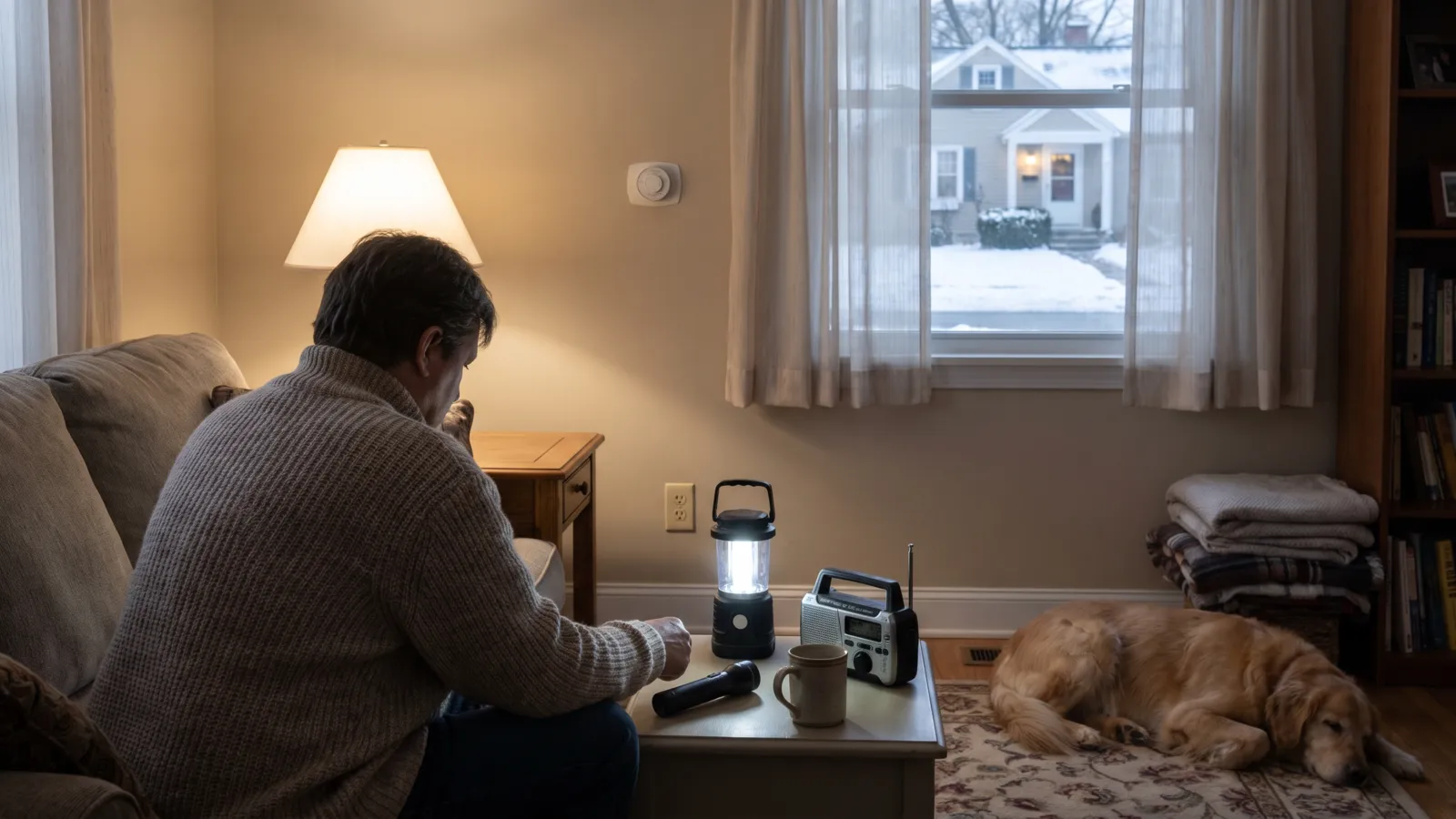
“The US power grid will go down in 2026 and a nationwide blackout is coming”
No agency forecasts it. NERC's risk is regional, in extreme cold.
- Searches for "when is the blackout going to happen 2026" and "will the power grid go down in 2026" have no official source behind them. We checked NERC, FERC, EIA and the Department of Energy. None of them forecasts a nationwide blackout.
- NERC's latest Winter Reliability Assessment (2025-2026, dated November 2025) found "adequate resources for normal winter peak-load conditions" in every area, and warned that "more extreme winter conditions extending over a wide area could result in electricity supply shortfalls." The 2026-2027 edition was not published as of November 3, 2026.
- The lower 48 states run on three mostly separate grids. The largest US blackout on record, in August 2003, reached about 50 million people and stayed regional. The February 2021 Texas freeze cut power to more than 4.5 million people.
- Last winter, extreme cold stressed parts of the Eastern and Texas grids and DOE issued emergency orders to ERCOT, PJM and other grid operators. NERC's statement on a joint FERC and NERC review says it found improved performance with no significant disruption, and that extreme cold "continues to challenge both systems."
- Plan for a regional outage of a few days, which is what happens. Ready.gov's list, sized to your home, is in our power outage kit builder.
The three things most homes are missing
Our top pick from each comparisonIf you already have these, you're most of the way there. As an Amazon Associate, PreparedStates earns from qualifying purchases. We may earn a commission when you buy through our links. When two products are close, commission can decide which one we pick. A clearly better product always wins.
Where the 2026 blackout idea comes from
There is no date, warning or forecast for a US blackout in 2026 from any federal body. The searches seem to mix several real documents that say something narrower: the Pentagon's plan for military bases to run without the civilian grid, which we checked in Is a 90-day blackout coming?; a Department of Energy report that models outage risk in 2030 under a retirement scenario; and NERC's seasonal reliability assessments, which name regions at elevated risk in extreme weather. None of them says the grid will go down this year.
The grid bodies to listen to are NERC, the North American Electric Reliability Corporation, which EIA says "develops and enforces mandatory grid reliability standards, which are approved by the Federal Energy Regulatory Commission (FERC)"; FERC itself; EIA, the government's energy statistics agency; and DOE, which can order plants to keep running in an emergency. Below is what each one has published, in its own words.
What NERC's winter assessment says, region by region
NERC publishes a Winter Reliability Assessment each November covering December through February. As of November 3, 2026, the 2026-2027 edition had not appeared on NERC's assessments page, so the latest is the 2025-2026 report, dated November 2025. We will update this page when the new one is out. Read its figures as last winter's assessment, not a forecast for this winter.
Its first key finding: "All areas are assessed as having adequate resources for normal winter peak-load conditions." Then the caveat: "more extreme winter conditions extending over a wide area could result in electricity supply shortfalls." NERC also reported that aggregate peak demand had risen by 20 GW (2.5%) since the previous winter, with data centers a driver in several areas, and counted four severe arctic storms since 2021.
Texas: NERC said Texas RE-ERCOT was "expected to continue facing reserve shortage risks during the peak load hour" in extreme cold, while expecting "sufficient operating reserves for the peak hour" in a normal winter, with a 36% anticipated reserve margin. ERCOT's own analysis, as reported by NERC, put the probability of an energy emergency alert on the January peak day at 2% and of controlled load shed at 1.8%.
The interior West: for WECC-Basin, which NERC says "includes Utah, southern Idaho, and a portion of western Wyoming," NERC's assessment says that under an extreme combination of generator derates and outages "the region could be short 1.6 GW before imports," and that "External assistance may not be available during region-wide extreme winter conditions." FERC staff's summary of NERC's analysis also lists WECC-NW, which FERC says covers Montana, Washington, Oregon and the northern parts of Idaho and California, among the areas that may face a higher likelihood of tight supply in extreme conditions.
The full list of areas with a higher chance of trouble in extreme conditions is best taken from FERC staff's winter assessment, published in November 2025, which summarizes NERC's analysis: all areas "anticipate adequate supplies and reserve margins under normal conditions, but ERCOT, NPCC-NE, SERC-East, SERC-Central, WECC-Basin, and WECC-NW may face a higher likelihood of tight supply and reliability issues during extreme conditions." That is Texas, New England, parts of the Southeast, the Northwest and the Great Basin. PJM, covering the mid-Atlantic and parts of the Midwest, was expected to have "little capacity adequacy risk," and NERC's probabilistic assessment for California found "no EUE or LOLH," meaning no expected unserved energy or loss-of-load hours.
A region on NERC's list is not a region that will lose power. It is a region where, if a prolonged, wide-area cold snap arrives, the operator may have to ask people to conserve, or in the worst case cut power to some customers in rotation to protect the rest of the system. A region not on the list is not guaranteed anything either: most outages come from storms knocking down local lines, which no grid assessment covers.
What happened last winter, and what DOE did
The most recent real test was the arctic cold of January 2026. On January 24, 2026, DOE issued emergency Order No. 202-26-01 under section 202(c) of the Federal Power Act, which "authorizes ERCOT to direct backup generation resources at data centers and other large load customers to operate as a last resort before declaring an Energy Emergency Alert (EEA) 3 or during an EEA 3." On January 25 it issued Order No. 202-26-02 allowing PJM "to run all electric generating units located within the PJM Region and to operate up to their maximum generation output levels, notwithstanding air quality or other permit limitations or fuel shortages." The first orders ran for days, not weeks: ERCOT's expired on January 27, and PJM's was extended on January 29. DOE issued similar orders that week to ISO New England (Order No. 202-26-03, January 25) and the New York ISO (January 26).
FERC, NERC and the regional entities reviewed that winter in a joint staff report released September 10, 2026. NERC's statement on it says: "Last winter, extreme cold snaps persisted over extended days in parts of the Eastern and Texas Interconnections, precipitating significant operational stress on the electric and gas systems that requires deliberate attention." It also says the report "finds laudable improved performance while noting that extreme cold continues to challenge both systems," and "strong system performance with no significant disruption to either system," and credits "new cold weather reliability standards," better coordination, advance fuel procurement and "emergency orders by the Secretary of Energy."
Those cold-weather standards are new. NERC's winter assessment notes that FERC approved EOP-012-3, a generator cold weather standard, effective October 1, 2025. FERC staff describe it as requiring existing generators to begin implementing plans to operate in extreme cold. Cold weather standards were tightened after the February 2021 Texas freeze, when the FERC and NERC report says "More than 4.5 million people in Texas lost power during the Event, and some went without power for as long as four days."
Why no agency forecasts a nationwide blackout
The United States does not have one grid. EIA explains: "The U.S. electric grid in the Lower 48 states has three main interconnections. These interconnections mostly operate independently from each other and rarely transfer electricity among them." They are the Eastern Interconnection, the Western Interconnection and ERCOT, which covers most of Texas. A 2017 DOE assessment, which counts Quebec's grid as a fourth interconnection, put the design this way: it "prevents power loss on one grid from affecting the other three, as the interconnections are electrically independent from each other, except for a few direct current (DC) links."
The links between grids are small. FERC and NERC staff wrote in their 2021 report that "The maximum amount of energy that can be simultaneously imported on all of the ties into ERCOT is 1,220 MW." That is one reason Texas struggled to get help in 2021, and also why a failure in one grid does not spread to the others. Inside each grid, EIA says, the many connected lines and plants give "redundancy" that "helps prevent widespread blackouts if a transmission line or power plant fails."
The record bears that out. The largest blackout in US history by load lost, on August 14, 2003, affected "an area with an estimated 50 million people" across eight states and Ontario, and "power was not restored for 4 days in some parts of the United States." It was severe, and it was regional. The 2021 Texas event ranks third by load lost. Nothing in the official record is nationwide, and NERC's 2026 State of Reliability says the bulk power system "continues to deliver reliable electric service under increasingly challenging conditions."
What NERC, FERC and DOE do warn about is narrower and real: rising demand, generators retiring, and extreme weather. None of that is a forecast of collapse. It is the reason the assessments exist.
What the Department of Energy's 2030 report says, and doesn't
A DOE report released July 7, 2025, is probably behind some of the alarm. DOE's own announcement says: "With projected load growth, retirements increase the risk of power outages by 100 times in 2030," and "Modeling shows annual outage hours could increase from single digits today to more than 800 hours per year." Read the conditions. DOE's scenario is for 2030, and it assumes "104 GW of firm generation" retires "without timely replacement," with only 22 GW of the 209 GW of new generation being firm baseload. It is a modeled warning meant to shape policy. It is not a forecast for 2026, and it does not describe a single nationwide event.
For scale, EIA measures how long the average customer actually went without power. In 2025 it was 262.6 minutes across the whole year including major events, about 4.4 hours (our arithmetic), and 120.8 minutes without them. In 2024 it was 611.3 minutes, roughly 10 hours. Those averages hide the people who lose power for days after a storm, which is why the plan below is sized for days, not hours.
What to plan for at home
Plan for the outage that happens: a regional one, in a storm or a cold snap, lasting hours to a few days. Ready.gov's Build a Kit page says: "Being prepared means having your own food, water and other supplies to last for several days." Our power outage kit builder sizes that list to your household, and the power outage checklist covers what to do before, during and after. If you want to go further than a few days, the 90-day home plan is a step-by-step version, not a shopping spree.
Ready.gov's power outage page lists the basics: "Have enough nonperishable food and water. Keep freezers and refrigerators closed." And: "Plan for batteries and other alternative power sources to meet your needs when the power goes out, such as a portable charger or power bank." Ready.gov's Build a Kit list adds "flashlights for every household member" and a "Battery-powered or hand crank radio" for alerts when the internet is down.
Carbon monoxide is one of the main dangers in a winter outage. Ready.gov says: "Generators and fuel should always be used outdoors and at least 20 feet away from windows, doors and attached garages." And: "Never use a gas stovetop or oven to heat your home." It also says: "Install carbon monoxide detectors with battery backup in central locations on every level of your home." Our stay warm without power and generator safety guides go through heating and generators in detail.
If your utility asks you to cut back during a cold snap, do it. NERC's winter assessment recommends amplifying "public appeals for electricity and natural gas conservation" in extreme cold. Lower demand on a tight evening is, in our view, the simplest thing a household can contribute. Check live outages and alerts for your area on our power outage map and state pages.
We will update this check when NERC publishes its 2026-2027 Winter Reliability Assessment, if FERC or DOE issues a warning aimed at the public, or if Ready.gov changes its advice for households. A new emergency order for a region, or a cold-weather conservation appeal, would go on our alerts and state pages rather than here.
Common questions
When is the blackout going to happen in 2026?
There is no scheduled or forecast blackout. No federal agency has given a date, because none has predicted one. NERC's winter assessment names regions at higher risk of supply shortfalls if extreme cold spreads over a wide area, which is a risk assessment, not a prediction of when or whether it happens.
Will the power grid go down in 2026?
No agency we checked forecasts it. NERC found every area adequate for a normal winter peak and warned about prolonged, wide-area extreme cold. DOE's July 2025 report models rising outage hours in 2030 under a retirement scenario, not a 2026 event. Local and regional outages will happen, as they do every year; EIA's 2025 US average is 262.6 minutes without power across the whole year, about 4.4 hours.
Is a 'great blackout' coming in 2026?
We found no official source for a 'great blackout' of 2026. The lower 48 run on three mostly independent grids, and even the largest US blackout, in August 2003, stayed regional at about 50 million people. If you have seen a specific claim with a date, look for the agency behind it. NERC, FERC, EIA and DOE have not issued one.
Is the US preparing for a blackout?
The US prepares for outages all the time, which is different from expecting a nationwide one. FERC approved a generator cold weather standard, EOP-012-3, effective October 1, 2025. DOE has issued emergency orders under section 202(c) of the Federal Power Act to keep plants available and, in January 2026, to let PJM run all its generating units at maximum output and to let ERCOT call on backup generators at data centers as a last resort. The Pentagon's FORTRESS plan is for military bases, and we checked it separately.
Which parts of the country are most at risk this winter?
The 2026-2027 assessment was not out as of November 3, 2026. In last winter's, FERC staff's summary of NERC's analysis listed ERCOT (Texas), NPCC-NE (New England), SERC-East, SERC-Central, WECC-Basin (Utah, southern Idaho, western Wyoming) and WECC-NW as areas that may face a higher likelihood of tight supply during extreme conditions. Every area was assessed adequate for a normal winter.
How long should I plan to be without power?
Ready.gov says to have food, water and supplies to last for several days. That covers the regional storm and cold-snap outages that actually happen, including the few days some Texans went without power in February 2021. Our power outage kit builder sizes Ready.gov's list to your household, and none of the agencies we checked asks households to prepare for months.
Sources (13)
- NERC: 2025-2026 Winter Reliability Assessment (PDF, November 2025)
- NERC: Statement on 2026 Cold Weather Performance Review (Sept 11, 2026)
- NERC: 2026 State of Reliability overview (PDF)
- FERC staff: Winter Energy Market and Electric Reliability Assessment 2025-2026 (PDF, November 2025)
- FERC and NERC: February 2021 cold weather event report (PDF)
- EIA: Delivery to consumers (Energy Explained)
- EIA: Electric Power Annual, Table 11.3 reliability metrics (2025 and 2024)
- Department of Energy: Report on Evaluating US Grid Reliability and Security (July 7, 2025)
- Department of Energy: 2026 DOE 202(c) orders
- Department of Energy: Assessment of electricity disruption incident response capabilities (2017)
- US-Canada Power System Outage Task Force: August 2003 blackout final report (PDF, hosted by NERC)
- Ready.gov: Power Outages
- Ready.gov: Build a Kit
Get one calm email when it matters
Seasonal checklists and gear price drops. No spam, unsubscribe any time.
Keep reading
 Is a 90-day blackout coming? What the Pentagon's plan for bases means for your homeIs a 90-day blackout coming? No agency has warned of one. The 90 days is a Pentagon target for bases to run wi…
 Power outage checklist: what to do before, during and afterA calm power outage checklist from Ready.gov and CDC: what to prepare, how to protect food, medicines and medi…
 Will the US power grid fail this winter? What NERC's winter assessment says, by regionWill the US power grid fail this winter? What NERC's latest winter assessment says for ERCOT, PJM, California …
 Could a national blackout happen in the US? How the three grids workCould the whole US lose power at once? The country runs on three mostly separate grids, with NERC setting stan…