Work out what your home really needs to power. Then choose the battery, generator or standby system that fits.
A guide that starts with what you'd lose in an outage, not with equipment: a worksheet for your watts, what the makers' own manuals say about power stations and generators, the carbon monoxide rules in full, the three safe ways to connect to the house, and a power plan sheet with a test schedule. It recommends no brands.
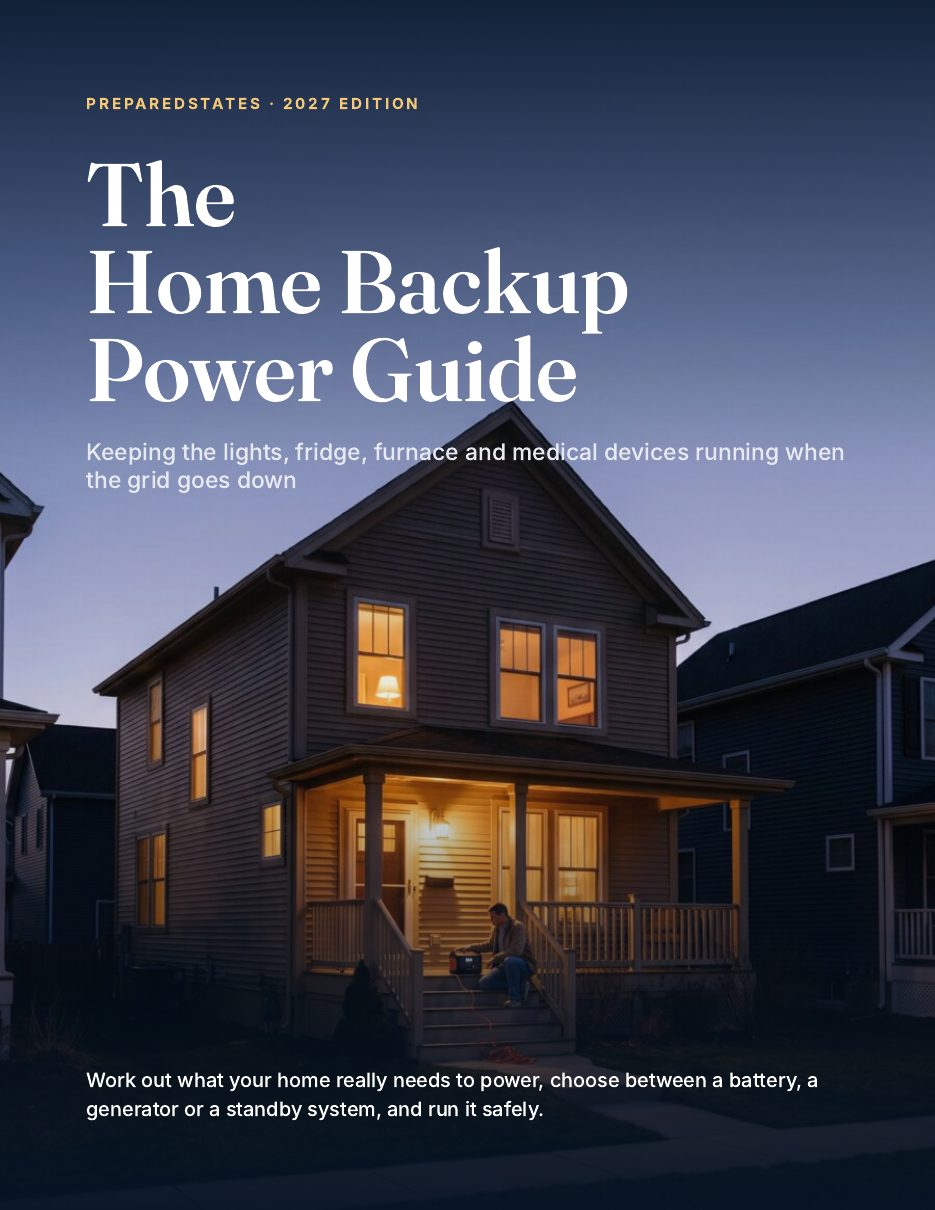
- Instant PDF download
- 105 pages
- Print it for your household
- 9 chapters across 105 pages, each opening with a five-step "Do this first" box
- A load worksheet that turns your list into running watts, starting watts and watt-hours a day
- The carbon monoxide rules on one page, to copy and keep with the generator
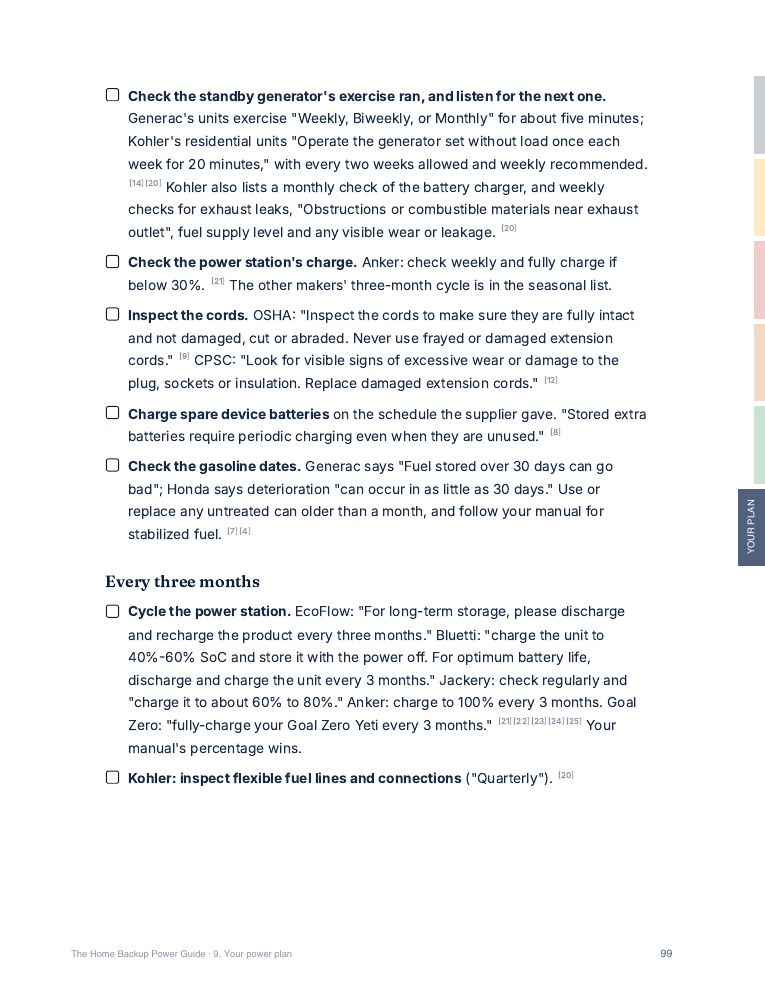
- A power plan sheet and a test schedule: monthly, every three months, at the clock change and yearly
Secure card payment by Stripe, in US dollars. You can download it as soon as you pay. By buying you agree to our terms of sale, including that digital downloads can't be returned.
- Instant PDF download
- 105 pages
- Print it for your household
Most people start by shopping. This book starts with what you'd miss.
"Backup power is a decision about what matters in your home, not a decision about equipment." That's the book's first line. People who start with a generator or a battery end up with something too small for the furnace, too big for the budget, or sitting in the garage without a cord that reaches the fridge.
The guide begins with how long US outages really last, from the Energy Information Administration's own figures: in 2024 the average customer was without power for 11 hours, and major events accounted for 80 percent of those hours. Then it sorts your home's loads into four groups, from medical devices and refrigerated medicines down to comfort, and turns the list into watts.
Only then does it turn to equipment: portable power stations, portable generators, cords, transfer switches and interlock kits, standby generators and home batteries, with the makers' own manuals quoted and no brand recommended. And it says plainly when a few flashlights, a power bank and a stocked pantry are the right size of plan.
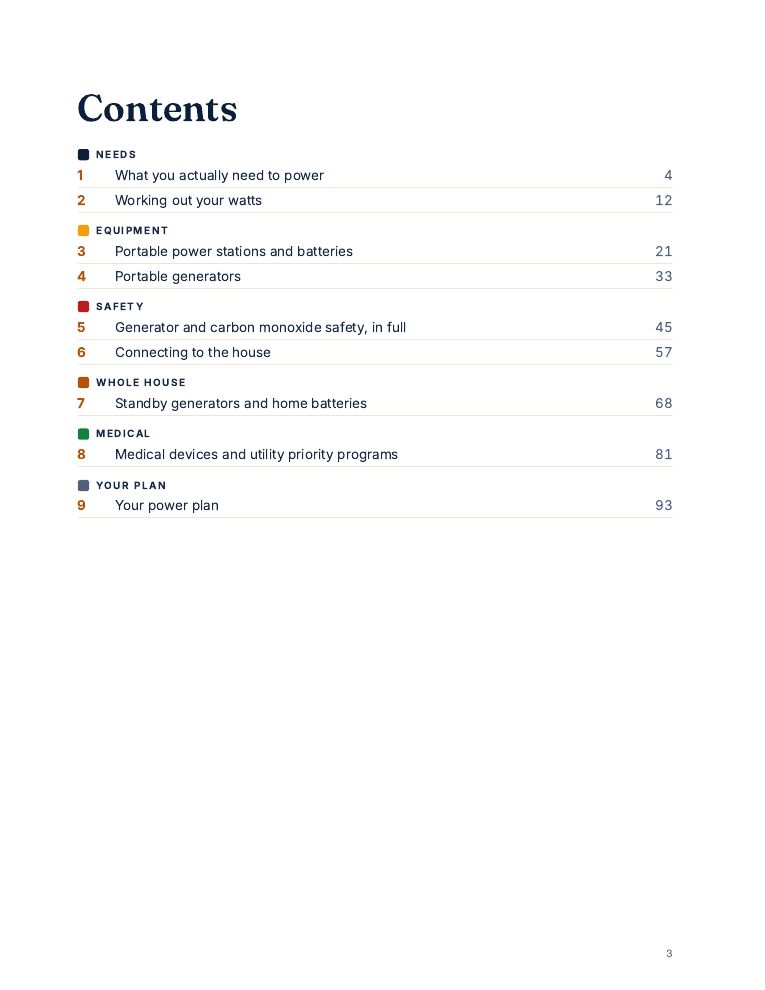
What's inside, chapter by chapter
9 chapters across 105 pages. Every chapter opens with a five-step "Do this first" box and ends with its numbered sources.
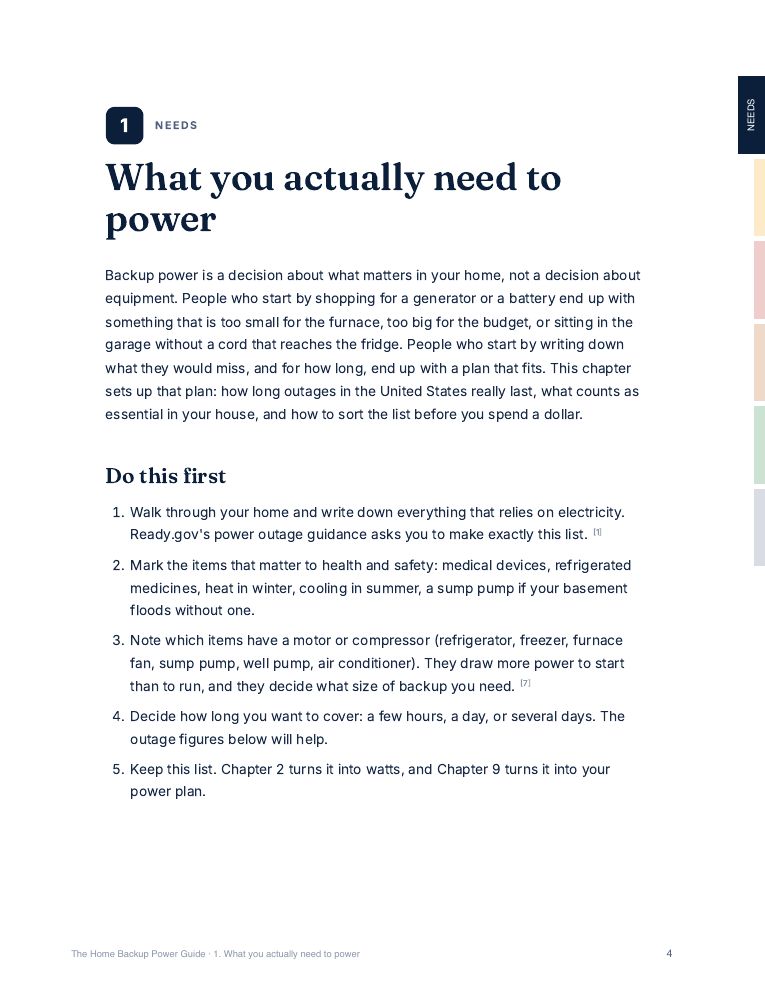
What you actually need to power
- How long US outages really last, from the EIA's 2024 and 2025 figures
- Sort your list into four groups: health, food, comfort, other
- The FDA's food rules while you decide: about 4 hours for a refrigerator, about 48 for a full freezer
Working out your watts
- Watts and watt-hours: the two numbers that matter
- Running watts and starting watts, and why anything with a motor decides the size
- The load worksheet, a worked example, and how propane and natural gas cut the output
Portable power stations and batteries
- The two numbers on the box, and what a power station cannot do
- Heat, cold, storage and charging, from four makers' manuals
- Lithium battery safety at home, disposal, flying, and an 8-point buying checklist
Portable generators
- Inverter or conventional, dual fuel and propane
- Where it runs, the CO shut-off feature, and storing and handling fuel
- Cords, grounding, rain, and a checklist for before the first outage
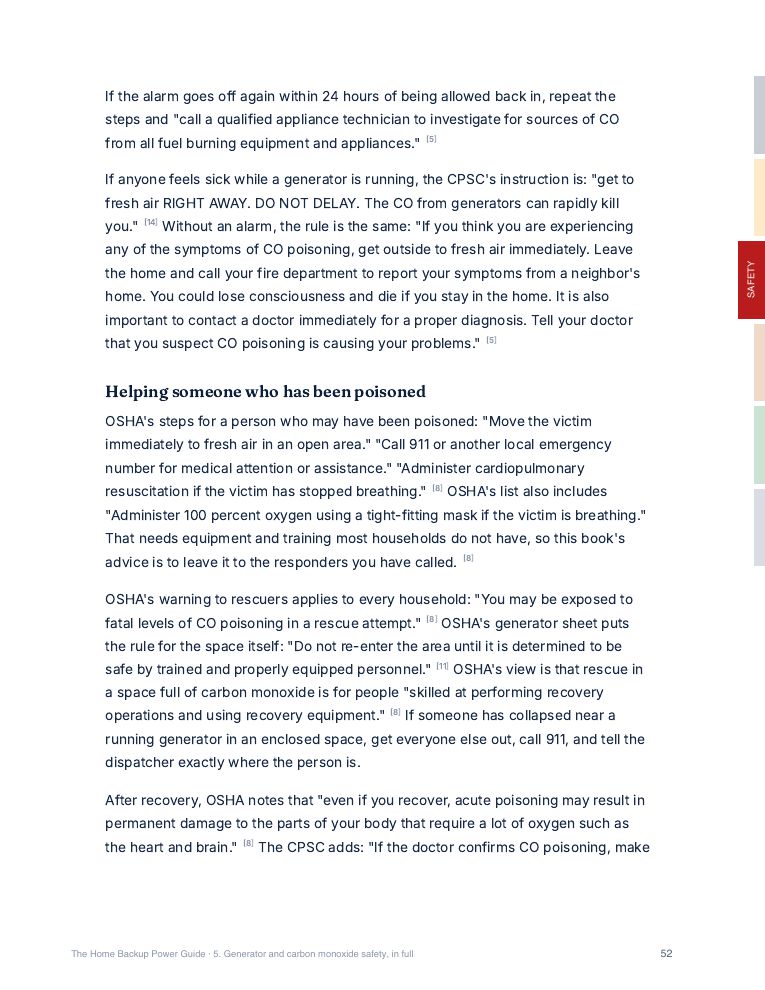
Generator and carbon monoxide safety, in full
- What CO is, who is most at risk, and the CPSC's and CDC's figures
- Where a generator may run, CO alarms, and what the numbers on them mean
- What to do when the alarm sounds, and the rules on one page
Connecting to the house
- Why backfeeding is never an option, in the CPSC's and OSHA's words
- Extension cords, a manual transfer switch or an interlock kit: what each can run and who installs it
- Permits, grounding, and what to have ready before you call the electrician
Standby generators and home batteries
- What each does, what it covers and where it goes
- Why solar panels alone won't power the house in an outage, from the Department of Energy
- Exercise and maintenance, and seven questions before you sign
Medical devices and utility priority programs
- The plan starts with the clinician and the supplier
- Device by device: breathing machines, oxygen, dialysis, wheelchairs, pumps, and refrigerated medicines
- What utility medical programs do and don't promise, and a device plan sheet
Your power plan
- What we will run, what we have, fuel and batteries on hand, how we connect, who we call
- The carbon monoxide rules, in your own hand
- A test schedule: monthly, every three months, at the clock change, yearly, and every outage
Look inside
Real pages from the book. Swipe for more, tapClick any page to see it full size.
Secure card payment by Stripe, in US dollars. You can download it as soon as you pay. By buying you agree to our terms of sale, including that digital downloads can't be returned.
Who it's for
It's for you if
- You're deciding between a power station, a portable generator and a standby system, and want the decision made on your own home's numbers
- Someone in your home relies on a plug-in medical device or refrigerated medicine
- You have a well pump, a sump pump, a freezer full of food or a furnace that won't run without power
- You already own a generator and want the safety rules and a test schedule in one place
Honestly, you can skip it if
- You want the book to pick a model. It recommends no brands and gives no prices
- You want wiring instructions. For a transfer switch or an interlock it says what every source says: a licensed electrician, with a permit
- Your list has nothing medical, no sump pump, no heat and no freezer. The book says a few flashlights, a power bank and a stocked pantry are the right size of plan, and it's fine to take that advice and stop
Built on official sources, not opinions
- Every figure names its source, and each chapter ends with a numbered list of them: 153 source lines across nine chapters.
- Where the book quotes a manual or a datasheet, it names the maker and model so you can check it, and says the figures show the shape of the product, not a recommendation.
- Where no agency gives a number (appliance wattages for sizing, how much gasoline you may store, generator noise), the book says so instead of inventing one.
From the team behind PreparedStates's free live trackers for power outages, NWS alerts, hurricanes and wildfires, built on the same public data and the same rule: every figure names its source. PreparedStates is independent and not affiliated with the US government.
The Household Set: $39.99 for all three
The binder holds your household's information, the power guide decides what you'd run and how, and the pantry plan builds the food store. Bought separately they come to $49.97 (The Family Emergency Binder $14.99 + The Home Backup Power Guide $14.99 + The Long-Term Food Storage and Pantry Plan $19.99). Together, $39.99, as one download.
Secure card payment by Stripe, in US dollars. You can download it as soon as you pay. By buying you agree to our terms of sale, including that digital downloads can't be returned.
Questions
Does it tell me which generator or power station to buy?+
No. It quotes the makers' own manuals for named models so you can see what the numbers mean, and gives an 8-point checklist for choosing a power station and a 7-point one for a generator. No brand is recommended, and there are no prices.
Is it only for people with a generator?+
No. Chapters 1 and 2 are for every home: what you'd miss, for how long, and in watts. Chapter 3 covers the portable power station most people actually buy. And the book says plainly when a few flashlights, a power bank and a stocked pantry are the right size of plan.
Does it cover medical devices?+
Chapter 8 does: the plan with your clinician and supplier, device-by-device notes, refrigerated medicines, and what utility medical programs do and don't promise. It gives no wattage figure for a CPAP or an oxygen concentrator, because the right one is the one for your model.
What format is it?+
A PDF, on Letter-size pages. It opens in the PDF viewer that's already on your phone, tablet or computer: iPhone, iPad, Android, Mac, Windows or Chromebook. No app, no account, nothing to install.
How does the download work?+
As soon as Stripe confirms your payment, the page you land on gives you your downloads and a personal link to them that works for at least a year. If you lose it, email us from the address you paid with and we'll send it again.
Can I print it?+
Yes, and we'd encourage it: paper still works when the power and the phone are out. Your license lets you print as many copies as your household needs, and give a printed copy to family who'd be helping you in an emergency.
Can I get a refund?+
Because the files are digital downloads you can keep as soon as you've paid, all sales are final and we don't give refunds for a change of mind. If a file won't download or open, or something in it is wrong, email us within 30 days of buying: we'll fix it, send a working copy, or refund you in full. If you were charged twice by mistake, we'll refund the extra charge.
Is it a subscription?+
No. You pay once, and the file is yours to keep. There's nothing to cancel.
Is it medical or safety advice for my situation?+
No. It's general information built on official US guidance. It doesn't replace your doctor, your pharmacist, or instructions from emergency services and your state or local emergency management office. In an emergency, call 911.
Start with the list, not the shopping.
The Home Backup Power Guide. Instant PDF download, paid once, yours to keep.
Secure card payment by Stripe, in US dollars. You can download it as soon as you pay. By buying you agree to our terms of sale, including that digital downloads can't be returned.
The Home Backup Power Guide is general information to help your household prepare. It is not legal, financial or medical advice. Written by Tom Calder for PreparedStates, sold by TMR Digital. PreparedStates is independent and not affiliated with the US government. Terms of sale.