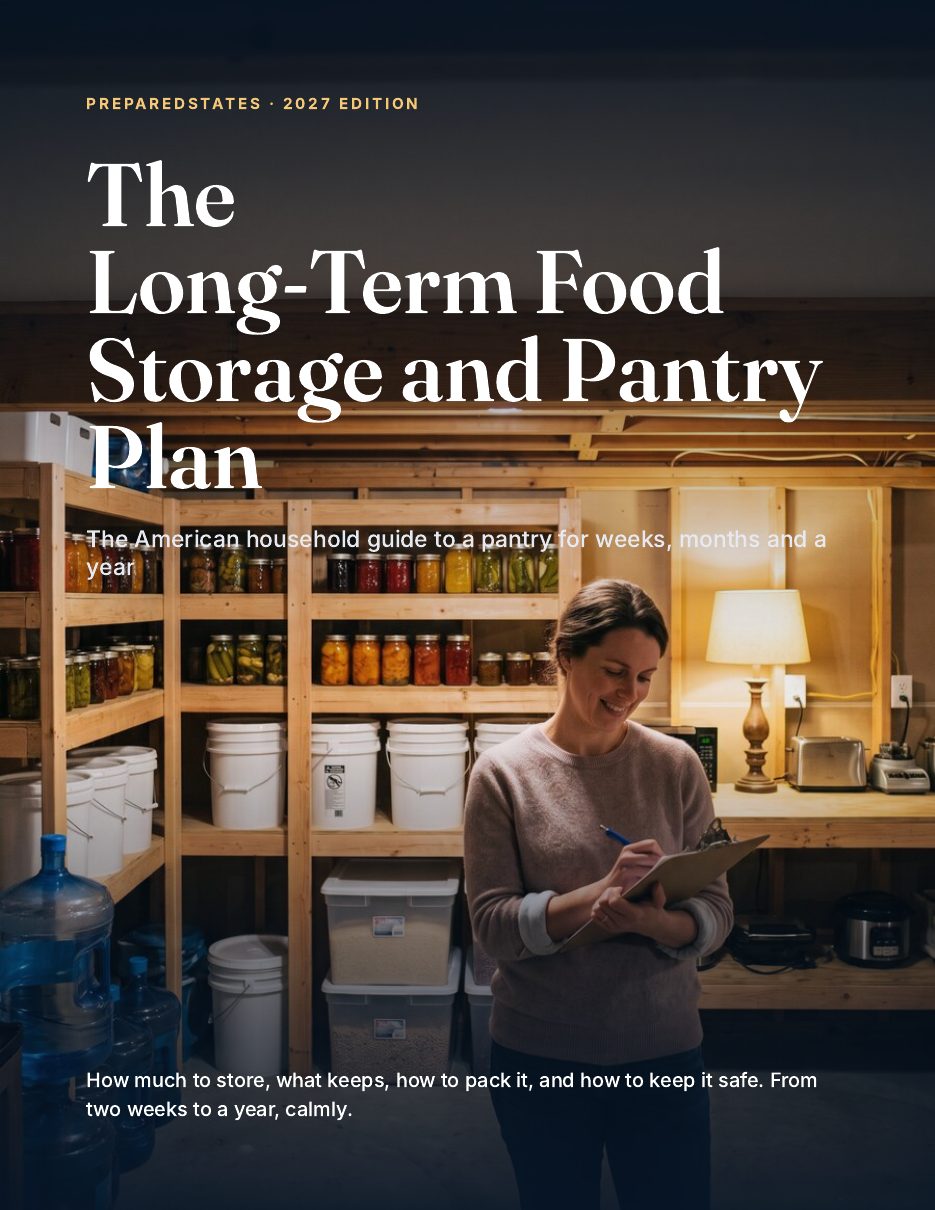
How much to store, what keeps, how to pack it and how to keep it safe. From two weeks to a year, calmly.
A pantry plan in three steps: a two-week supply, three months of the food you already eat, and a longer-term layer of dry staples. The per-person amounts come from the Red Cross, the CDC and university Extension services, scaled to your household, with inventory sheets, a rotation calendar and a month-by-month shopping plan. No brands and no prices.
- Instant PDF download
- 167 pages
- Print it for your household
- 10 chapters across 167 pages, each opening with a five-step "Do this first" box
- Per-person amounts for 1, 3 and 12 months, for one adult and for four, with a worksheet for your own household
- Shelf lives for nine dry staples from Utah State and BYU research, and a step-by-step bucket-and-Mylar method
- Four inventory sheets, a 12-month rotation calendar, a shopping plan by month and a storage map
Secure card payment by Stripe, in US dollars. You can download it as soon as you pay. By buying you agree to our terms of sale, including that digital downloads can't be returned.
- Instant PDF download
- 167 pages
- Print it for your household
The advice stops at two weeks. The pantry doesn't have to.
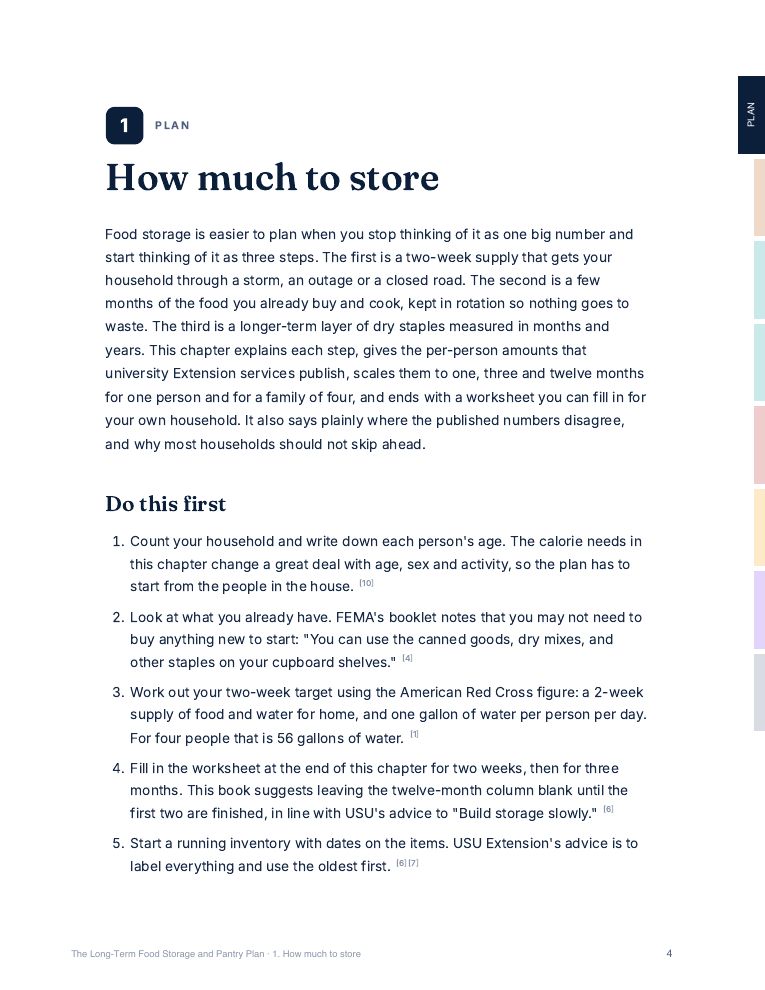
The American Red Cross says to keep a two-week supply of food and water at home, at one gallon of water per person per day. For four people, that's 56 gallons. FEMA's booklet adds that you may not need to buy anything new to start: "You can use the canned goods, dry mixes, and other staples on your cupboard shelves."
Past two weeks, the numbers come from university Extension services and food science research, and they don't all agree. The University of Georgia's list comes to about 700 pounds of staples per adult per year; Utah State's basis is one pound of dry food per person per day. The book shows both, says which it uses where, and never averages them.
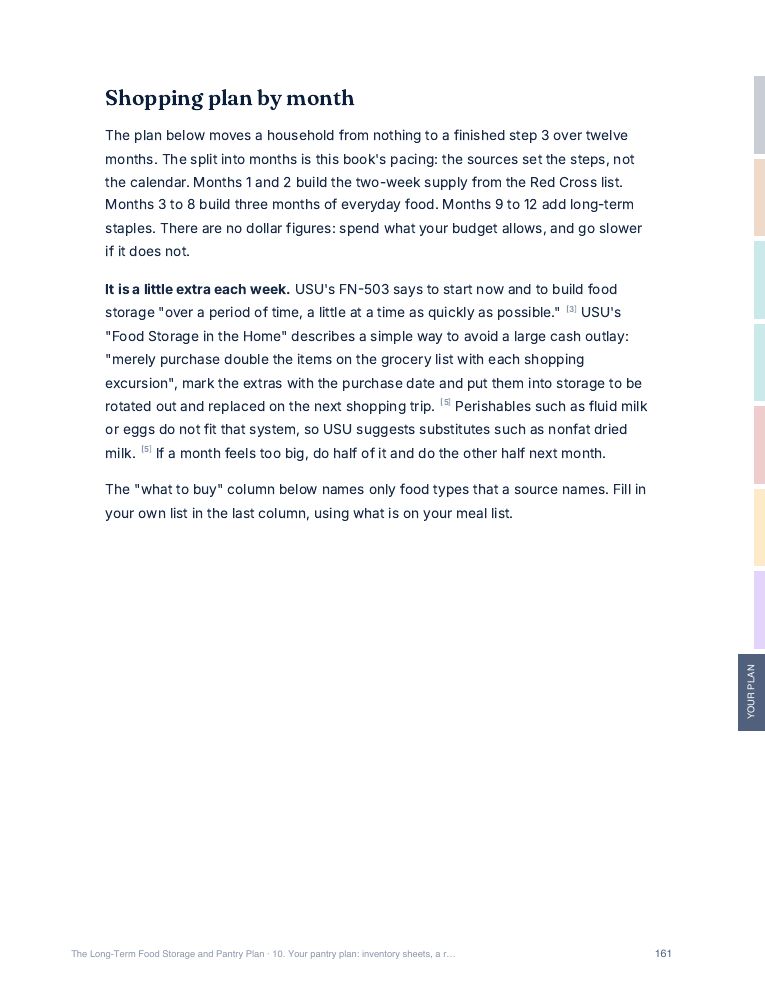
Its three steps are deliberate: finish the two-week supply, then build three months of the food you already eat by buying a little extra each week, and only then add staples by the year. Utah State's own warning is quoted: food that is not a normal part of the diet "will more likely not be used and more likely be wasted."
What's inside, chapter by chapter
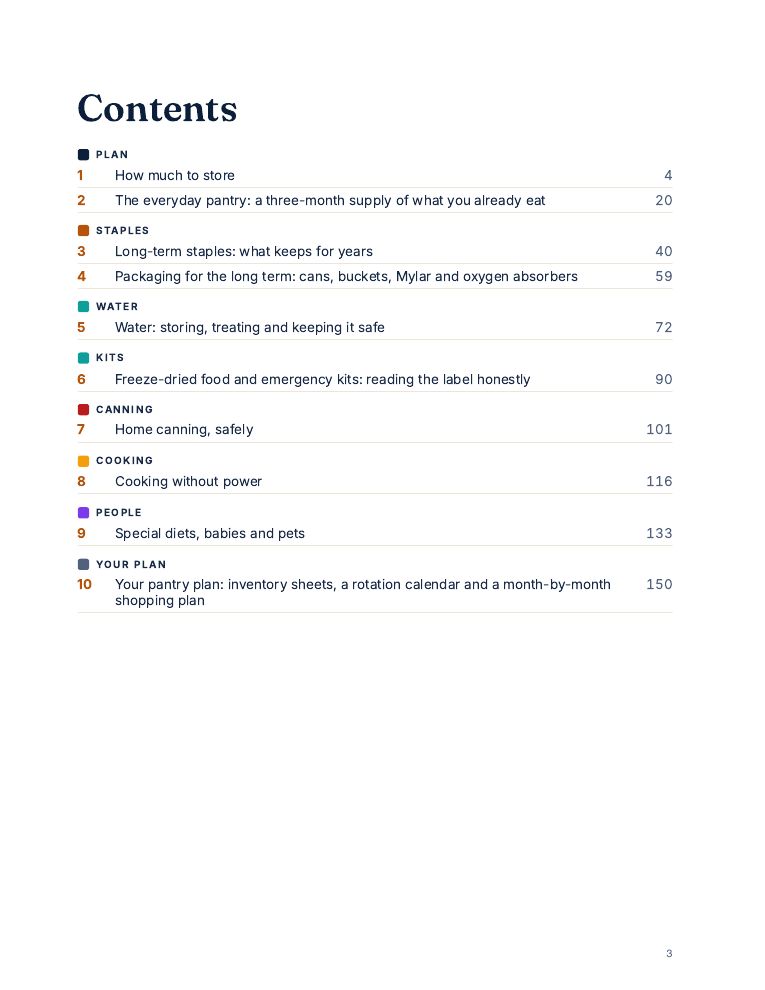
10 chapters across 167 pages. Every chapter opens with a five-step "Do this first" box, carries "honest bit" notes where the sources disagree or run out, and ends with its numbered sources.
How much to store
- The three tiers: two weeks, three months, and staples by the year
- Per-adult amounts from UGA and USU, scaled to 1, 3 and 12 months for one adult and for four
- A calorie reality check from the Dietary Guidelines, and the "how much do we need" worksheet
The everyday pantry: a three-month supply of what you already eat
- Count the meals you actually eat, multiply by 13 weeks, subtract what's on the shelf
- What the USDA says about cans and dates: "best if used by" is not a safety date
- Cool, dry, dark storage, rotation, pests and moisture, and a sample pantry for a family of four
Long-term staples: what keeps for years
- Wheat, white rice, dry beans, rolled oats, nonfat dry milk, sugar and honey, salt, oils, pasta and corn
- Edible is not the same as best quality: the conditions behind the long numbers
- What shortens shelf life, how to cook each staple, and an "our staples" sheet
Packaging for the long term: cans, buckets, Mylar and oxygen absorbers
- #10 cans, food-grade buckets, PETE bottles, foil pouches and glass jars
- Oxygen absorbers: sizes, how many, and the 15-minute clock once a packet is open
- Packing a bucket step by step, what not to pack this way, and a packing log
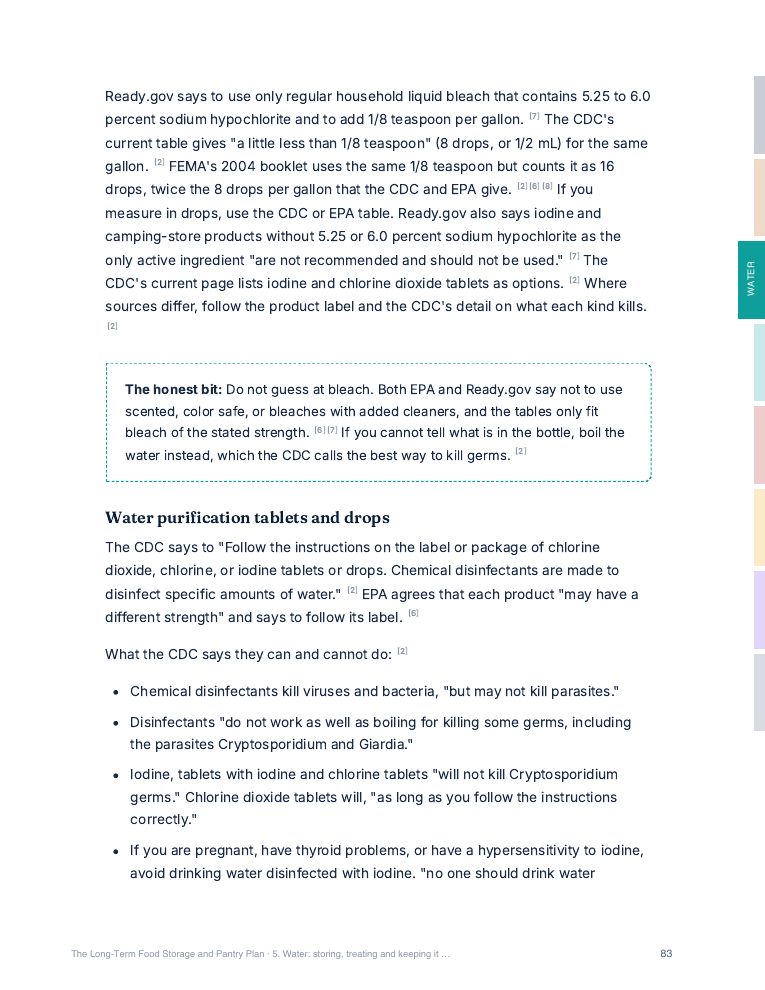
Water: storing, treating and keeping it safe
- How much for 1 to 6 people at 3 days, 2 weeks and a month, and the CDC's six-month replacement rule
- Containers to use and not use, how to sanitize them, and the water already in your home
- Boiling, bleach (with the EPA's and CDC's tables), tablets, filters, and what treatment cannot do
Freeze-dried food and emergency kits: reading the label honestly
- Freeze-dried and dehydrated: the difference, and what freeze-drying doesn't do
- Turning a kit's total calories into real person-days at 2,000 a day
- What "up to 25 years" means, sodium and allergens, and when a kit earns its place
Home canning, safely
- One rule: a tested recipe, followed exactly
- The pH 4.6 line between boiling-water and pressure canning, and the botulism rules from the CDC and the USDA
- Altitude, equipment, methods that are never canning, and a canning log
Cooking without power
- Eat in the right order: about 4 hours for a refrigerator, about 48 for a full freezer
- The carbon monoxide rules, each in its source's own words, and the 20-foot generator distance
- The few official ways to cook, fuel storage, light without flames, and a kit checklist
Special diets, babies and pets
- Formula: three kinds, which to store, and the CDC's water rules for the youngest babies
- Diabetes and insulin storage, kidney disease, food allergies and celiac disease
- Older adults, pets, and a special needs supply sheet
Your pantry plan: inventory sheets, a rotation calendar and a month-by-month shopping plan
- A household sheet and four inventory sheets: everyday pantry, staples, water, special needs
- A 12-month rotation calendar and a shopping plan by month, with no dollar figures
- A storage map, and the 14-point "a finished plan has" checklist
Look inside
Real pages from the book. Swipe for more, tapClick any page to see it full size.
Secure card payment by Stripe, in US dollars. You can download it as soon as you pay. By buying you agree to our terms of sale, including that digital downloads can't be returned.
Who it's for
It's for you if
- You want a pantry you actually eat from, built a little at a time, not a pallet of buckets
- You've done two weeks and want to know what three months, or a year, really takes in pounds and gallons
- You're weighing a freeze-dried kit and want to read its label the way the FDA does
- You want to can at home and want the USDA's rules, not a forum's
Honestly, you can skip it if
- You want brand picks, prices or recipes. There are none
- You want to buy a year of staples this weekend. The book says to finish the first two steps first, and that if a food won't be eaten, "the right number of pounds is zero"
- You want instructions for a home can sealer or for sealing bags with an iron. Its sources don't describe them, so it doesn't either
Built on official sources, not opinions
- Every figure names its source, and each chapter ends with a numbered list of them: 143 source lines across ten chapters.
- Every shelf life comes from Utah State University Extension or Brigham Young University research, not from a product label. Where sources disagree, the book shows both and says which it uses.
- The three-month tier is labeled as the book's own planning step, not an official recommendation, and "up to 25 years" on a freeze-dried meal is called what it is: the manufacturer's claim.
From the team behind PreparedStates's free live trackers for power outages, NWS alerts, hurricanes and wildfires, built on the same public data and the same rule: every figure names its source. PreparedStates is independent and not affiliated with the US government.
The Household Set: $39.99 for all three
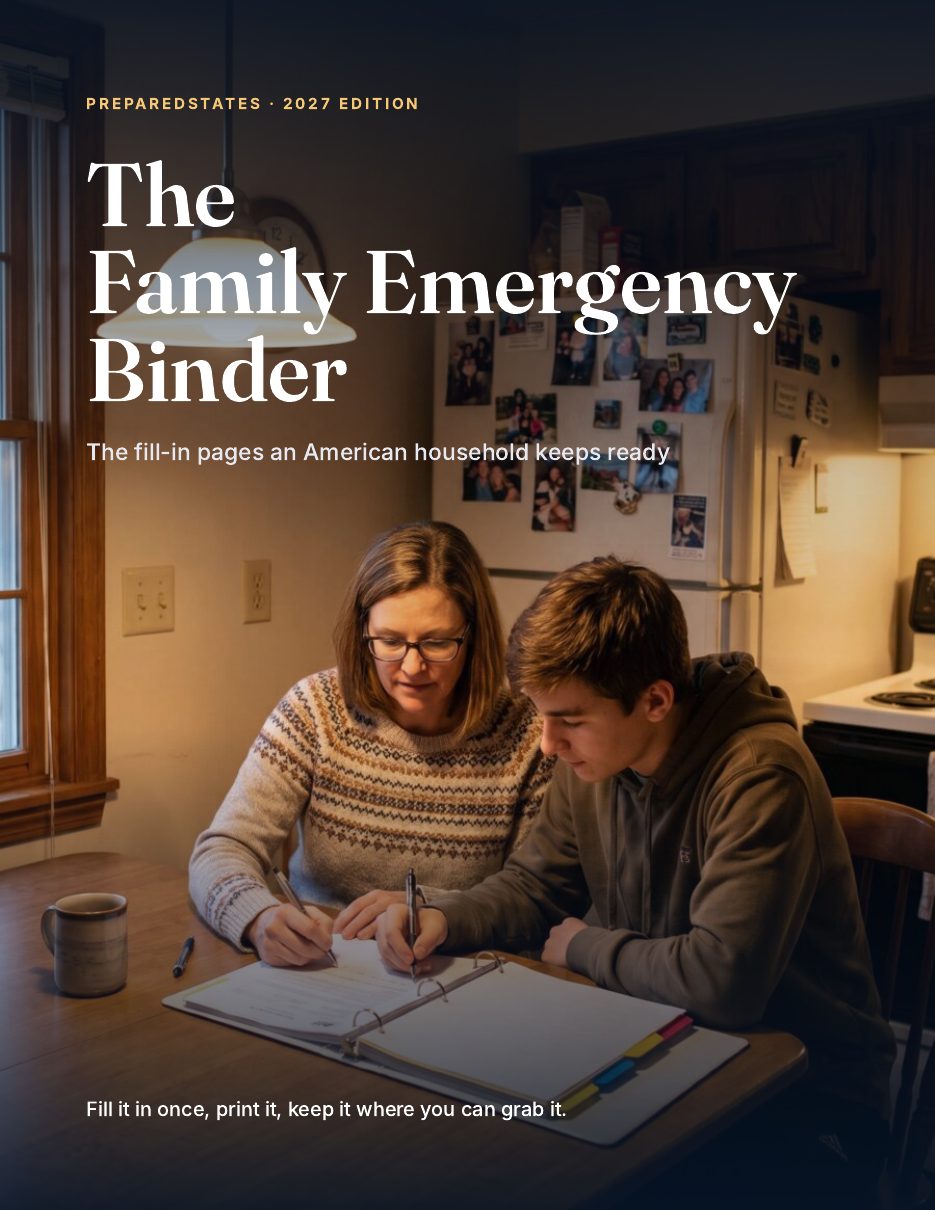
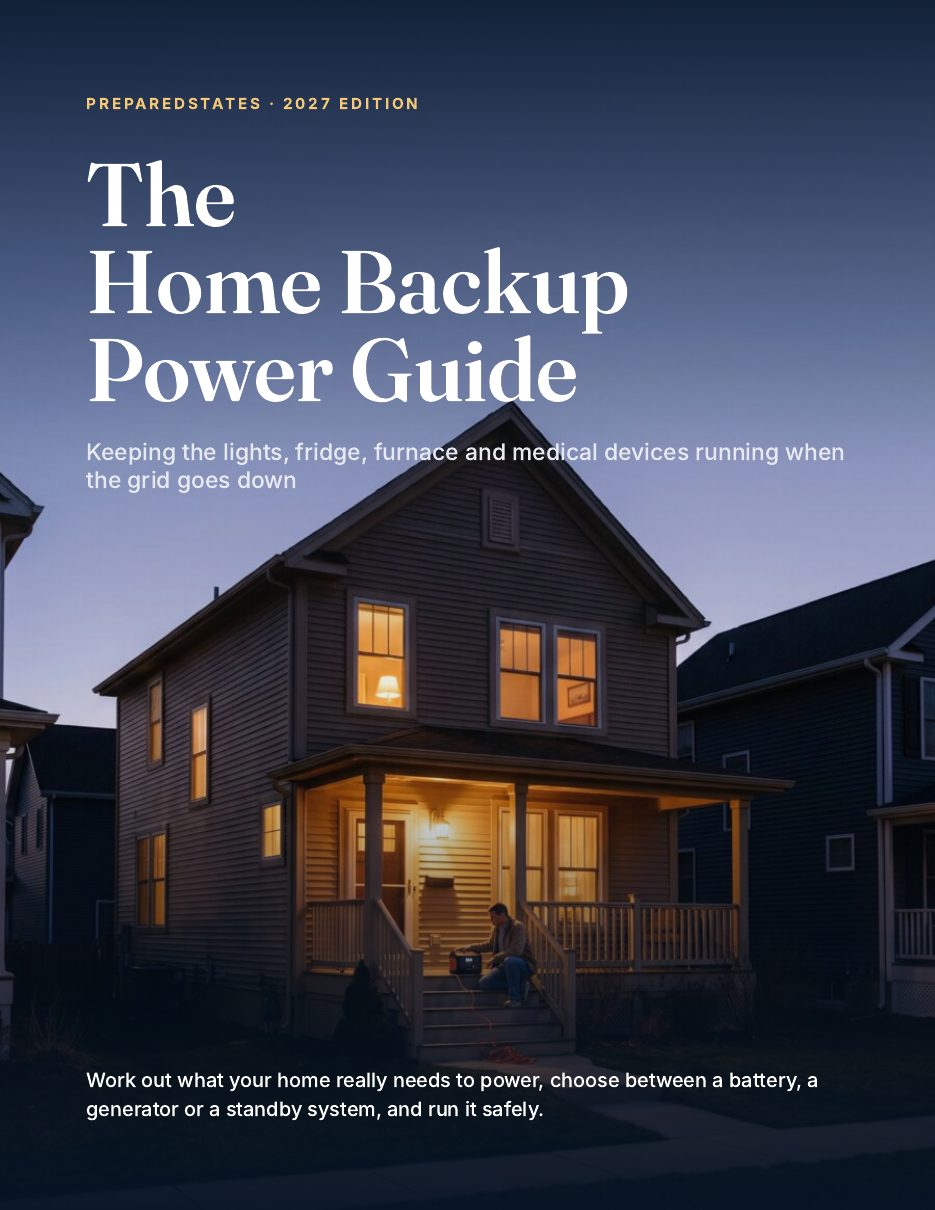
The binder holds your household's information, the power guide decides what you'd run and how, and the pantry plan builds the food store. Bought separately they come to $49.97 (The Family Emergency Binder $14.99 + The Home Backup Power Guide $14.99 + The Long-Term Food Storage and Pantry Plan $19.99). Together, $39.99, as one download.
Secure card payment by Stripe, in US dollars. You can download it as soon as you pay. By buying you agree to our terms of sale, including that digital downloads can't be returned.
Questions
Do I need a year of food?+
No, and the book doesn't say you do. It's built in three steps: two weeks (the Red Cross's figure), three months of what you already eat (the book's own planning step), and staples by the year for households that want them. Most of its advice is about finishing the first two steps well.
Does it cover water?+
Chapter 5 does: how much for 1 to 6 people, which containers to use and how to sanitize them, the water already in your pipes and water heater, and treating water by boiling, bleach, tablets and filters, with the CDC's and EPA's tables side by side.
Is it about freeze-dried food?+
One chapter is, and it's about reading the label: servings, calories per person-day, sodium, allergens and what "up to 25 years" means. Its verdict is to buy a kit for the evacuation bag or for a place where you can't rotate food, not as your main plan.
What format is it?+
A PDF, on Letter-size pages. It opens in the PDF viewer that's already on your phone, tablet or computer: iPhone, iPad, Android, Mac, Windows or Chromebook. No app, no account, nothing to install.
How does the download work?+
As soon as Stripe confirms your payment, the page you land on gives you your downloads and a personal link to them that works for at least a year. If you lose it, email us from the address you paid with and we'll send it again.
Can I print it?+
Yes, and we'd encourage it: paper still works when the power and the phone are out. Your license lets you print as many copies as your household needs, and give a printed copy to family who'd be helping you in an emergency.
Can I get a refund?+
Because the files are digital downloads you can keep as soon as you've paid, all sales are final and we don't give refunds for a change of mind. If a file won't download or open, or something in it is wrong, email us within 30 days of buying: we'll fix it, send a working copy, or refund you in full. If you were charged twice by mistake, we'll refund the extra charge.
Is it a subscription?+
No. You pay once, and the file is yours to keep. There's nothing to cancel.
Is it medical or safety advice for my situation?+
No. It's general information built on official US guidance. It doesn't replace your doctor, your pharmacist, or instructions from emergency services and your state or local emergency management office. In an emergency, call 911.
Store what you eat. Eat what you store.
The Long-Term Food Storage and Pantry Plan. Instant PDF download, paid once, yours to keep.
Secure card payment by Stripe, in US dollars. You can download it as soon as you pay. By buying you agree to our terms of sale, including that digital downloads can't be returned.
The Long-Term Food Storage and Pantry Plan is general information to help your household prepare. It is not legal, financial or medical advice. Written by Tom Calder for PreparedStates, sold by TMR Digital. PreparedStates is independent and not affiliated with the US government. Terms of sale.