Medicare, Medicaid, the paperwork, home safety and care. The guide for sons and daughters, step by step.
From the first conversation to a hospital discharge: how to notice changes, build one medicine list, understand Medicare's parts and its 2026 costs, see what Medicaid pays for, get the legal documents in place, guard against scams, make the home safer, plan for emergencies, weigh care options and look after yourself. With eight fill-in sheets. Sourced to the National Institute on Aging, Medicare.gov, the CFPB and the FTC.

- Instant PDF download
- 156 pages
- Print it for your household
- 12 chapters across 156 pages, each opening with an "In an emergency, do this first" box and ending with a checklist
- Medicare's four parts in plain terms, with the 2026 costs, enrollment windows and penalties
- The money and health care documents, what each does and doesn't do, and who can see your parent's health information
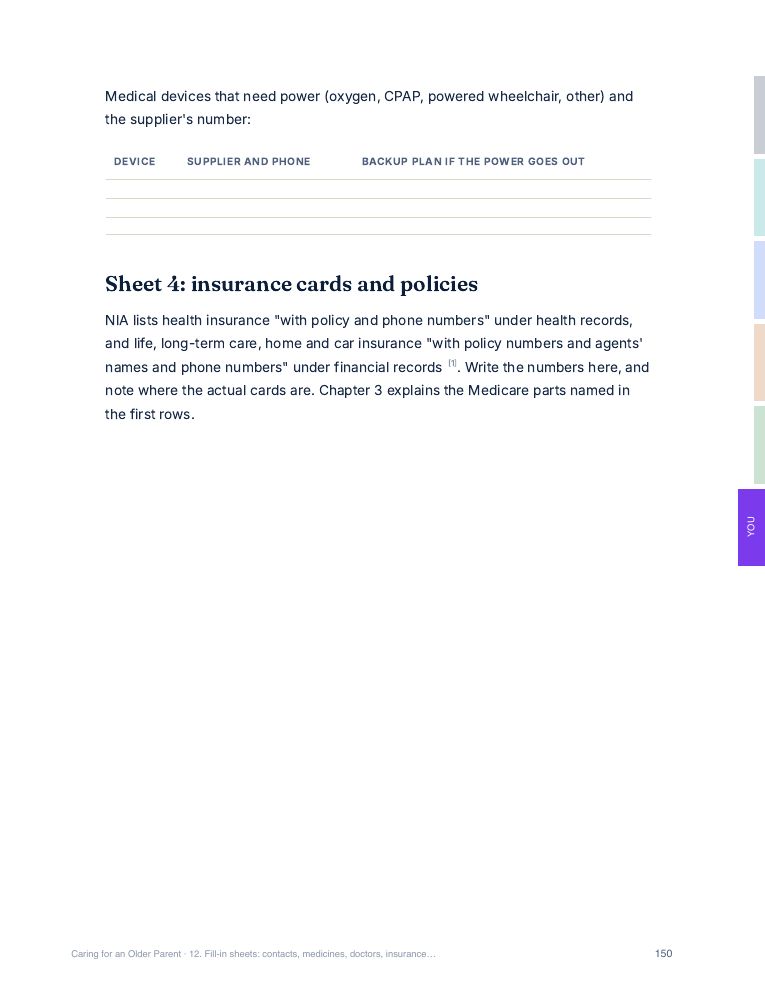
- Eight fill-in sheets: who to call, medicines, doctors, insurance, documents, money, a binder index and a yearly review
Secure card payment by Stripe, in US dollars. You can download it as soon as you pay. By buying you agree to our terms of sale, including that digital downloads can't be returned.
- Instant PDF download
- 156 pages
- Print it for your household
It starts with small things. The questions come all at once.
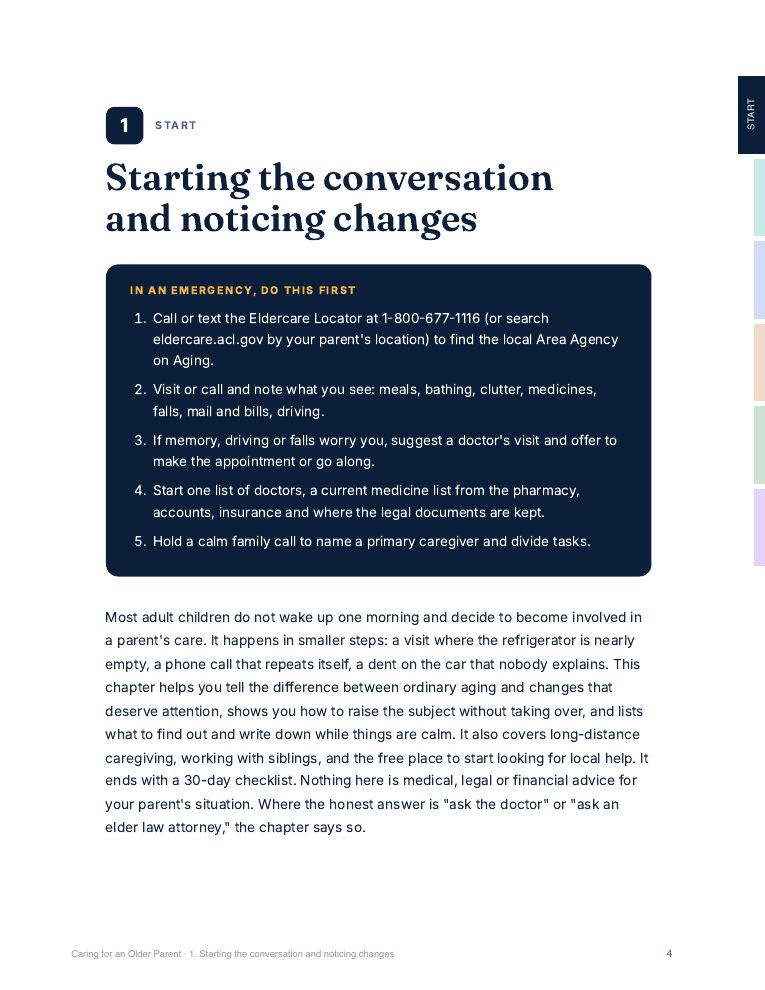
Most adult children don't wake up one morning and decide to become involved in a parent's care. It happens in smaller steps: a visit where the refrigerator is nearly empty, a phone call that repeats itself, a dent on the car that nobody explains. The book's first chapter helps you tell ordinary aging from changes that deserve a doctor's visit, and shows how to raise it without taking over.
Then the questions arrive together. What does Medicare actually cover? Why doesn't it pay for long-term care? Who can talk to the doctor? What's a durable power of attorney, and why does Social Security need a separate form anyway? Which of the calls Mom is getting are scams? The answers are spread across Medicare.gov, Medicaid.gov, the National Institute on Aging, the CFPB, the FTC and the Department of Labor. This book brings them into one place, in order.
It says what it is: general information, not medical, legal or financial advice for your parent's situation. Where the honest answer is "ask the doctor" or "ask an elder law attorney," the chapter says so. And it gives the free numbers first: the Eldercare Locator, 1-800-MEDICARE and your state's SHIP counselors.
What's inside, chapter by chapter
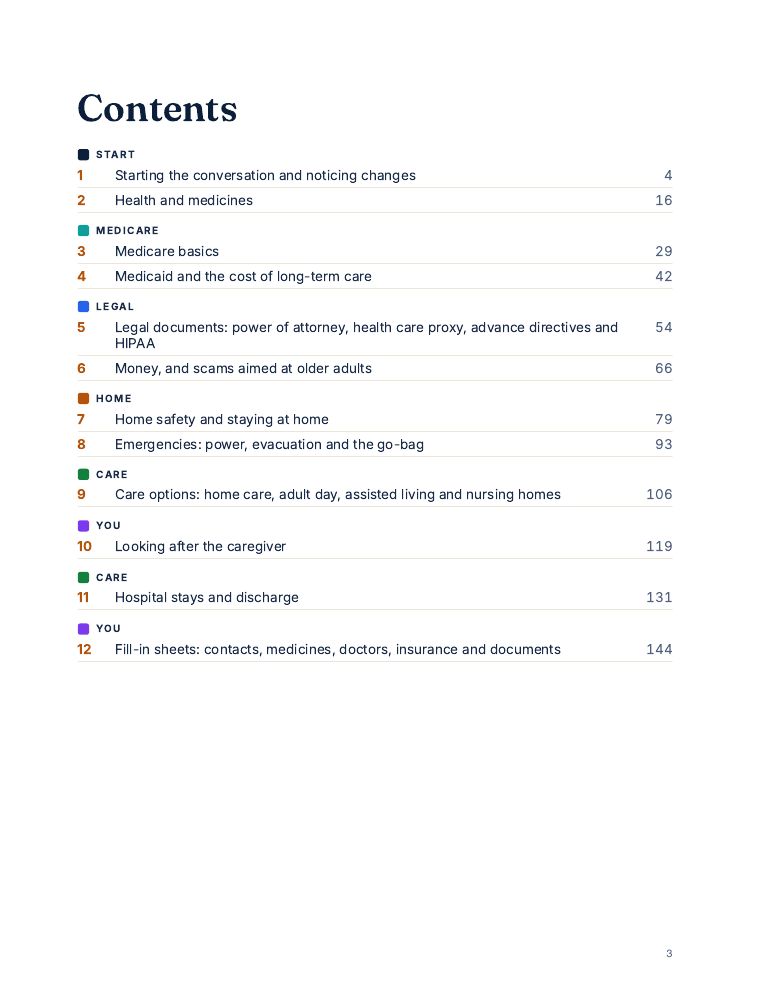
12 chapters across 156 pages. Each opens with an "In an emergency, do this first" box, carries "honest bit" notes where the official pages fall short, and ends with a checklist and its numbered sources.
Starting the conversation and noticing changes
- What to notice at home, memory and driving: normal aging, or time to see a doctor
- How to open the conversation, and respect your parent's right to decide
- Long-distance caregiving, siblings, the free first call, and a 30-day checklist
Health and medicines
- Build one medicine list, and use one pharmacy
- Preventing falls: the three screening questions, and what to do if your parent falls
- Hearing, vision and the Medicare Annual Wellness Visit: what's covered and what isn't
Medicare basics
- The four parts in plain terms, and Original Medicare or Medicare Advantage
- What it costs in 2026: the Part B premium of $202.90 a month, the deductibles and the coinsurance
- Enrollment windows, late penalties, Medigap, help with costs, and how to speak to Medicare for your parent
Medicaid and the cost of long-term care
- What Medicare does and doesn't pay for: skilled nursing, home health and hospice
- Medicaid as the main payer for long-term care, protection for a spouse at home, and estate recovery
- Help at home and in the community, PACE, long-term care insurance, VA Aid and Attendance, and reverse mortgages
Legal documents: power of attorney, health care proxy, advance directives and HIPAA
- Why to do it while your parent can still decide
- The money documents and the health care documents, and what an agent must do
- HIPAA, guardianship as a last resort, the separate Social Security payee form, and free legal help
Money, and scams aimed at older adults
- Getting a picture of the finances with consent, and helping without taking over
- The FTC's four signs of a scam, the common scams one by one, and where to report
- Exploitation by someone close, a credit freeze, Do Not Call, and a "pause and call me" rule
Home safety and staying at home
- What aging in place means, and the services that come to the house
- A room-by-room safety check from the CDC: stairs, floors, kitchen, bedroom, bathroom
- Smoke and CO alarms, medical alert systems, and who pays for home changes
Emergencies: power, evacuation and the go-bag
- Medical devices and medicines that need power, and what utility programs do and don't promise
- Generators and carbon monoxide, heat and cold, evacuation and shelters
- The older adult's go-bag and emergency binder, alerts, and FEMA help after a disaster
Care options: home care, adult day, assisted living and nursing homes
- The ladder from least help to most, and why home health and home care aren't the same
- Visiting a facility, Care Compare's star ratings, and inspection reports
- Residents' rights, the Long-Term Care Ombudsman, and what to do when things go wrong
Looking after the caregiver
- Signs you need help, and sharing the load
- The Family and Medical Leave Act: up to 12 workweeks, unpaid, and who it covers
- Paid leave by state, respite care, support groups, and a self-check
Hospital stays and discharge
- Inpatient or outpatient: the status that changes the bill, and the 3-day rule
- What Part A costs for a hospital stay in 2026, and what a benefit period is
- Discharge planning, the fast appeal of a discharge, delirium, and the first days at home
Fill-in sheets: contacts, medicines, doctors, insurance and documents
- Who to call, the medicine list, and doctors and other health contacts
- Insurance cards and policies, documents and where they are, and money at a glance
- The emergency binder index and the yearly review
Look inside
Real pages from the book. Swipe for more, tapClick any page to see it full size.

Secure card payment by Stripe, in US dollars. You can download it as soon as you pay. By buying you agree to our terms of sale, including that digital downloads can't be returned.
Who it's for
It's for you if
- You've started to notice changes in a parent and don't know where to begin
- You're the one the family turns to for Medicare, the bills or the paperwork
- You're caring from an hour or more away, or splitting it with siblings
- A hospital stay is coming, or just happened, and you need to understand discharge and what comes next
Honestly, you can skip it if
- You want state-specific Medicaid limits, paid leave rules or assisted living licensing. Those vary by state, and the book says "ask your state" rather than print a figure
- You want care prices or product picks. It gives neither
- Your parent can no longer understand a document. The book says to see an elder law attorney, and treats guardianship as a last resort
Built on official sources, not opinions
- Every figure names its source, and each chapter ends with a numbered list of them: 201 source lines across twelve chapters.
- The Medicare figures are Medicare.gov's 2026 amounts, and the book says they change every year.
- Where a step is the book's own device rather than agency guidance, such as the "pause and call me" rule or the binder index, it says so.
From the team behind PreparedStates's free live trackers for power outages, NWS alerts, hurricanes and wildfires, built on the same public data and the same rule: every figure names its source. PreparedStates is independent and not affiliated with the US government.
Questions
Is it legal or medical advice for my parent?+
No. It's general information built on federal sources. Where the honest answer is "ask the doctor" or "ask an elder law attorney," the chapter says so, and it points to free help first: the Eldercare Locator, 1-800-MEDICARE and your state's SHIP counselors.
Does it cover dementia?+
Not as a chapter. Chapter 1 covers the memory signs the National Institute on Aging says warrant a doctor's visit, and chapter 10 gives the NIA's ADEAR Center line. It isn't a dementia care guide.
Are the Medicare numbers current?+
They're Medicare.gov's 2026 figures. The book says they change every year and shows where to check the current ones.
What format is it?+
A PDF, on Letter-size pages. It opens in the PDF viewer that's already on your phone, tablet or computer: iPhone, iPad, Android, Mac, Windows or Chromebook. No app, no account, nothing to install.
How does the download work?+
As soon as Stripe confirms your payment, the page you land on gives you your downloads and a personal link to them that works for at least a year. If you lose it, email us from the address you paid with and we'll send it again.
Can I print it?+
Yes, and we'd encourage it: paper still works when the power and the phone are out. Your license lets you print as many copies as your household needs, and give a printed copy to family who'd be helping you in an emergency.
Can I get a refund?+
Because the files are digital downloads you can keep as soon as you've paid, all sales are final and we don't give refunds for a change of mind. If a file won't download or open, or something in it is wrong, email us within 30 days of buying: we'll fix it, send a working copy, or refund you in full. If you were charged twice by mistake, we'll refund the extra charge.
Is it a subscription?+
No. You pay once, and the file is yours to keep. There's nothing to cancel.
Is it medical or safety advice for my situation?+
No. It's general information built on official US guidance. It doesn't replace your doctor, your pharmacist, or instructions from emergency services and your state or local emergency management office. In an emergency, call 911.
Start the conversation while things are calm.
Caring for an Older Parent (US edition). Instant PDF download, paid once, yours to keep.
Secure card payment by Stripe, in US dollars. You can download it as soon as you pay. By buying you agree to our terms of sale, including that digital downloads can't be returned.
Caring for an Older Parent (US edition) is general information to help your household prepare. It is not legal, financial or medical advice. Written by Tom Calder for PreparedStates, sold by TMR Digital. PreparedStates is independent and not affiliated with the US government. Terms of sale.