Your home, your insurance, your kit and your evacuation decision, settled before the 2027 season starts.
A handbook for Louisiana households built on what the National Hurricane Center, the National Weather Service, FEMA, the CDC, the Red Cross and GOHSEP, Get a Game Plan, LADOTD and the Louisiana Department of Insurance publish: how a hurricane actually hurts a home, the calm-weather jobs to do before June 1, the two kits, the house, watches and warnings, the evacuation decision, riding it out, the days after, and a Louisiana chapter with your parish OHSEP, GOHSEP alerts and the Get a Game Plan app, local special-needs registration and medical special needs shelters, and named-storm deductibles and Louisiana Citizens. It names no storm and recommends no brands. Hurricane season ends November 30: this is the book for getting ready before the next one.
This is the Louisiana edition. Also available for Florida, Texas and North and South Carolina.
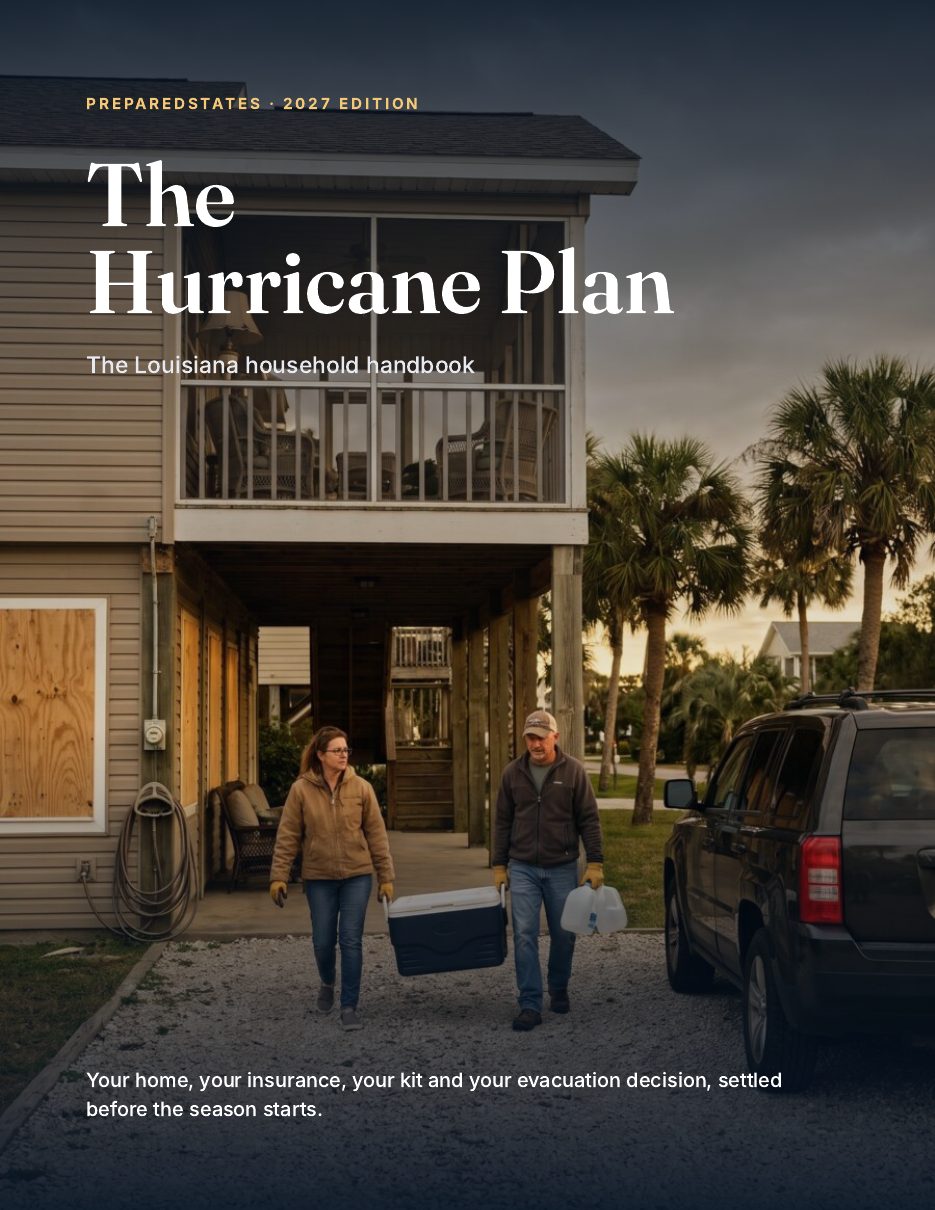
- Instant PDF download
- 107 pages
- Print it for your household
- 9 chapters across 107 pages, each opening with a "Do this first" box of the jobs that matter most
- Eight chapters for every Gulf and Atlantic coast home, plus one for Louisiana: your parish OHSEP, GOHSEP alerts and the Get a Game Plan app, local special-needs registration and medical special needs shelters, and named-storm deductibles and Louisiana Citizens
- Fill-in sheets: your household plan, insurance details, medicines, evacuation destinations, an alert sheet, a claim log, and a Louisiana sheet
- The watches-and-warnings table, the generator and carbon monoxide rules in full, and the refrigerator keep-or-throw table
Secure card payment by Stripe, in US dollars. You can download it as soon as you pay. By buying you agree to our terms of sale, including that digital downloads can't be returned.
- Instant PDF download
- 107 pages
- Print it for your household
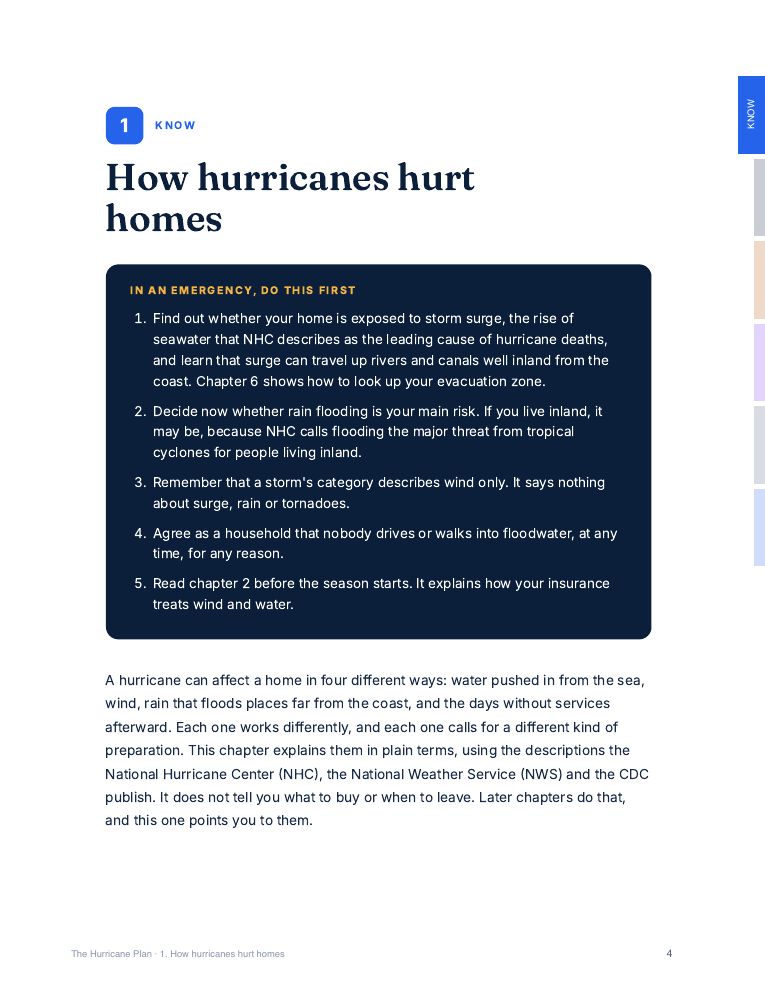
A hurricane hurts a home in four different ways. Most plans only prepare for one.
"A hurricane can affect a home in four different ways: water pushed in from the sea, wind, rain that floods places far from the coast, and the days without services afterward." That is the book's first line, and each of the four calls for a different kind of preparation. The category you hear on the news describes wind only. It says nothing about surge, rain or tornadoes.
The book starts with what the National Hurricane Center says about each: storm surge is the leading cause of hurricane deaths, and flooding from rain is the major threat for people living inland. Then it works through the calm-weather jobs: the household plan, what a standard policy leaves out and the 30-day wait on a new flood policy, the two kits, the garage door, the shutters and the roof.
Only then does it turn to the storm itself: what a watch and a warning mean and when each is issued, how to read the cone, the evacuation decision in NOAA's words (run from the water, hide from the wind), riding it out, and the days after. The Louisiana chapter at the end puts your state's own tools in one place: why there is no statewide zone lookup, and the three questions to ask your parish OHSEP this month; the alert sign-up on GOHSEP's home page, the Get a Game Plan app, 511 and 2-1-1; local special-needs registration and medical special needs shelters; and named-storm deductibles, Louisiana Citizens, and what LDI's catastrophe claims guide says an insurer must do and when.
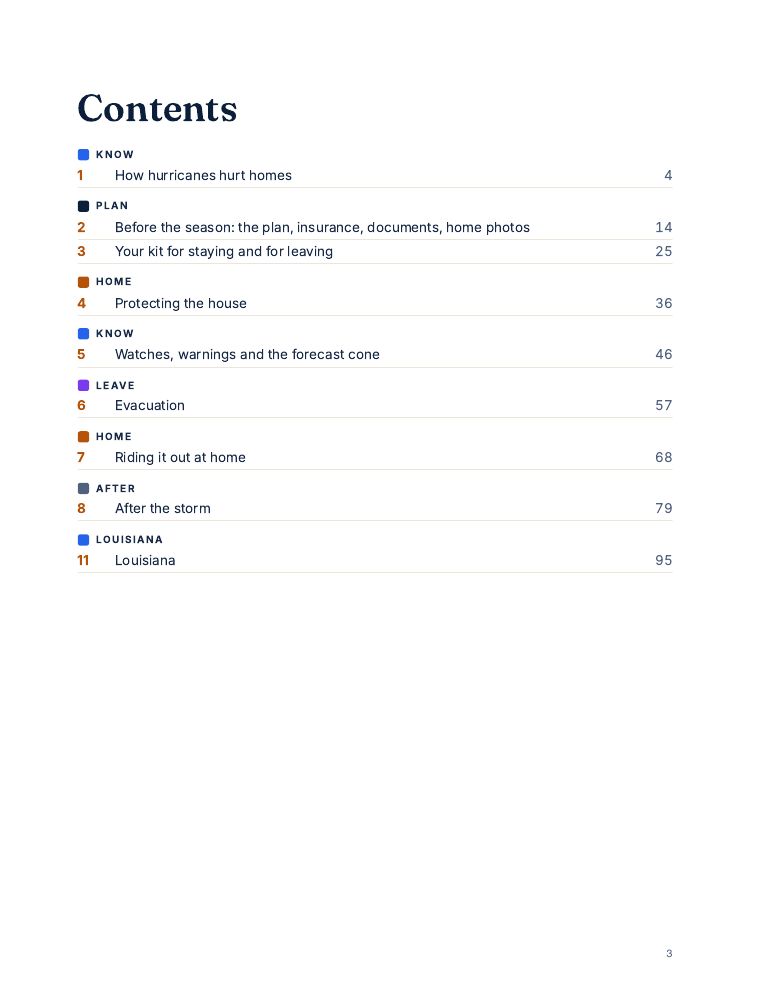
What's inside, chapter by chapter
9 chapters across 107 pages. Chapters 1 to 8 are the same in every edition; the last chapter is Louisiana's. Every chapter opens with a "Do this first" box and ends with its numbered sources.
How hurricanes hurt homes
- Storm surge, wind, rain and the outage afterward, in NHC's, the NWS's and the CDC's words
- The Saffir-Simpson scale, what it leaves out, and tornadoes in the rain bands
- A short fill-in sheet: your zone, surge risk, the nearest river and the roads that flood
Before the season: the plan, insurance, documents, home photos
- When the season runs, and why the work is done before June 1
- What a standard policy leaves out, the NFIP's limits and 30-day wait, and wind and hurricane deductibles
- Your household plan, where the document copies go, and photos and a home inventory
Your kit for staying and for leaving
- How many days to plan for: 3 days to carry, 2 weeks at home, from the Red Cross, Ready.gov and the CDC
- The stay-at-home checklist, water, food that needs no cooking, medicines and powered medical equipment
- The go-bag checklist, the car kit and the gas tank, cash, babies, pets and papers, and keeping it ready through a hot summer
Protecting the house
- Windows: shutters, pre-cut plywood, impact glass, and why tape provides no protection
- Doors and the garage door, the roof and soffits, trees, gutters, loose items and vehicles
- A timeline: before the season, when a watch is issued, when a warning is issued
Watches, warnings and the forecast cone
- Every watch and warning in one table: what it means, its lead time and what you do
- How the cone is built and what it does not show; wind probabilities, arrival times and the surge map
- Where to get alerts, an alert sheet, and reading the timing so you finish while it is still safe
Evacuation
- Zones and who orders them, run from water and hide from wind, who should leave and when
- The trip: destination, route and timing, the car, what to take, leaving the house
- Public shelters, special-needs and medical shelters, pets and service animals, and your evacuation sheets
Riding it out at home
- The last 12 hours, where to shelter, the eye of the storm, and if water comes into the house
- Generators and carbon monoxide: the CDC's and CPSC's rules in one table, and if a CO alarm sounds
- Food while the power is out, boiling and bleach for water, heat, and when the wind drops
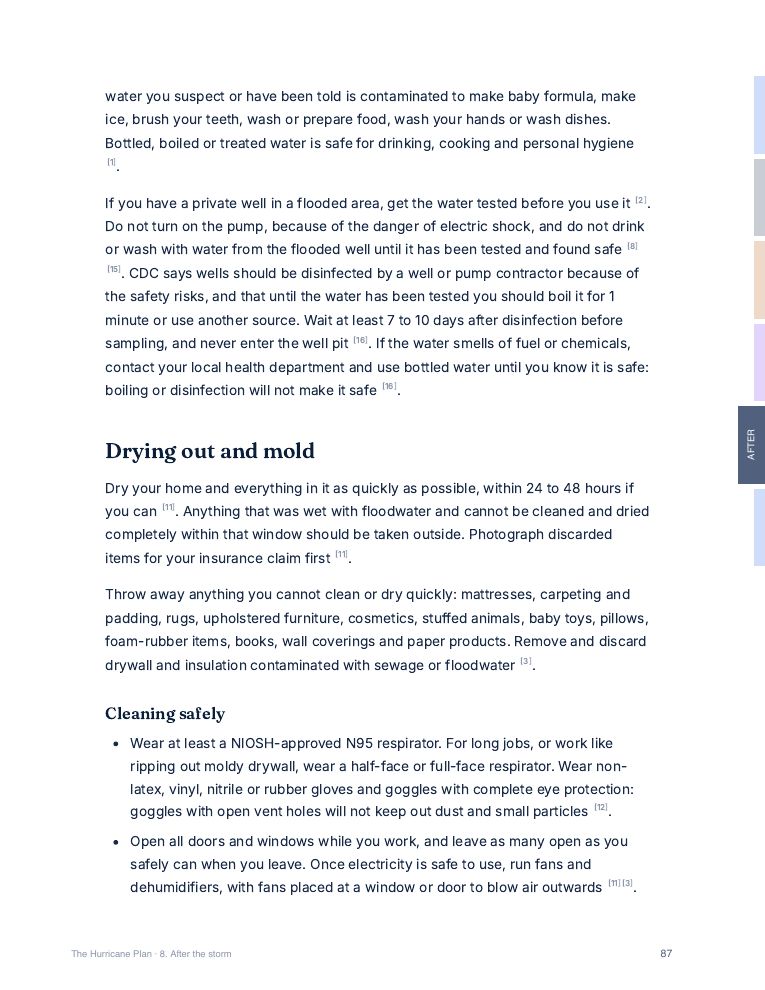
After the storm
- Going back in, the equipment that comes out after a storm, floodwater, and the refrigerator keep-or-throw table
- Drying out and mold, cleaning safely, and when to bring in a professional
- The insurance claim and a claim log, FEMA assistance, contractors and scams
Louisiana
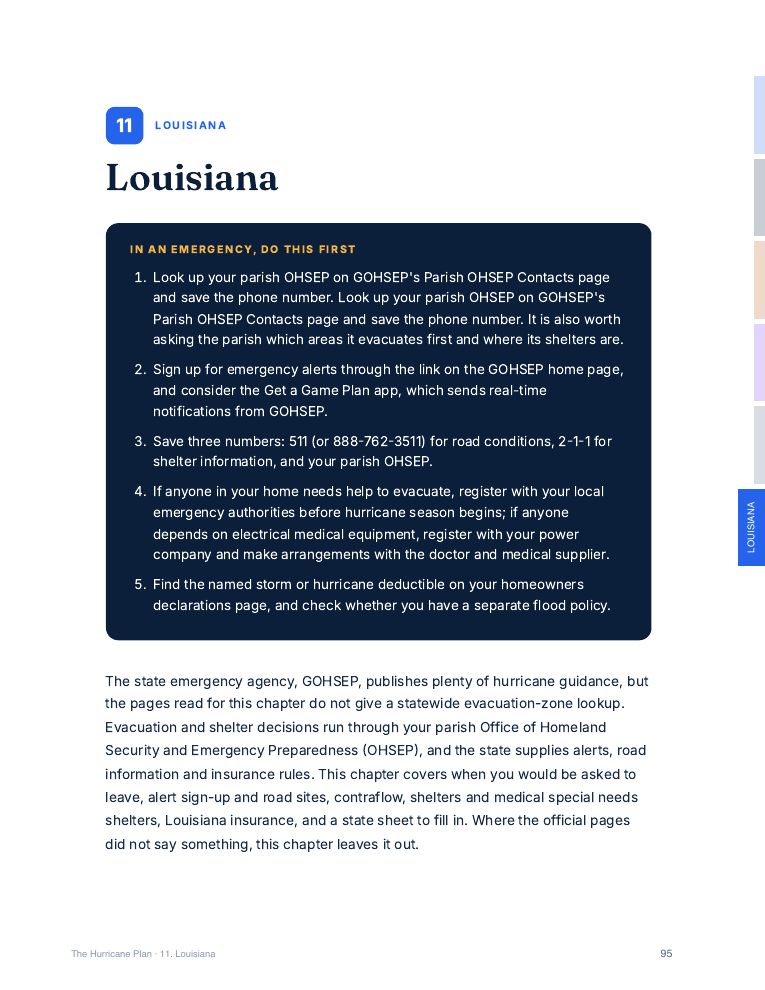
- Why there is no statewide zone lookup, who GOHSEP says should plan to leave early, and the three questions to ask your parish OHSEP this month
- The GOHSEP alert sign-up and the Get a Game Plan app, 511 and 2-1-1, the contraflow map, shelters, pets, DSNAP and medical special needs shelters
- Named-storm deductibles, Louisiana Citizens, LDI's claims timeline and helpline, contractors, and a Louisiana sheet to fill in
Look inside
Real pages from the book. Swipe for more, tapClick any page to see it full size.
Secure card payment by Stripe, in US dollars. You can download it as soon as you pay. By buying you agree to our terms of sale, including that digital downloads can't be returned.
Who it's for
It's for you if
- You own or rent a home in Louisiana and want the before-the-season jobs done once, in order, with the state's own tools in one place
- You have never been sure which areas your parish evacuates first, or who gives the order to leave
- You want to know what your policy pays for wind and what it pays for water before you ever need to claim
- Someone in your home relies on powered medical equipment, or you have pets, and the evacuation plan has to include them
Honestly, you can skip it if
- You want a forecast. The book names no storm and says nothing about the coming season: it is for getting ready before the 2027 season starts, and it says plainly to follow local officials on the day
- You want the book to pick shutters, a generator or a radio. It quotes what the sources say to look for and recommends no brands
- You live outside Louisiana. Chapters 1 to 8 are the same in every edition, but the state chapter is Louisiana's: the Florida, Texas, and North and South Carolina editions have their own
Built on official sources, not opinions
- Every figure names its source, and each chapter ends with a numbered list of them: 139 source lines across nine chapters.
- Where an official page did not say something, the book says so instead of guessing: the Louisiana chapter's "honest bit" boxes say what the state's own pages leave out, and what to ask your local office instead.
- No storm is named and no season is forecast. The book quotes what the agencies say to do before June 1 and leaves the day's decisions to local officials.
From the team behind PreparedStates's free live trackers for power outages, NWS alerts, hurricanes and wildfires, built on the same public data and the same rule: every figure names its source. PreparedStates is independent and not affiliated with the US government.
Questions
Which edition do I need?+
The one for your state. Chapters 1 to 8 are the same in all four editions; the last chapter is Louisiana's own: your parish OHSEP, GOHSEP alerts and the Get a Game Plan app, local special-needs registration and medical special needs shelters, and named-storm deductibles and Louisiana Citizens. The other editions are Florida, Texas, and North and South Carolina. There is no edition for other coastal states yet.
Does it tell me whether to evacuate?+
No. It explains what evacuation zones mean, NOAA's "run from the water, hide from the wind", who the sources say should leave and when, and how to plan the trip, and it says to follow the orders of local officials. The Louisiana chapter shows where to look up your zone and who gives the order.
Is it about this year's storms?+
No. The Atlantic season runs June 1 to November 30, and this is the book for getting ready before the 2027 season. It names no storm and makes no forecast.
Does it cover insurance?+
Chapter 2 covers wind and flood for every home: what a standard policy leaves out, the NFIP's limits and its 30-day wait, and wind and hurricane deductibles. The Louisiana chapter adds what the Louisiana Department of Insurance says: named-storm deductibles typically run 2% to 5% of the insured value, Louisiana Citizens is the insurer of last resort, and its catastrophe claims guide sets out what your insurer must do and when, from starting to adjust the claim within 30 days to a written offer on the undisputed part.
What format is it?+
A PDF, on Letter-size pages. It opens in the PDF viewer that's already on your phone, tablet or computer: iPhone, iPad, Android, Mac, Windows or Chromebook. No app, no account, nothing to install.
How does the download work?+
As soon as Stripe confirms your payment, the page you land on gives you your downloads and a personal link to them that works for at least a year. If you lose it, email us from the address you paid with and we'll send it again.
Can I print it?+
Yes, and we'd encourage it: paper still works when the power and the phone are out. Your license lets you print as many copies as your household needs, and give a printed copy to family who'd be helping you in an emergency.
Can I get a refund?+
Because the files are digital downloads you can keep as soon as you've paid, all sales are final and we don't give refunds for a change of mind. If a file won't download or open, or something in it is wrong, email us within 30 days of buying: we'll fix it, send a working copy, or refund you in full. If you were charged twice by mistake, we'll refund the extra charge.
Is it a subscription?+
No. You pay once, and the file is yours to keep. There's nothing to cancel.
Is it medical or safety advice for my situation?+
No. It's general information built on official US guidance. It doesn't replace your doctor, your pharmacist, or instructions from emergency services and your state or local emergency management office. In an emergency, call 911.
Settle it before the season starts.
The Hurricane Plan: Louisiana edition. Instant PDF download, paid once, yours to keep.
Secure card payment by Stripe, in US dollars. You can download it as soon as you pay. By buying you agree to our terms of sale, including that digital downloads can't be returned.
The Hurricane Plan: Louisiana edition is general information to help your household prepare. It is not legal, financial or medical advice. Written by Tom Calder for PreparedStates, sold by TMR Digital. PreparedStates is independent and not affiliated with the US government. Terms of sale.