How long will a home battery backup power a house during an outage?
How long a home battery backup runs a typical US house, or just the essentials, in an outage: worked from EIA and maker figures, with costs, the tax credit and garage rules.
By Tom Calder · Updated November 4, 2026 · Sourced to the EIA, the IRS, NFPA, the California Public Utilities Commission, CPSC and the makers' own datasheets
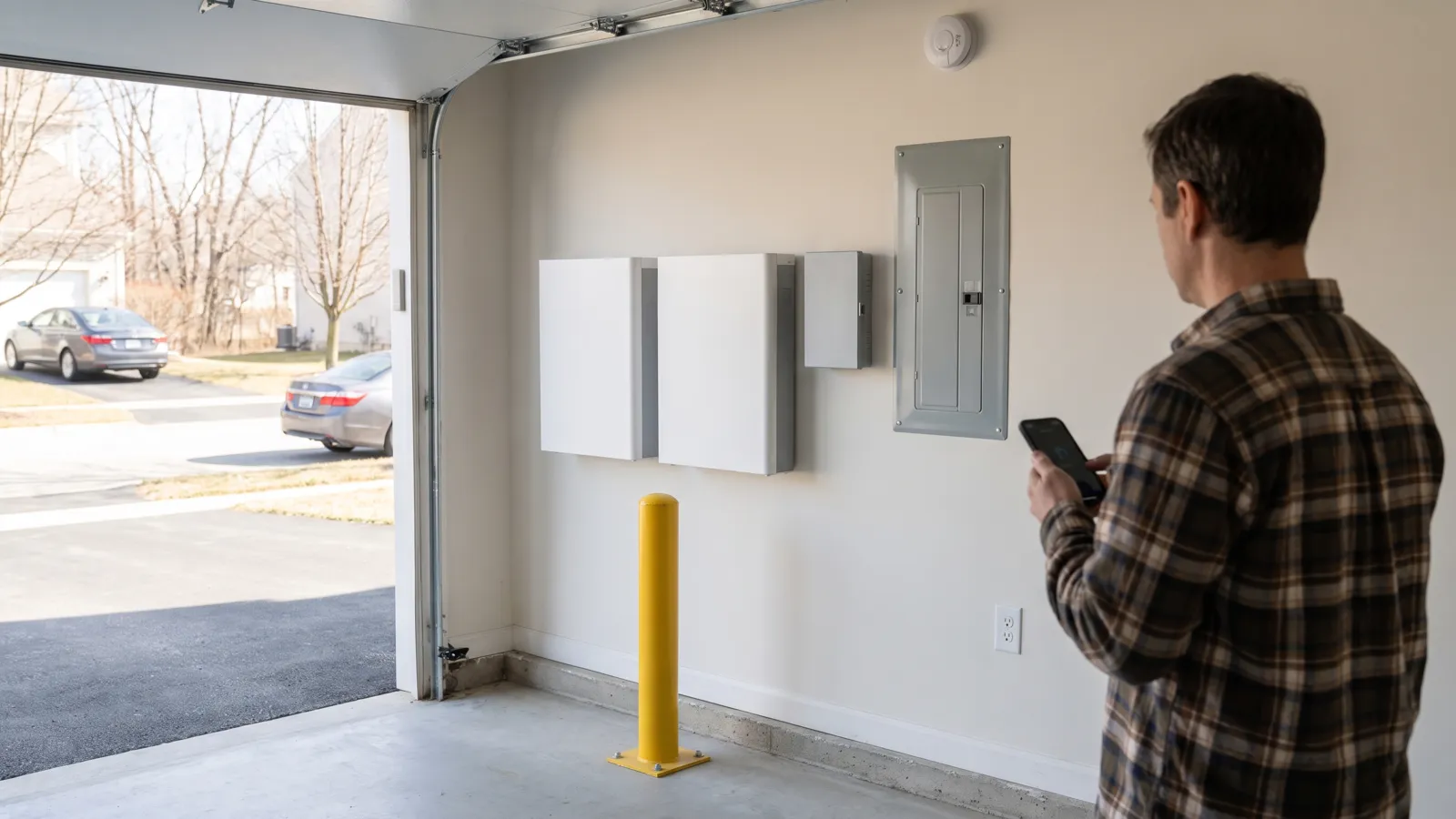
- The average US home bought 10,791 kWh of electricity in 2022, the EIA says: about 29.6 kWh a day. One 13.5 kWh Tesla Powerwall 3 holds about 11 hours of that average use, so running the whole house as normal empties a single battery in less than a day.
- Run only the essentials (refrigerator, furnace blower, well and sump pumps, CPAP, Wi-Fi, a few lights and phones) and our worked example needs about 6.6 to 9.8 kWh a day with the furnace running, or 3 to 5 kWh without it: roughly 1.4 to 2 days on one Powerwall 3, or about 2.7 to 4.5 days in mild weather.
- A home battery only runs the house in an outage through its maker's gateway, backup switch or controller, which cuts the home off from the grid first. Tesla lists "Gateway 3, Backup Switch, Backup Gateway 2" as Powerwall 3's islanding devices.
- The 30% federal Residential Clean Energy Credit (section 25D) has ended. The IRS: "The credit will not be allowed for any expenditures made after December 31, 2025," and an expenditure counts as made when installation is completed.
- NFPA 855 permits home batteries in attached and detached garages, utility closets and storage spaces, and on exterior walls and outdoors at least 3 feet from doors and windows, with limits on unit size and total stored energy. Your local building and fire officials decide what applies where you live.
- For a shorter list of essentials, a large portable power station, or a generator with a transfer switch for the furnace and pumps, usually costs less than an installed home battery.
The short answer: hours for the whole house, days for the essentials
How long a home battery lasts is simple division: the energy it stores, in kilowatt-hours (kWh), over what the house uses. The U.S. Energy Information Administration (EIA) says that "in 2022, the average annual amount of electricity sold to (purchased by) a U.S. residential electric-utility customer was 10,791 kilowatthours (kWh), an average of about 899 kWh per month." That is about 29.6 kWh a day. Louisiana homes bought an average of 14,774 kWh a year and Hawaii homes 6,178, so your own bill is the better guide: divide the kWh on it by the days in the billing period.
At the national average, one 13.5 kWh Tesla Powerwall 3 holds about 11 hours of normal use, two hold about 22 hours, and one 15 kWh FranklinWH aPower 2 about 12 hours. Central heating and cooling are among the biggest loads. On the appliance figures our tools use, from DTE Energy, a 3-ton central air conditioner or electric heat pump draws about 6,000 watts while running, so a full 13.5 kWh battery covers a little over two hours of it running flat out. That is why many systems back up a chosen set of circuits, not the whole house, and stretch it further with solar.
The useful question is what you need to keep running, and for how long. The worked examples below answer it for the usual list of essentials, using the same appliance data as our what will it run tool.
Whole-home batteries and portable power stations: what is on sale
Two figures matter on any battery. Capacity, in kilowatt-hours (kWh), is how much energy it stores and decides how long it lasts. Power, in kilowatts (kW), is how much it can deliver at once and decides how many things run together, and whether it can start a motor such as a well pump. Here is how the main installed home batteries sold in the US are rated on their makers' datasheets. Each is installed in multiples for more storage.
| Battery | Capacity | Continuous power | Peak or start | Chemistry |
|---|---|---|---|---|
| Tesla Powerwall 3 | 13.5 kWh (AC) | 11.5 kW | 185 LRA | Not stated |
| Enphase IQ Battery 5P | 5.0 kWh | 3.84 kVA | 7.68 kVA peak (32 A for 3 seconds); 48 A LRA | LFP |
| FranklinWH aPower 2 | 15 kWh (AC) | Up to 10 kW | 15 kW for 10 seconds | LFP |
Tesla supports up to 4 Powerwall 3 units in one system; FranklinWH up to 15 aPower 2 units (225 kWh) on one aGate. LRA, locked rotor amps, is the starting current a motor such as an air conditioner compressor or well pump needs. Lithium iron phosphate, written LFP or LiFePO4, is the lithium-ion chemistry Enphase and FranklinWH list, and most of the large power stations on our home backup battery comparison list it too. Whatever the chemistry, the safety rules further down come from the codes and the maker's manual.
Portable power stations are the other route, and EcoFlow's and Anker's home systems are built on them. The large ones on our comparison store about 2.8 to 6.1 kWh, most list 120V and 240V output and can add expansion batteries. EcoFlow's DELTA Pro Ultra pairs a 6,144 Wh battery with 7,200 W of output, and EcoFlow lists the system at 6 to 90 kWh and 7.2 to 21.6 kW as units are added; Anker's SOLIX F3800 Plus is 3,840 Wh with 6,000 W. They power a home's own circuits only through the maker's transfer switch or home panel, installed by an electrician; otherwise you plug appliances into them. Smaller units for a fridge and phones are on our power station comparison, and what size power station do I need works through the sizing.
Why backup needs a gateway, transfer switch or backup panel
A battery that is simply connected to your wiring would push power back out onto the utility's lines in an outage. The Consumer Product Safety Commission warns, about generators, that powering house wiring through a wall outlet, "a practice known as 'backfeeding'," is "extremely dangerous and presents an electrocution risk to utility workers and neighbors served by the same utility transformer." The same physics applies to any backup source, so every home battery system set up for backup includes a device that disconnects the house from the grid before the battery takes over, then reconnects it when power returns.
For each maker it is a named part of the system. Tesla lists "Gateway 3, Backup Switch, Backup Gateway 2" as Powerwall 3's supported islanding devices. Enphase lists the IQ System Controller for "grid-tied and backup operation" with the IQ Battery 5P, and its datasheet's first example layout is "whole home backup." FranklinWH systems are built around its aGate. EcoFlow, Jackery and Goal Zero sell home panels or transfer switches for their power stations. A generator needs the same separation: OSHA says never attach one to a home's wiring "unless a qualified electrician has properly installed the generator with a transfer switch," and the Red Cross says to have an electrician install a power transfer switch "in accordance with the National Electrical Code (NEC)." Our transfer switch comparison covers the generator side.
Whole-home or essentials only is the other design choice. A whole-home setup puts the gateway between the meter and the main panel, so every circuit stays live and the battery's power rating and your own habits decide what runs. An essential-loads setup moves the circuits you choose (refrigerator, furnace, well pump, sump pump, a bedroom outlet for a CPAP, the router, some lights) to a separate backup panel and leaves the big loads off. It is cheaper to size for and makes the battery last longer. The CPUC: "A single-battery system can typically power your priority appliances (e.g., refrigerator, lighting, and a few other outlets) for 24 to 48 hours during a power shut-off." Ask which circuits are on the backup side, in writing, before you sign.
Worked example: a day of essentials
Here is a winter day of essentials, using the appliance figures behind our what will it run and power station runtime tools. The hours are our example, not a rule: change them for your house. Each line gives the energy at the plug for one day, from the low to the high end of the appliance's average draw.
| Appliance | Hours a day | kWh a day | Watts from |
|---|---|---|---|
| Refrigerator | 24 | 0.8 to 2.0 | Energy Star, 34 to 84 W average |
| Gas furnace blower | 8 running | 3.6 to 4.8 | DTE Energy, 450 to 600 W |
| Well pump | 1 running | 0.75 to 1.0 | DTE Energy, 750 to 1,000 W |
| Sump pump | 1 running | 1.0 | DTE Energy, 1,000 W |
| CPAP, no humidifier | 8 | 0.03 to 0.16 | ResMed, about 4 to 20 W |
| Modem and Wi-Fi router | 24 | 0.24 to 0.43 | Netgear, about 10 to 18 W |
| 4 LED bulbs, 2 phones | 5 (bulbs), 2 (each phone) | 0.2 to 0.4 | Energy Star, Apple |
| Total with furnace | 6.6 to 9.8 | ||
| Total without furnace | 3.0 to 5.0 |
The furnace blower is the biggest line: a gas furnace still needs power for its fan and controls. Without it, in mild weather or with heat that needs no electricity, the day falls to 3.0 to 5.0 kWh. A sump pump in a storm can run far more than an hour.
Motors also need a moment of extra power to start. DTE gives well and sump pumps a starting factor of 3, so a 1,000-watt sump pump wants about 3,000 watts for a moment. Check the battery's peak or LRA rating against the pumps you plan to run, and our what will it run tool for the rest.
How many days that is on each battery
Tesla and FranklinWH rate their batteries in AC energy, the energy they deliver, and Enphase gives usable capacity, so the days below divide that rating by the day's total, with nothing taken off for the system's own draw. Those are starting points, not promises. Tesla's 13.5 kWh is stated for 77°F at the start of the battery's life, a battery also used every day for solar or time-of-use savings may not be full when the outage starts unless it keeps a backup reserve, and your own appliances may draw more or less.
| Battery | With furnace | Without furnace |
|---|---|---|
| One Tesla Powerwall 3 (13.5 kWh) | 1.4 to 2 days | 2.7 to 4.5 days |
| Two Enphase IQ Battery 5P (10 kWh) | 1 to 1.5 days | 2 to 3.3 days |
| One FranklinWH aPower 2 (15 kWh) | 1.5 to 2.3 days | 3 to 5 days |
Portable power stations are rated by the battery inside, so our runtime method takes 90% of capacity for depth of discharge and 85% for the inverter, and adds about 10 watts for the unit's own use. On that method a 3,840 Wh unit such as the Anker SOLIX F3800 Plus has about 2,940 Wh to give. It will not carry the full winter list for a day, but a shorter list (refrigerator, router, CPAP, four LED bulbs and two phones, about 1.3 to 3.0 kWh a day) runs about 22 hours to 2 days on it. Our will a power station run my refrigerator guide works the fridge on its own.
Solar recharge during a long outage
Solar is what turns a home battery from a day or two of backup into something that can ride out a longer outage. The California Public Utilities Commission: "If you have a solar plus battery storage system and the sun is shining, the amount of time you have backup power is extended." Powerwall 3 has a solar inverter built in and supports up to 20 kW of panels; the large power stations take solar too, up to 3,200 W on the Anker SOLIX F3800 Plus.
How much it helps depends on the season, the weather and your roof. Short winter days and snow on the panels can leave little to recharge with, which is also when a furnace blower is running, so plan on the battery alone for a winter outage and count solar as a bonus. Panels without a battery, or without a backup-capable inverter, shut down when the grid does: our will solar panels work in a power outage guide explains why. In a long outage, the habits that stretch a battery are the same as with any backup: keep the refrigerator and freezer doors shut, run the well pump to fill containers rather than on demand, and leave big loads like the dryer, oven and water heater off.
What it costs, and what happened to the tax credit
The CPUC's guide puts an installed battery at "$7,000 to over $20,000 for the whole battery system, depending on the size and type of batteries," with installation. Get quotes that list the gateway or backup panel, any electrical upgrades, permits and the circuits covered.
The federal credit that used to take 30% off is gone for new installations. The IRS page for the Residential Clean Energy Credit says it "equals 30% of the costs of new, qualified clean energy property for your home installed anytime from 2022 through December 31, 2025," and battery storage counted from 2023 if it had "a capacity of at least 3 kilowatt hours." The IRS FAQ on Public Law 119-21 (signed July 4, 2025) says the credit "will not be allowed for any expenditures made after December 31, 2025," and that paying early does not help: "If installation is completed after December 31, 2025, the expenditure will be treated as made after December 31, 2025, which will prevent the taxpayer from claiming the section 25D credit."
If your system was installed by the end of 2025, you claim on Form 5695 for the tax year it was installed, and the IRS says "you can carry forward any excess unused credit." For a battery installed in 2026, there is no federal 25D credit. Some states and utilities run their own battery programs, so check your utility's site and your state energy office before you buy.
Where it can go: garages, codes and fire safety
The fire safety standard for home batteries is NFPA 855. Homes are usually regulated through the International Residential Code (section R328) and the fire code, which carry similar rules, and which edition applies depends on where you live; Enphase's datasheet, for example, cites the 2021 IRC, the 2021 International Fire Code and the 2023 edition of NFPA 855. NFPA's 2021 summary of its residential chapter says it covers units "between 1kwh and 20 kwh," and that NFPA 855 "only permits residential ESS to be installed in the following areas: attached garages, detached garages, on exterior walls at least 3 ft (914 mm) away from doors or windows, outdoors at least 3 ft (914 mm) away from doors or windows, utility closets, storage or utility spaces." It sets total stored-energy limits of 40 kWh in utility closets and storage or utility spaces and 80 kWh in garages, detached structures, on exterior walls and outdoors; beyond those, the stricter commercial rules apply. In an unfinished room, "the walls and ceiling need to be protected by at least 5/8 in. (16 mm) gypsum board."
Two more rules in NFPA's summary matter most in garages. Batteries "installed in a location where they are subject to vehicle damage" need "approved barriers, usually in the form of safety bollards," or should sit where a car cannot reach them. And a home with a battery needs interconnected smoke alarms "throughout your house, including any garages or rooms housing ESS units"; where a smoke alarm cannot go, such as an attached garage, "a heat detector must be installed and be connected to the smoke alarms in the rest of the house."
The maker's manual sets the rest: temperature, clearances and mounting. Tesla rates Powerwall 3 for indoor and outdoor use from -4°F to 122°F, with performance that may be reduced above 104°F, and lists UL 9540 and UL 9540A among its certifications; Enphase rates the IQ Battery 5P's enclosure NEMA 3R for outdoor use. A permitted install by a licensed electrician or the maker's certified installer is how all of this gets checked. Portable power stations have their own care rules in our lithium battery fire safety guide.
An installed home battery is the quiet, automatic answer if outages are frequent or long where you live, if someone at home depends on powered medical equipment, or if solar and your utility's rates already make it pay. If what you want is the refrigerator, Wi-Fi, a CPAP and the phones for a day or two, a large portable power station can do it, and a generator used outdoors with an electrician-installed transfer switch can add the furnace blower and sump pump for as long as fuel lasts. Either usually costs less, and since January 1, 2026 there is no federal 25D credit to narrow the gap. Size it for the essentials either way.
Common questions
How long can a home battery backup power a typical house during an outage?
The average US home bought about 29.6 kWh a day from its utility in 2022 (EIA), so one 13.5 kWh Tesla Powerwall 3 lasts about 11 hours at average use. Limited to essentials such as the refrigerator, furnace blower, pumps, CPAP, Wi-Fi and lights, our worked example runs about 1.4 to 2 days in winter and 2.7 to 4.5 days in mild weather.
Can a home battery run central air or electric heat?
Briefly. DTE Energy's figure for a 3-ton central air conditioner or heat pump is about 6,000 watts running, so a full 13.5 kWh battery covers a little over two hours of it running constantly. Most systems back up essentials instead, or rely on solar to recharge.
Do I need a transfer switch or gateway for a home battery?
Yes, to power your home's circuits. Each maker's system includes the part that disconnects the house from the grid before the battery takes over (Tesla's Gateway 3 or Backup Switch, Enphase's IQ System Controller). Without it, power could backfeed onto utility lines, which CPSC warns is an electrocution risk.
Is there still a federal tax credit for home batteries?
Not for new installations. The IRS says the 25D Residential Clean Energy Credit will not be allowed for expenditures made after December 31, 2025, and an expenditure counts when installation is completed. Systems installed by then are claimed on Form 5695.
Can I install a home battery in my garage?
NFPA 855 permits residential batteries in attached and detached garages, with up to 80 kWh in total there before stricter rules apply, barriers such as bollards where a vehicle could hit them, interconnected smoke alarms throughout the house, and a heat detector tied to them where a smoke alarm can't go, such as an attached garage. Your local code and the maker's manual have the final say.
What is an LFP battery?
Lithium iron phosphate (LFP or LiFePO4) is a lithium-ion chemistry. Enphase's IQ Battery 5P and FranklinWH's aPower 2 list it, as do most large portable power stations on our comparison.
Sources (13)
- U.S. Energy Information Administration: How much electricity does an American home use?
- Tesla: Powerwall 3 datasheet (North America)
- Enphase: IQ Battery 5P data sheet
- FranklinWH: aPower 2 datasheet
- EcoFlow: DELTA Pro Ultra
- IRS: Residential Clean Energy Credit
- IRS: FAQs on the energy credit changes in Public Law 119-21
- NFPA: Residential energy storage system regulations (NFPA 855)
- California Public Utilities Commission: Public Safety Power Shutoff FAQs
- CPSC: Portable generator safety alert
- OSHA: Using portable generators safely
- American Red Cross: Safe generator use
- Ready.gov: Power outages
Get one calm email when it matters
Seasonal checklists and gear price drops. No spam, unsubscribe any time.
Keep reading
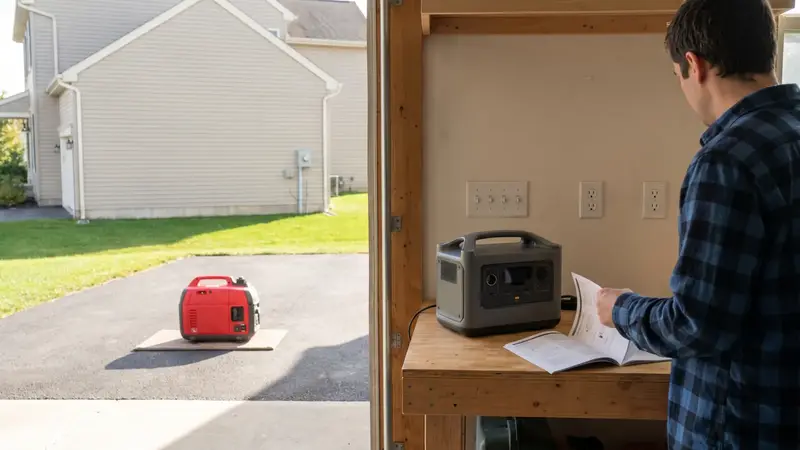 Power station vs generator: which one suits your home in an outage?A portable power station is a battery; a generator burns fuel. What that means for carbon monoxide, fuel stora…
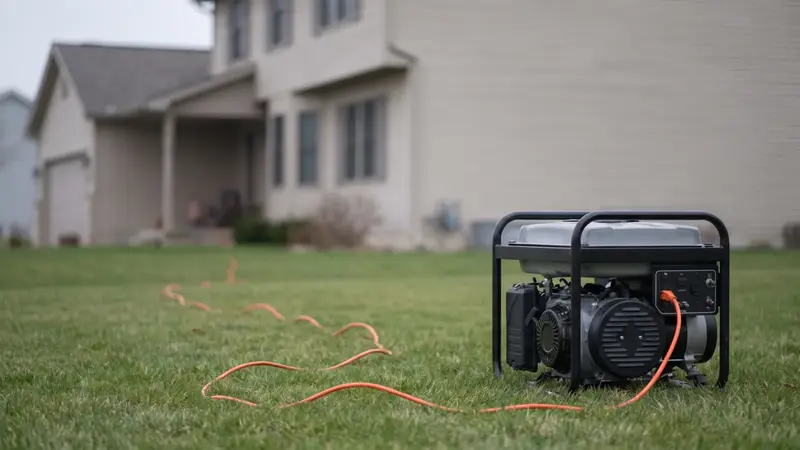 Portable generator safety: where to run it, carbon monoxide and cordsHow to use a portable generator safely in an outage: 20 feet from windows, never in a garage, CO alarms, outdo…