Goal Zero Yeti power stations compared: the current US range (2026)
Goal Zero, based in Utah, has made Yeti power stations for longer than most brands on this list, and its current range uses LiFePO4 batteries throughout. This page compares the Yeti models on Goal Zero's US store on November 9, 2026, from the 297Wh Yeti 300 to the 1,505Wh Yeti 1500, plus the Yeti PRO 4000 home battery, with capacity, output, surge, weight, battery cycles, recharge time and solar input side by side. Every figure is Goal Zero's own or from its Amazon listing; we haven't tested these units. The size calculator below works out what you'd actually need for an outage.
By Tom Calder · Updated November 9, 2026 · 6 products, all price-tracked
Our picks by size
Which size? ↓Not sure which size? Work it out ↓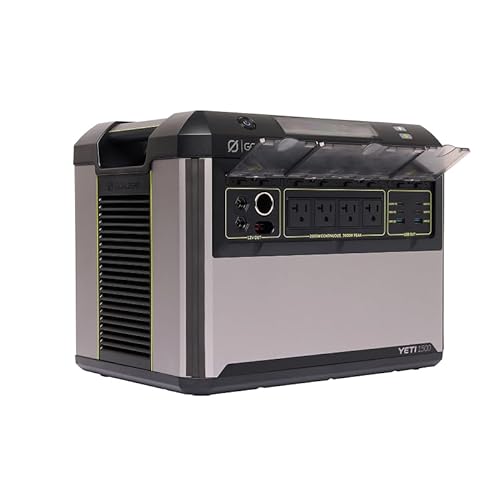 Photo: Amazon
Goal Zero Yeti 1500
1.5kWh with IPX4 water resistance, but heavy
as of Nov 9, 2026, 11:40 AM ET · Details
Product prices and availability are accurate as of the date/time indicated and are subject to change. Any price and availability information displayed on Amazon.com at the time of purchase will apply to the purchase of this product. Photo: Amazon
Goal Zero Yeti 300
A small Goal Zero for phones, lights and a router
as of Nov 9, 2026, 11:40 AM ET · Details
Product prices and availability are accurate as of the date/time indicated and are subject to change. Any price and availability information displayed on Amazon.com at the time of purchase will apply to the purchase of this product.All 6 compared
| Power station | Capacity | AC output | Surge | Weight | Battery | Cycles | Wall recharge | Solar in | AC volts | Expands | Price |
|---|---|---|---|---|---|---|---|---|---|---|---|
499.2 Wh · 500 W · 1,000 W · 16.1 lb · LiFePO4 · 4,000 · 1.4 h (fast) · 200 W · 120V · No About 500Wh for a CPAP or router overnight | 499.2 Wh | 500 W | 1,000 W | 16.1 lb | LiFePO4 | 4,000 | 1.4 h (fast) | 200 W | 120V | No | $499.95 at Goal Zero Checked Nov 9In stockCheck price → |
Our verdictOur verdictResearched 499Wh and 500W at 16.1 lb: a step up from the Yeti 300 for an overnight CPAP or a router and lights, but not a fridge. Best for About 500Wh for a CPAP or router overnight Good
Worth knowing
Who shouldn't buy it: Don't buy it if you want a fridge on it: the 1kWh class with 1,500W or more is the start. What it runs → | |||||||||||
 677 Wh · 600 W · 1,000 W · 20.3 lb · LiFePO4 · 4,000 · 1.7 h (fast) · 200 W · 120V · No A rugged mid-size from a long-standing brand | 677 Wh | 600 W | 1,000 W | 20.3 lb | LiFePO4 | 4,000 | 1.7 h (fast) | 200 W | 120V | No | $699.95 at Amazon as of Nov 9, 2026, 11:40 AM ET · DetailsProduct prices and availability are accurate as of the date/time indicated and are subject to change. Any price and availability information displayed on Amazon.com at the time of purchase will apply to the purchase of this product.In stockCheck price → |
Our verdictOur verdictResearched 677 Wh of LiFePO4 and 600 W (1,000 W surge) in a 20.3 lb unit from one of the original power-station brands; EcoFlow's RIVER 2 Pro holds more (768 Wh) at 18.2 lb. Best for A rugged mid-size from a long-standing brand Good
Worth knowing
Who shouldn't buy it: Don't buy it if you want the most capacity for the weight: the RIVER 2 Pro holds more and weighs less. Read the full review →What it runs → | |||||||||||
1,505 Wh · 2,000 W · 3,600 W · 52.75 lb · LiFePO4 · 4,000 · 1.1 h (fast) · 900 W · 120V 1.5kWh with IPX4 water resistance, but heavy | 1,505 Wh | 2,000 W | 3,600 W | 52.75 lb | LiFePO4 | 4,000 | 1.1 h (fast) | 900 W | 120V | — | $1,499.95 at Amazon as of Nov 9, 2026, 11:40 AM ET · DetailsProduct prices and availability are accurate as of the date/time indicated and are subject to change. Any price and availability information displayed on Amazon.com at the time of purchase will apply to the purchase of this product.In stockCheck price → |
Our verdictOur verdictResearched 1.5 kWh with a 2,000 W inverter (3,600 W surge) and IPX4 water resistance, but at nearly 53 lb it weighs about 21 lb more than Jackery's 1,536Wh Explorer 1500 v2. Best for 1.5kWh with IPX4 water resistance, but heavy Good
| |||||||||||
297 Wh · 350 W · 600 W · 13.7 lb · LiFePO4 · 4,000 · 50 min (fast) · 200 W · 120V · No A small Goal Zero for phones, lights and a router | 297 Wh | 350 W | 600 W | 13.7 lb | LiFePO4 | 4,000 | 50 min (fast) | 200 W | 120V | No | $349.95 at Amazon as of Nov 9, 2026, 11:40 AM ET · DetailsProduct prices and availability are accurate as of the date/time indicated and are subject to change. Any price and availability information displayed on Amazon.com at the time of purchase will apply to the purchase of this product.In stockCheck price → |
Our verdictOur verdictResearched 297Wh and 350W from Goal Zero's LiFePO4 line: sturdy, but at 13.7 lb it's heavier than rivals of the same size. Best for A small Goal Zero for phones, lights and a router Good
Worth knowing
Who shouldn't buy it: Don't buy it if weight matters: the EcoFlow RIVER 3 holds 245Wh at 7.8 lb. What it runs → | |||||||||||
 3,994 Wh · 3,600 W · 7,200 W · 115.7 lb · LiFePO4, 4,000+ cycles (maker) A US household that wants a plug-in battery that can also feed essential circuits through a transfer switch | 3,994 Wh | 3,600 W | 7,200 W | 115.7 lb | LiFePO4, 4,000+ cycles (maker) | — | — | — | — | — | |
Our verdictOur verdictResearched Goal Zero's own page lists 3,994 Wh, 3,600 W continuous and 7,200 W surge, with a 5-year warranty. It says the unit can back up to 10 home circuits through its Haven 10 manual transfer switch and runs almost any home appliance aside from air conditioning. A good fit for fridge, lights, Wi-Fi and a medical device, and it needs a transfer switch or an electrician for the circuit hookup. Best for A US household that wants a plug-in battery that can also feed essential circuits through a transfer switch Good
Worth knowing
Who shouldn't buy it: Don't buy it if you need central air conditioning to run in an outage: Goal Zero says it runs most home appliances aside from air conditioning. What it runs → | |||||||||||
998.4 Wh · 2,000 W · 3,600 W · 35.3 lb · LiFePO4 · 4,000 · 1.2 h (fast) · 900 W · 120V A 1kWh Goal Zero with 2,000W output | 998.4 Wh | 2,000 W | 3,600 W | 35.3 lb | LiFePO4 | 4,000 | 1.2 h (fast) | 900 W | 120V | — | $1,199.95 at Goal Zero Checked Nov 9Out of stockCheck price → |
Our verdictOur verdictResearched 998Wh and 2,000W (3,600W surge) by Goal Zero's spec table, but 35.3 lb, about 10 lb more than the lightest 1kWh rivals. Best for A 1kWh Goal Zero with 2,000W output Good
Worth knowing
Who shouldn't buy it: Don't buy it if you'll carry it: the Anker SOLIX C1000 Gen 2 is 24.9 lb with the same output. What it runs → | |||||||||||
ⓘ As an Amazon Associate, PreparedStates earns from qualifying purchases. We may earn a commission when you buy through our links. When two products are close, commission can decide which one we pick. A clearly better product always wins. Amazon prices come from Amazon's own product data and can change at any time.
Before you buy
Decode the range.
The Yeti 300, 500 and 700 are for small loads: phones, a router, lights, a CPAP. The Yeti 1000 and 1500 are the home-outage sizes, each with 2,000W output and a 3,600W surge by Goal Zero's figures. The Yeti PRO 4000 is a home battery, on our home backup page.
Size it on what you'd run.
A router and phones need well under 300Wh for an evening. A CPAP overnight suits the Yeti 500 or 700. A fridge needs the 1kWh class with enough surge to start its compressor: the Yeti 1000 or 1500.
Battery life.
Goal Zero rates every current Yeti here at 4,000 cycles to 80% of original capacity, in line with other LiFePO4 stations.
Recharging.
Goal Zero quotes a fast AC charge of 50 minutes on the Yeti 300, 1.4 hours on the Yeti 500, 1.7 hours on the Yeti 700, 1.2 hours on the Yeti 1000 and 1.1 hours on the Yeti 1500, with slower default speeds. The Yeti 1000 and 1500 take up to 900W of solar; Goal Zero's own Boulder and Nomad panels fit, as do others: see our solar panel comparison.
120V only.
The Yeti 300 to 1500 have 120V outlets, so none will run a 240V well pump or dryer.
What it will run, and for how long
Each figure runs that one thing on its own from the AC outlet, worked out with BLUETTI’s runtime formula: capacity × 90% usable × 85% inverter efficiency ÷ (the appliance’s average draw + about 10W the power station uses itself). A refrigerator or freezer is costed at its day-long average from Energy Star’s figures, not the compressor’s peak. Routers and phones last longer on the USB or DC ports, which skip the inverter. Treat every figure as an estimate and plan on the low end.
| Running just this | Average draw | Small (about 300Wh) | 1kWh class (1,024Wh) | 2kWh class (2,048Wh) |
|---|---|---|---|---|
| Refrigeratorneeds a pure sine wave inverter: check the spec | 34–84W | may not start it (a compressor can need about 2,600W for a moment) | 8.5 to 18 hours | 17 to 36 hours |
| Freezer (chest or upright)needs a pure sine wave inverter: check the spec | 23–71W | may not start it (a compressor can need about 2,600W for a moment) | 9.5 to 24 hours | 19 to 47 hours |
| CPAP (blower only: humidifier and heated tube off)needs a pure sine wave inverter: check the spec | 4–20W | 7.5 to 16 hours | 26 to 56 hours | 2 to 4 days |
| CPAP with heated humidifier (and heated tube)needs a pure sine wave inverter: check the spec | 21–67W | 3 to 7 hours | 10 to 25 hours | 20 to 51 hours |
| Gas furnace blower (1/3 to 1/2 HP) | 450–600W | may not start it (a compressor can need about 1,800W for a moment) | about 1.5 hours | 2.5 to 3.5 hours |
| Modem and Wi-Fi router | 10–18W | 8 to 11 hours | 28 to 39 hours | 2 to 3 days |
| Laptop (plugged in, in use) | 30–70W | 3 to 5.5 hours | 10 to 20 hours | 20 to 39 hours |
| LED light bulb (60W equivalent, each) | 7.5–10W | 11 to 13 hours | 39 to 45 hours | about 3 days |
| TV (32 to 65-inch LED) | 30–128W | 1.5 to 5.5 hours | 5.5 to 20 hours | 11 to 39 hours |
| Home oxygen concentratorneeds a pure sine wave inverter: check the spec | 275–325W | 0.5 to 1 hour | about 2.5 hours | 4.5 to 5.5 hours |
Method: BLUETTI — Elite 200 V2 (runtime formula: DoD 90%, η 85%, self-consumption about 10W) · BLUETTI — Elite 100 V2 (self-consumption about 10W) · EcoFlow — test runtime before an emergency (0.80–0.90 for AC; DC ports for routers and phones). Appliance figures from Energy Star’s product data, Champion’s and DTE Energy’s wattage charts and the device makers’ manuals; the runtime pages show the workings for each appliance.
What size do you need? Work it out
Tick what you would keep running and for how long. It uses typical figures for each appliance, allows for what the power station uses itself and leaves 10% of the battery unused, and shows a cautious figure for older or larger appliances alongside.
You need about 1,597Wh of battery (up to 2,136Wh if your appliances are older or larger), and 898W of output if everything runs at once.
We verify every product's specifications against at least two independent sources, re-check its US price and stock on a schedule where we can track it automatically, and cross-check safety-relevant claims against official guidance. Every review is labeled Researched or Used and reviewed by us: where we've bought a product, or been sent it free, and used it ourselves, its review says which; where we haven't, our verdict is a considered spec-and-evidence comparison, not a hands-on test. When two products are close, commission can decide which one we pick. A clearly better product always wins. Read our full methodology →
Head-to-head
Related gear comparisons
Guides that go with this
Sizing a portable power station for a US home: watts vs watt-hours, starting surge, what a refrigerator, CPAP,…
Will a portable power station run your refrigerator? How fridge wattage works at 120V, why starting surge matt…
What a CPAP draws, from ResMed and Philips manuals, how to size a portable power station for a night, and the …
A portable power station is a battery; a generator burns fuel. What that means for carbon monoxide, fuel stora…
Common questions
Which Goal Zero Yeti should I buy?
For a fridge in an outage, the Yeti 1000: 998Wh, 2,000W output and a 3,600W surge at 35.3 lb, by Goal Zero's spec table, if it's in stock. For a CPAP or router overnight, the Yeti 500 or 700.
Are Goal Zero power stations worth it?
They're well-made LiFePO4 stations from a long-standing US brand, but on paper they're heavier than Anker, EcoFlow and Jackery models of the same capacity and the smaller ones take less solar. Buy one if you value the brand and its support; otherwise compare in our full power station table.
Yeti 1000 or Yeti 1500?
The same 2,000W output and 3,600W surge by Goal Zero's figures. The 1500 holds about 50% more (1,505Wh against 998Wh) and weighs 52.75 lb against 35.3 lb.
Can I add batteries to a Goal Zero Yeti?
Not the current Yeti 300, 500 or 700, which Goal Zero lists as not chainable, and we found no expansion battery listed for the Yeti 1000 or 1500. Goal Zero's Tank PRO 4000 expansion battery is for the Yeti PRO 4000 home battery, on our home backup page.