
Is stockpiling illegal? What hoarding law and price-gouging rules cover at home
Not for ordinary household supplies. The federal hoarding rule covers only goods the President designates as scarce, and price-gouging laws are about sellers.
By Tom Calder · Updated November 11, 2026 · Sourced to the US Code, the Federal Register, HHS, the Congressional Research Service, Ready.gov and CDC
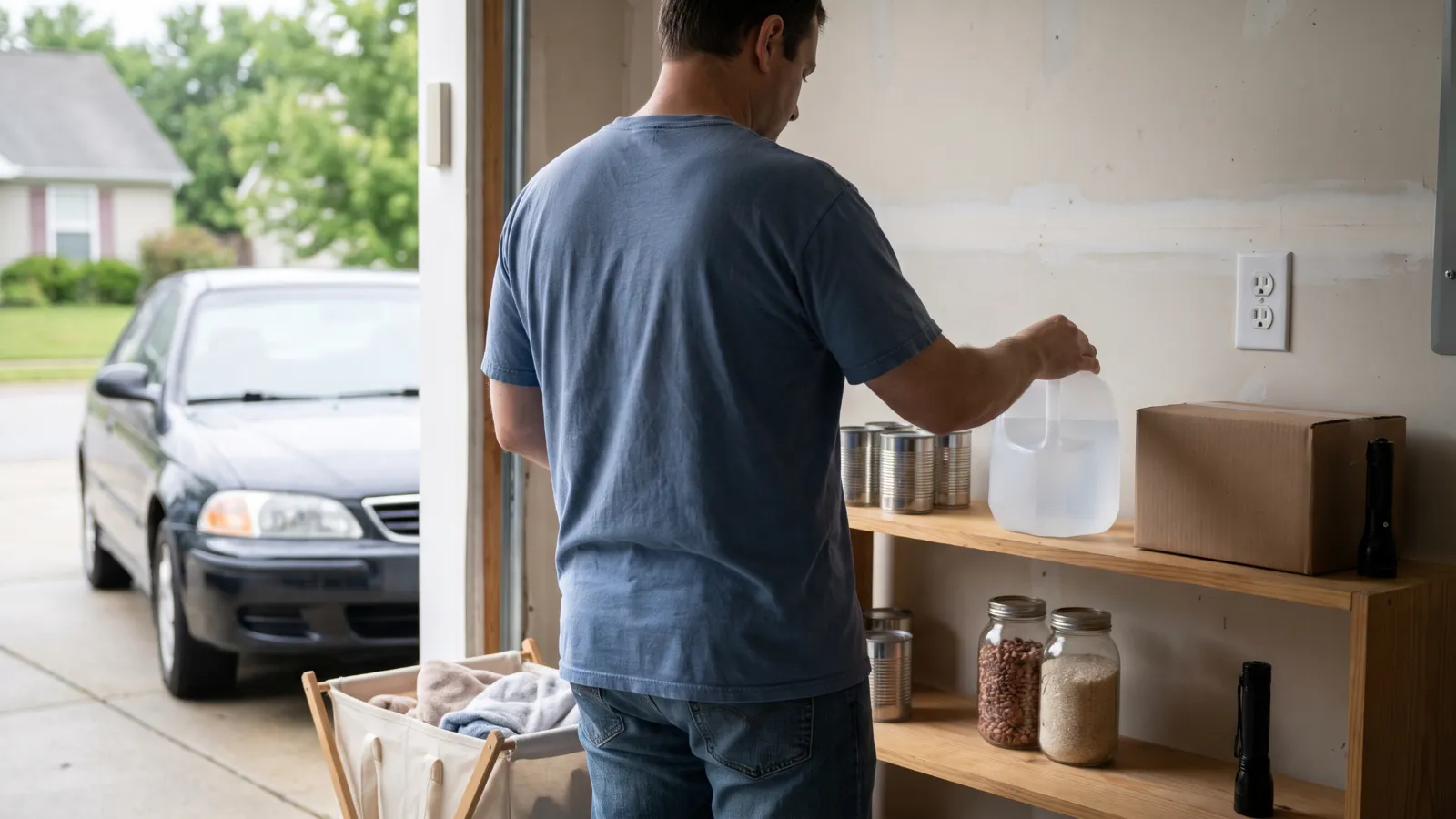
“is stockpiling illegal”
Household supplies: no. Hoarding law: designated scarce goods only.
- Is stockpiling illegal? Not for ordinary household supplies. The federal hoarding rule, section 102 of the Defense Production Act, covers only materials the President has designated as scarce, and only amounts beyond the reasonable demands of personal or home use, or bought to resell above market prices.
- The last list we found was COVID-era medical supplies, such as N95 respirators, ventilators and gloves. The 2020 order behind it was revoked in April 2024, and HHS rescinded the last list in May 2025. We found no designation in force.
- Price-gouging laws, which most states have, are about sellers raising prices, usually after a declared emergency. They don't limit how much a household keeps.
- Ready.gov and CDC ask households to keep several days of food and water, and 2 weeks of water if possible. You don't need to buy anything because of this headline.
The three things most homes are missing
Our top pick from each comparison
as of Nov 13, 2026, 6:44 PM ET · Details
Product prices and availability are accurate as of the date/time indicated and are subject to change. Any price and availability information displayed on Amazon.com at the time of purchase will apply to the purchase of this product.
as of Nov 13, 2026, 6:44 PM ET · Details
Product prices and availability are accurate as of the date/time indicated and are subject to change. Any price and availability information displayed on Amazon.com at the time of purchase will apply to the purchase of this product.
as of Nov 13, 2026, 6:44 PM ET · Details
Product prices and availability are accurate as of the date/time indicated and are subject to change. Any price and availability information displayed on Amazon.com at the time of purchase will apply to the purchase of this product.If you already have these, you're most of the way there. As an Amazon Associate, PreparedStates earns from qualifying purchases. We may earn a commission when you buy through our links. When two products are close, commission can decide which one we pick. A clearly better product always wins.
What the federal hoarding law says
The US hoarding rule is section 102 of the Defense Production Act, now 50 U.S.C. 4512. It says: "In order to prevent hoarding, no person shall accumulate (1) in excess of the reasonable demands of business, personal, or home consumption, or (2) for the purpose of resale at prices in excess of prevailing market prices, materials which have been designated by the President as scarce materials or materials the supply of which would be threatened by such accumulation."
So the rule has two parts. It only reaches materials the President has designated. And even for those, it only covers amounts beyond reasonable business, personal or home use, or buying to resell above the going price. The law also says every designation, and any withdrawal of one, must be published in the Federal Register.
The penalty section, 50 U.S.C. 4513, applies to anyone who "willfully" breaks the rules in this part of the law: on conviction, a fine of up to $10,000, up to a year in prison, or both.
The last time it was used: COVID medical supplies
On March 23, 2020, Executive Order 13910 said it was US policy that health and medical resources needed to respond to COVID-19, "such as personal protective equipment and sanitizing and disinfecting products, are not hoarded." It handed the President's section 102 power to the Secretary of Health and Human Services.
HHS designated 15 kinds of item, taking effect March 25, 2020. The list was clinical: N95 and other respirators, ventilators, chloroquine and hydroxychloroquine, sterilization services, gowns, coveralls, face masks, surgical masks, face shields and gloves, and disinfecting products "suitable for use in a clinical setting." Food and bottled water were not on it.
HHS extended the list in July 2020, February 2021 and July 2021, trimming it along the way. Its July 2021 notice dropped N95s and other items "because they are no longer scarce or threatened materials," and said the designation "terminates on November 15, 2021."
Executive Order 14122 of April 12, 2024 revoked Executive Order 13910. On May 14, 2025, HHS rescinded that July 2021 notice, one of what it called "four informal guidance documents."
What is confirmed, and what is not
Confirmed: the federal hoarding rule is still in the US Code, with criminal penalties. It applies only to materials designated as scarce, and only to amounts beyond reasonable personal or home use, or bought to resell above market prices. The 2020 order that produced the last list has been revoked, and the last list has been rescinded.
Not found: any designation in force today. We found no newer designation in the Federal Register records we checked. A new one would have to be published there, and this page will change if one is.
Not covered here: every state's and city's emergency powers. This page covers the federal hoarding rule and state price-gouging laws in general, from official sources. It isn't legal advice, and it doesn't mean we have checked every local rule.
Price gouging: rules for sellers
Price gouging is a different thing from stocking up. The Congressional Research Service, Congress's research office, describes it as a phrase "commonly used to refer to sellers increasing prices to take advantage of certain circumstances" such as emergencies, when supply drops but demand doesn't.
In a May 5, 2026 report on gasoline prices, CRS says a majority of states, as well as the District of Columbia, Guam and the Northern Mariana Islands, have laws or regulations that prohibit price gouging, excessive price increases or unconscionable pricing. Most are triggered by a declared emergency, and other states may use their general deceptive trade practice laws. It also says no federal statute specifically addresses retail gasoline price spikes caused by individual sellers acting on their own.
These laws are about the price charged for a sale. They don't limit how much a household buys or keeps. They can matter if you buy up goods to resell after a disaster, and the rules differ from state to state. USA.gov lists every state attorney general, the top legal officer in each state or territory.
What it means for your home
Official US advice is to keep supplies, not to avoid them. Ready.gov says that after an emergency "you may need to survive on your own for several days," and that "being prepared means having your own food, water and other supplies to last for several days." CDC says to store at least 1 gallon of water per person, per day for 3 days, and to "try to store a 2-week supply if possible."
Ready.gov also says to build an emergency supply kit over time, starting with items you may already have, and that when you go to the grocery store, "you can pick up an extra item each time that you use regularly." That is how official advice expects households to build a supply: gradually, from things they use.
Our emergency kit checklist, how much water to store and how to stockpile food and water guides set out the basics, and the kit builder sizes Ready.gov's list to your household.
What not to do
Don't buy large amounts to resell after a storm or other emergency: state price-gouging laws may apply to you as a seller. Don't clear shelves in a rush either; a few extra items on each regular shop builds the same supply without leaving neighbors short.
And don't buy anything because of this headline. If you already have several days of food and water at home, you're doing what Ready.gov asks.
We will update this check if the President or a federal agency publishes a new scarce-materials designation in the Federal Register, or if Congress passes a federal price-gouging law.
Common questions
Is stockpiling illegal?
Not for ordinary household supplies. The federal hoarding rule in the Defense Production Act covers only materials the President has designated as scarce, and only amounts beyond reasonable personal or home use, or bought to resell above market prices. The last designations, for COVID medical supplies, have been rescinded, and we found none in force.
Can the government stop me from stocking up?
Under section 102 of the Defense Production Act, the President can designate scarce materials and set conditions on accumulating them beyond reasonable home use. Every designation must be published in the Federal Register. Even then, the rule targets amounts beyond reasonable business, personal or home use, or buying to resell above market prices.
What was covered by the 2020 hoarding order?
Medical supplies. HHS's March 2020 list named 15 kinds of item, including N95 and other respirators, ventilators, gowns, masks, face shields, gloves, chloroquine and hydroxychloroquine, and clinical disinfecting products. Food and bottled water were not on it. The order was revoked in 2024, and HHS rescinded the last list in 2025.
Is it price gouging to resell supplies I bought?
It can be. Most states have price-gouging laws, usually triggered by a declared emergency, and they apply to what sellers charge. The rules differ by state. Buying for your own household isn't what these laws cover.
How much food and water should I keep at home?
Ready.gov says several days of food, water and other supplies. CDC says at least 1 gallon of water per person, per day for 3 days, and a 2-week supply if possible. Build it gradually from foods your family eats.
Sources (14)
- US Code: 50 U.S.C. 4512, Hoarding of designated scarce materials (GovInfo, 2023 edition)
- US Code: 50 U.S.C. 4513, Penalties (GovInfo, 2023 edition)
- Executive Order 13910: Preventing Hoarding of Health and Medical Resources To Respond to the Spread of COVID-19 (85 FR 17001, Mar 26, 2020)
- HHS: Notice of Designation of Scarce Materials or Threatened Materials Subject to COVID-19 Hoarding Prevention Measures (85 FR 17592, Mar 30, 2020)
- HHS: Extension of Designation of Scarce Materials or Threatened Materials (86 FR 35810, Jul 7, 2021)
- Executive Order 14122: COVID-19 and Public Health Preparedness and Response (89 FR 27355, Apr 17, 2024)
- HHS: Rescission of guidance documents (90 FR 20393, May 14, 2025)
- Congressional Research Service: Gasoline Price Increases: Federal and State Authority to Limit "Price Gouging" (R47072, May 5, 2026)
- USA.gov: State attorneys general
- Ready.gov: Build a kit
- Ready.gov: Low and no cost preparedness
- CDC: Creating and storing an emergency water supply
- UK Cabinet Office: Households encouraged to take small, simple steps to stay prepared in an emergency (Oct 22, 2026)
- The National: UK government advises stockpiling water and food (Oct 23, 2026)
Get one calm email when it matters
Seasonal checklists and gear price drops. No spam, unsubscribe any time.
Keep reading
 Is the US government telling Americans to stockpile? What the UK, Japan and the US actually sayThe UK and Japan are asking households to keep a few days of supplies, framed around storms, cyber attacks and…
 How to stockpile food and water for your household: what the official lists sayHow to stockpile food and water for your household: Ready.gov says several days, the Red Cross says 2 weeks. W…
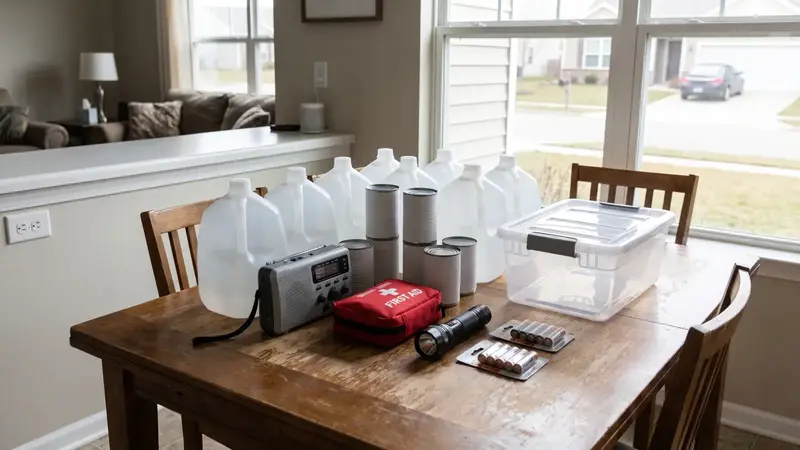 Emergency kit checklist: what to include, how much to keep and where to store itA plain-English emergency kit checklist built on Ready.gov's basic kit and extra items, with how many days of …
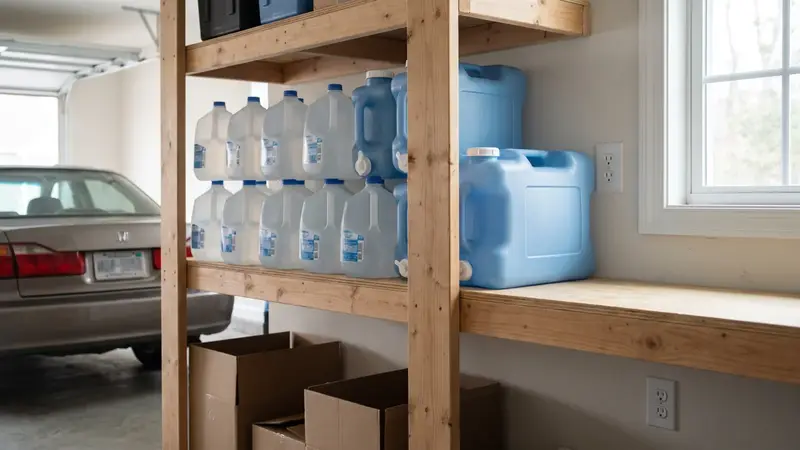 How much water to store for an emergency: per person, per pet and for how longHow much water to store for an emergency: 1 gallon per person per day, pets, which containers to use, when to …