
Why were US flights grounded on November 13, and could it happen again?
A router switched in during copper-to-fiber telecom work flooded the FAA's network, Secretary Duffy says. Departures stopped nationwide for about four hours.
By Tom Calder · Updated November 15, 2026 · Sourced to the FAA (its statement, Command Center advisories, controller glossary, history pages and battery rules), the Department of Transportation, the Department of Homeland Security, L3Harris, NATCA, and the statements of Delta, American and Alaska Airlines
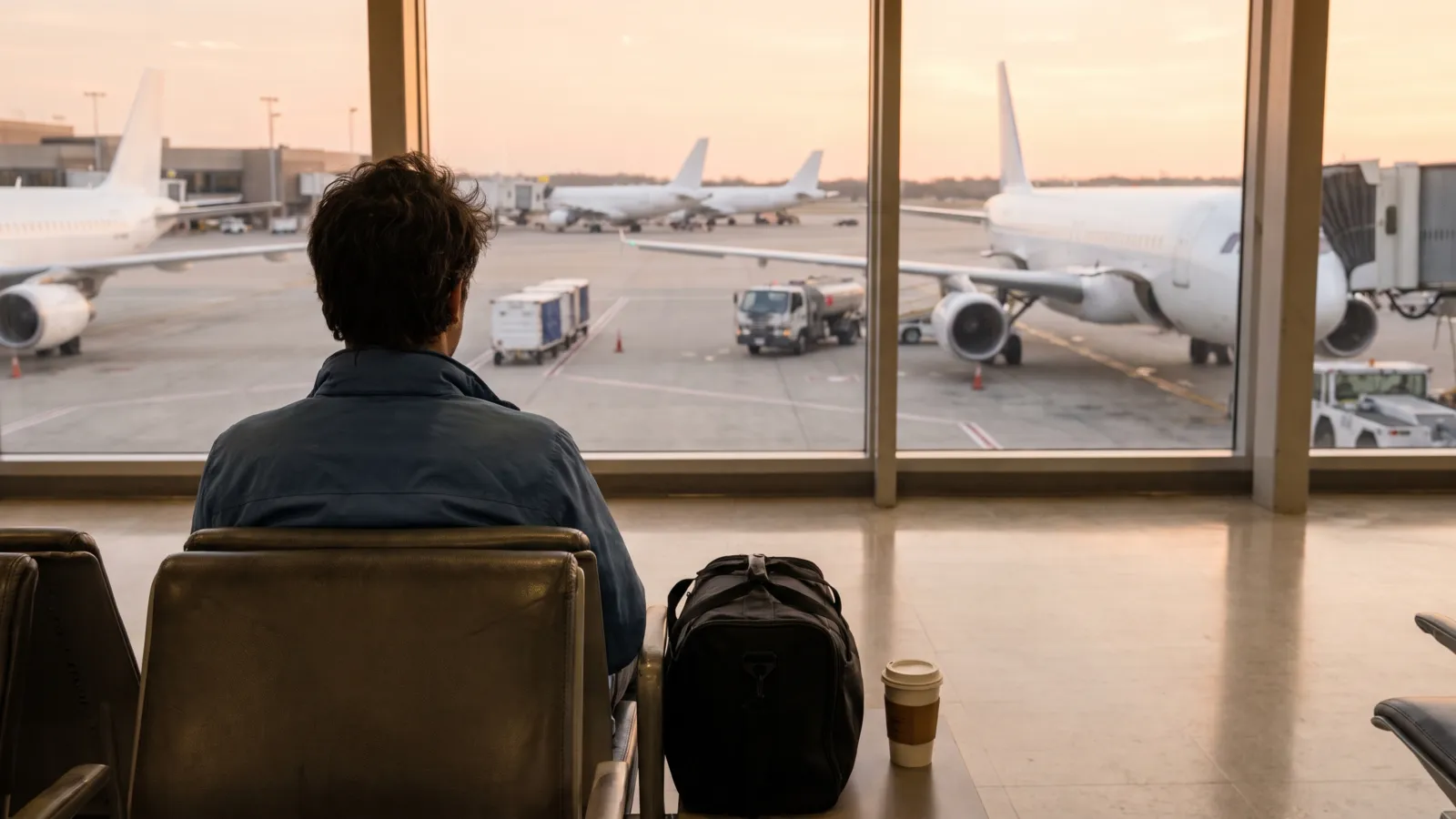
- Flights were grounded because the FAA's air traffic control telecom network was disrupted, according to Transportation Secretary Sean Duffy. He said a router being replaced during routine copper-to-fiber work at a remote FAA site "started flooding other routers," disrupting communication with planes and radar feeds. The FAA ordered a ground stop at all US airports at 3:54 p.m. Eastern on Friday, November 13, and Duffy said the airspace reopened at 8:15 p.m.
- Planes already flying kept going and landed: Duffy said more than 3,500 were in the air. The exact fault isn't known yet. Duffy said on November 14: "We haven't determined what the fault was." He named the contractor as L3Harris, which says it is supporting the FAA's investigation. Officials have said they don't believe it was a cyberattack.
- Could it happen again? Duffy said there will be "a reevaluation of when we do this work." We found no official timeline. Before any trip, check your flight with your airline. There is nothing to buy.
Why were flights grounded? What stopped, and when
The FAA's Command Center ordered at 3:54 p.m. Eastern on Friday, November 13: "ALL AIRPORTS ARE GROUND STOPPED. ALL DEPARTING TRAFFIC SHOULD REMAIN GROUND STOPPED UNTIL FURTHER NOTICE." The FAA's statement that day said it acted "following communication issues impacting multiple Air Route Traffic Control Centers." Duffy said the instability began at 3:36 p.m. and that the airspace reopened at 8:15 p.m. Eastern; the Command Center's cancellation notice was signed at 8:19 p.m. That is about four hours and 20 minutes from the order to the reopening, by our reading of those times.
Some reports have called it the longest nationwide ground stop since 2001. We found no FAA or DOT statement that says so, so we don't repeat it as fact.
Whether it was a cyberattack is answered in our check of what officials have said. If your flight was canceled, see what airlines owe you after the ground stop. This page explains the cause officials have given, what a ground stop is, and what they have said about it happening again.
What a ground stop is, and why planes in the air kept flying
The FAA's controller glossary defines it: "The GS is a process that requires aircraft that meet a specific criteria to remain on the ground." It says ground stops "normally occur with little or no warning." The FAA's traffic management order calls them "one of the most restrictive methods of traffic management" and lists, among the times to use one, when "a facility is unable or partially unable to perform ATC services due to unforeseen circumstances."
A ground stop holds departures; it doesn't order planes out of the sky. Delta said on Friday evening that "flights currently enroute will continue to their destinations," and American and Alaska said the same. Duffy said that when the ground stop was issued "we had over 3,500 airplanes in the air," and DOT said controllers and pilots landed them safely. Inbound international flights, the Command Center's order said, "will be managed on a case by case basis." Alaska Airlines said flights within Alaska and Neighbor Island flights in Hawaii were "not impacted."
What the FAA and Secretary Duffy say caused it
On November 13, Duffy described the FAA's analog telecom: "Our switches, our routers actually got overloaded with data," and "It's the old hardware that went down." On November 14, with FAA Administrator Bryan Bedford, he gave more detail. At "at least one of our remote FAA locations, a contractor was doing routine maintenance to switch telecommunication lines from old copper wire and they were bringing it over to fiber."
He said the contractor is L3Harris, which he called "our legacy provider," adding that "L3Harris actually owns that network." The router being swapped in "started flooding other routers in our air traffic control system," with "over 1,000 connection attempts every four to five seconds," which affected communication with airplanes and "caused some disruption with our radar feeds." Once the work at the site was isolated, he said, "all of our systems came back online."
On a cyberattack, Duffy said: "We don't believe so." Homeland Security Secretary Markwayne Mullin said on November 13: "We have seen zero evidence that this is a cyberattack" (he added "or an SI attack"). Bedford said the work was routine upkeep of the existing network and "not part of the Peraton-FAA $12.5 billion modernization effort."
What the controllers' union and L3Harris have said
L3Harris said on November 14 that it is "supporting the FAA in its investigation to understand the conditions that led to the Nov. 13 ground stop" and "takes the nationwide ground stop and its impact on travelers, airlines and air traffic operations seriously." Its statement doesn't give a cause or respond to Duffy's question of whether the fault was an install error or a faulty router.
The National Air Traffic Controllers Association (NATCA) has posted that its president, Nick Daniels, appeared on CNN and BBC America during the ground stop. As of Sunday morning, we found no written NATCA statement on the cause on its website, so we have no union account to set beside the officials' one.
What is still not known
The precise fault. Duffy said officials are "working to determine" whether it was "user error or install error from L3Harris" or "a faulty router." The FAA's own November 13 statement calls its information "preliminary and subject to change," and as of Sunday morning the FAA had posted nothing newer. We found no official count of all canceled flights. Alaska Air Group alone said it had canceled "nearly 600 flights since the ground stop began, affecting the travel plans of more than 52,000 of our guests."
Could it happen again? What the FAA and DOT have said
Officials have not said it can't. On timing, Duffy said work at small remote sites has been done during the day, while switchovers at big facilities such as Newark "happen at night," and "there'll be a reevaluation of when we do this work." He said the copper-to-fiber change is being made "because it's safer and it's more resilient," and that "we have replaced 69% of the copper communications." L3Harris says that it, its telco partners and the FAA have completed "more than 70%" of the planned conversion. We found no official date for finishing it.
Duffy and Mullin both called on Congress to fund a full replacement air traffic control system. Duffy said the $12.5 billion already provided covers a portion that "will be done by the time President Trump leaves office." That is their plan and their timeline, not ours.
The FAA has ordered nationwide ground stops before. Its history says that on September 11, 2001, it "put a ground stop on all traffic for the first time in U.S. aviation history." On January 11, 2023, after its NOTAM pilot-notice system failed, the FAA stopped all US departures from about 7:15 a.m. to 9:07 a.m. Eastern. The FAA later said "contract personnel unintentionally deleted files" and that it found no evidence of a cyberattack.
Before you fly in the coming weeks, Thanksgiving included
A ground stop can't be planned for, but a long wait can. Airlines' own advice is the first step: American says to "check their flight status on the American app or aa.com before heading to the airport," and Alaska and Delta say the same for their apps and websites. Turn on your airline's flight alerts so a change reaches your phone.
If the airline cancels your flight and you choose not to travel, DOT's rules entitle you to a refund; our refund guide explains how, and what hotels and meals depend on. Pack your carry-on for a few extra hours: medicines you take, a phone charger and a snack. A power bank must go in your carry-on: the FAA says spare lithium batteries, "including power banks," go "in carry-on baggage only," and must come out of a bag checked at the gate.
- Check your flight status with the airline before you leave home
- Turn on the airline's text or app alerts
- Know your refund right if the airline cancels
- Carry medicines, a charger, a power bank and a snack in your carry-on bag
What not to do
Don't head to the airport on an old departure time after a disruption: check first. Don't cancel a nonrefundable ticket yourself while the flight is still scheduled if you want your money back; read the airline's waiver first. And be wary of posts naming a cause or a culprit as settled: Duffy said on November 14 that the fault hadn't been determined, and we found no update since.
We'll update this story if the FAA, DOT or L3Harris names the fault, if NATCA publishes a statement on the cause, or if the FAA or DOT announces changes to when telecom work is done, or a completion date for the copper-to-fiber switch.
Common questions
Why were flights grounded?
Transportation Secretary Sean Duffy says a router being replaced during copper-to-fiber telecom work at a remote FAA site flooded other routers in the air traffic control network, disrupting communication with planes and radar feeds. The FAA stopped departures nationwide to keep flights safe. Duffy said on November 14 that the exact fault had not been determined.
How long did the FAA ground stop last?
The FAA Command Center's order was signed at 3:54 p.m. Eastern on Friday, November 13. Duffy said the airspace reopened at 8:15 p.m. Eastern, and the cancellation notice was signed at 8:19 p.m. Delays and cancellations continued into the weekend.
Why did planes already in the air keep flying?
A ground stop holds aircraft on the ground; the FAA defines it as a process that requires aircraft "to remain on the ground." Airlines said flights already in the air continued to their destinations. Duffy said more than 3,500 were airborne when the ground stop was issued, and DOT says they all landed safely.
Was it a cyberattack?
Officials say they don't believe so. Duffy said: "We don't believe this was cyber at all." DHS Secretary Markwayne Mullin said officials had seen "zero evidence" of a cyberattack. Our separate check covers what each official said.
Could a nationwide ground stop happen again?
No official has ruled it out. Duffy said there will be a reevaluation of when telecom work is done, and that 69% of copper communications has been replaced. Earlier nationwide ground stops include September 11, 2001, the first in US aviation history according to the FAA, and one of about two hours on January 11, 2023.
Sources (18)
- FAA Command Center: advisory 111, national ground stop (Nov 13, 2026)
- FAA Command Center: advisory 005, nationwide ground stop canceled (Nov 14, 2026 UTC)
- FAA: Statement on nationwide ground stop (Nov 13, 2026)
- Department of Transportation: Secretary Duffy announces lifting of nationwide ground stop (Nov 13, 2026)
- Department of Transportation: Secretary Duffy provides update on restoration of airspace (Nov 14, 2026)
- Department of Transportation: Secretary Duffy begins retiring decades-old floppy disks
- Department of Homeland Security: Secretary Mullin and Secretary Duffy address nationwide FAA ground stop (Nov 13, 2026)
- FAA: Pilot/Controller Glossary, G (ground stop)
- FAA: Order JO 7210.3, chapter 18 section 13, Ground Stop(s)
- FAA: A brief history of the FAA
- FAA: NOTAM statements (Jan 11 and 19, 2023)
- FAA: Written statement of Acting Administrator Billy Nolen on the NOTAM outage
- FAA PackSafe: Lithium batteries
- L3Harris: Statement on the Nov. 13 ground stop (Nov 14, 2026)
- NATCA: President Nick Daniels appeared on CNN OutFront during the nationwide ground stop (Nov 13, 2026)
- Delta News Hub: Flexible rebooking options as operations recover (Nov 13–14, 2026)
- American Airlines newsroom: Update on FAA's nationwide ground stop (Nov 13–14, 2026)
- Alaska Airlines: Statement on FAA-issued ground stop (Nov 13–14, 2026)
Get one calm email when it matters
Seasonal checklists and gear price drops. No spam, unsubscribe any time.
Keep reading
 Was the Microsoft outage and FAA ground stop a cyberattack? What officials have saidDHS says it has seen zero evidence of a cyberattack. The FAA blames a communications failure. Microsoft's outa…
 Flight canceled in the FAA ground stop: are you owed a refund, a hotel or compensation?If the airline canceled your flight and you chose not to fly, DOT says you're owed a refund. A hotel, meals or…
 Go-bag checklist: what to pack in case you have to evacuateWhat to pack in a go-bag: documents, medications, cash, chargers, per-person items, kids and pets, and how it …
 How to make a family emergency plan: steps, questions and a communication planHow to make a family emergency plan: Ready.gov's four steps, the questions to ask, a communication plan, meeti…