
Is there going to be a blackout for 18 months? What the grid record and the Pentagon plan say
Is there going to be a blackout for 18 months? No official source says so. Where the figure comes from, what NERC and the Pentagon say, and what to plan for at home.
By Tom Calder · Updated November 21, 2026 · Sourced to the Department of Energy, NERC, the Department of War, the US Army, the EMP Commission, EIA, FEMA, Ready.gov, CDC and Gadget Review
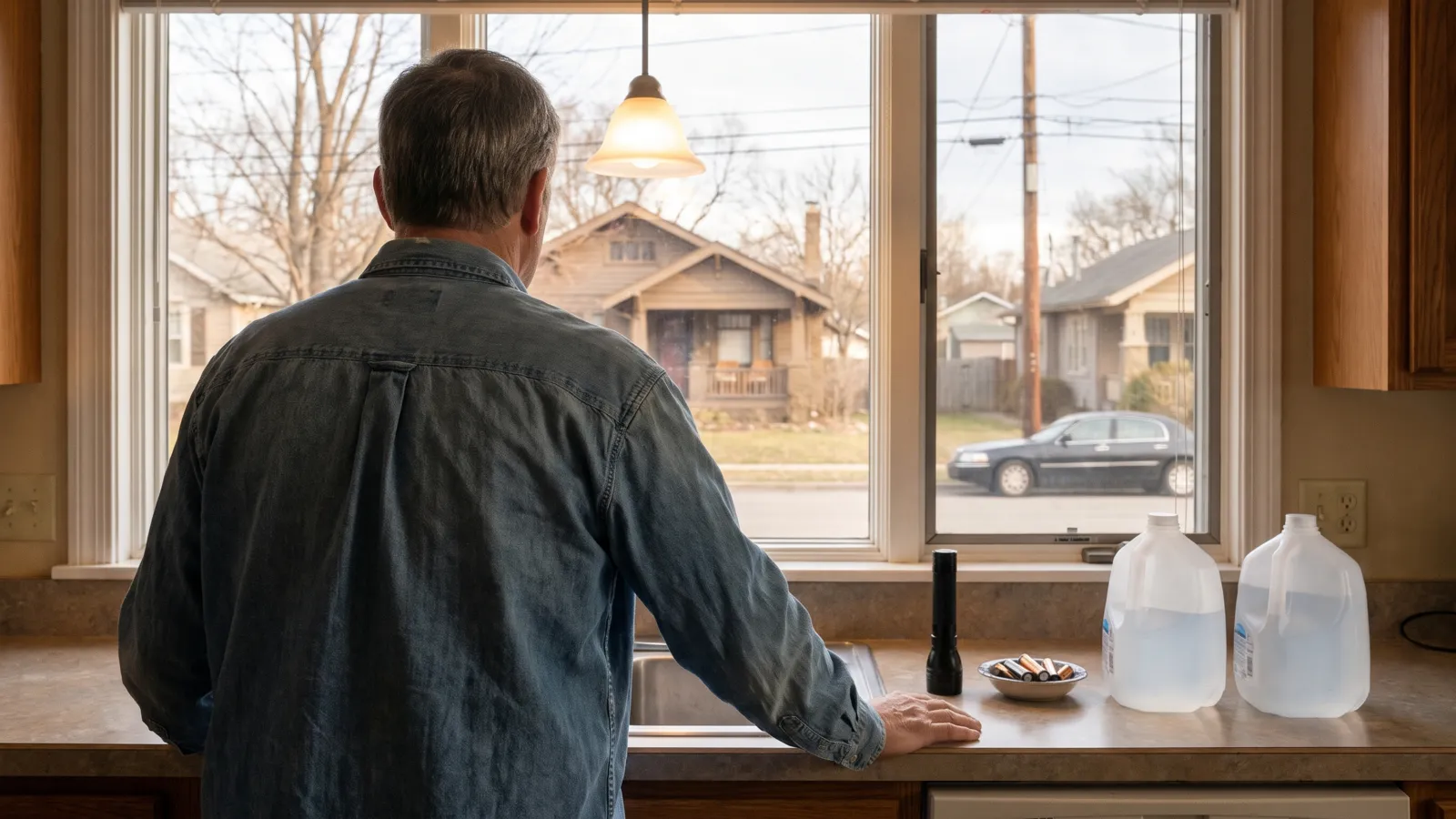
“Expert Warns U.S. Grid Could Face an 18-Month Blackout Scenario”
We found no official forecast, date or length for a US blackout. The 18 months is a press-reported attack scenario.
- Is there going to be a blackout for 18 months? We found no official source that says so. None of the Energy Department, NERC or Pentagon documents we checked gives a date or a length for a US blackout; the 18 months comes from a worst-case attack scenario that a tech site credits to a former federal energy regulator.
- Official papers do give long times, for equipment. The Energy Department wrote in 2014 that buying a large power transformer could take "up to 18 to 24 months" when demand is high, and in 2024 that 36-month lead times are commonly quoted. That is a delivery time, not a blackout length.
- NERC's winter assessment, posted November 18, found adequate resources for a normal winter peak, with the risk in extreme, wide-area cold. The Pentagon's plan is for bases to run 30 days without utilities.
- You don't need to buy anything. Ready.gov's advice is supplies for several days.
The three things most homes are missing
Our top pick from each comparison
as of Nov 21, 2026, 1:52 AM ET · Details
Product prices and availability are accurate as of the date/time indicated and are subject to change. Any price and availability information displayed on Amazon.com at the time of purchase will apply to the purchase of this product.
as of Nov 21, 2026, 1:52 AM ET · Details
Product prices and availability are accurate as of the date/time indicated and are subject to change. Any price and availability information displayed on Amazon.com at the time of purchase will apply to the purchase of this product.
as of Nov 21, 2026, 1:52 AM ET · Details
Product prices and availability are accurate as of the date/time indicated and are subject to change. Any price and availability information displayed on Amazon.com at the time of purchase will apply to the purchase of this product.If you already have these, you're most of the way there. As an Amazon Associate, PreparedStates earns from qualifying purchases. We may earn a commission when you buy through our links. When two products are close, commission can decide which one we pick. A clearly better product always wins.
Where 18 months appears in official papers
We could not find the 18-month blackout figure in any document from FERC, NERC or the Energy Department, and we could not read the magazine article the site cites. What the official record does contain is long times for replacing equipment.
The Energy Department's 2014 study of large power transformers, the huge units at major substations, says the average lead time to get one is between five and 16 months, and "can increase when the demand is high, up to 18 to 24 months." It adds that this "could extend beyond 20 months and up to five years in extreme cases" if a maker can't get key parts. That is probably the closest official source for an 18-month figure.
Those waits have grown. The department's July 2024 report to Congress says that before the COVID-19 pandemic, a large transformer could be ordered "with a lead time of less than a year," but now "36-month lead times being commonly quoted and maximum lead times reaching as much as 60 months." It says stakeholders see these lead times and the "limited availability of spare LPTs as a potential concern." A long wait to buy a transformer is not the same as a long blackout, and neither report says the country will lose power for that long.
The other long official figure is in the 2008 report of the EMP Commission, set up by Congress to study an electromagnetic pulse from a nuclear blast high above the country. For that attack scenario, it said damage "could leave significant parts of the electrical infrastructure out of service for periods measured in months to a year or more." That is an assessment of a hypothetical attack, not a forecast or a warning of one.
Is there going to be a blackout for 18 months? What is confirmed, and what is not
Confirmed: large power transformers take a long time to replace, by the Energy Department's own figures, and official studies have modeled severe attacks that could cause long outages in parts of the country.
Not confirmed: any plan, warning or forecast of an 18-month blackout. When we checked on November 21, 2026, the Energy Department's newsroom had no announcement of a long or nationwide blackout; its latest grid items were steps to protect the Mid-Atlantic grid and to keep coal-fired plants running in the Midwest ahead of winter, and a loan for grid reliability in Wyoming. NERC's November 18 winter assessment gives no blackout date or length, and neither do the Pentagon documents on its base plan.
Our reading: "18 months" is a press-reported estimate for one worst-case attack, resting on how long big equipment takes to build. It is not an official prediction, and we found no agency asking households to prepare for months without power.
What NERC and the Pentagon plan actually say
NERC, the North American Electric Reliability Corporation, published its 2026-2027 Winter Reliability Assessment on November 18. Its first finding: "Adequate resources for normal winter peak-load conditions (i.e., 50-50 peak demand forecast) are available across the BPS," meaning the bulk power system. The caveat: "more extreme winter conditions extending over a wide area could result in supply shortfalls in some assessment areas." The areas it names at risk in extreme conditions are SERC-East (North and South Carolina) and two Canadian areas, the Maritimes and Québec.
Even the long-range view is about shortfalls, not months without power. NERC's 2025 Long-Term Reliability Assessment, published in January 2026, finds "13 of 23 assessment areas face resource adequacy challenges over the next 10 years." In its high-risk areas, planned resources "would result in energy shortfalls that exceed resource adequacy targets"; in elevated-risk areas, shortfalls "are expected to be limited to more extreme weather conditions." Its newest winter report asks operators to plan for extreme cold that could "last for 10 days or more."
The Pentagon's FORTRESS America plan is for military bases. The Pentagon's own October 29 story says the installations "will be designed to rely on their own infrastructure for 30 days, completely detached from external utilities in case the surrounding civilian grid collapses." The Army's write-up of Secretary of War Pete Hegseth's September 30 speech says the plan calls for every installation "to eventually run under its own power." Neither mentions 18 months or homes, and the September 30 memo that set up the program gives no blackout date or length either.
What it means for your home
Plan for the outages that happen. EIA says the average US electricity customer went 262.6 minutes without power in all of 2025, about 4.4 hours (our arithmetic), or 120.8 minutes leaving out major events. Long outages are regional: the August 2003 blackout affected an area with "an estimated 50 million people," and in some parts of the United States "power was not restored for 4 days." The longest restoration in the official sources we checked is Puerto Rico after Hurricane María, where FEMA says 65 percent of customers had power back after 90 days.
Ready.gov's advice is unchanged: "After an emergency, you may need to survive on your own for several days." CDC says to store at least 1 gallon of water per person, per day for 3 days, and to "try to store a 2-week supply if possible." Our power outage kit builder sizes Ready.gov's list to your household, and the power outage checklist covers before, during and after. If you want to go further, the 90-day home plan works in stages, so you can stop where it suits you.
- Water: 1 gallon per person, per day, for at least 3 days; 2 weeks if you can
- Food your household already eats, for several days, that needs no fridge
- A flashlight for every person, plus spare batteries
- A battery-powered or hand-crank radio
- A plan for anyone who relies on powered medical devices or cold medicines
What not to do
Don't buy 18 months of supplies, or a generator, because of a headline about an attack scenario. None of the official sources we checked asks households to prepare for months without power, and food you never eat goes to waste.
If you already run a generator in an outage, use it safely. Ready.gov says: "Generators and fuel should always be used outdoors and at least 20 feet away from windows, doors and attached garages." It also says: "Do not use a gas stove or oven to heat your home. It increases your risk of carbon monoxide poisoning," and to "Install working carbon monoxide detectors on every level of your home." Our generator safety guide goes through it step by step.
We will update this check if the Energy Department, FERC, NERC or the Pentagon gives any date or length for a US blackout, if a federal agency warns households about a long grid outage, or if Ready.gov changes its advice. New winter grid emergencies go on our power outages and state pages.
Common questions
Is there going to be a blackout for 18 months?
We found no official source that says so. None of the Energy Department, NERC or Pentagon documents we checked gives a date or a length for a US blackout. The 18 months comes from a worst-case scenario about coordinated attacks on substations, credited in an August 2026 Gadget Review article to former FERC chairman Jon Wellinghoff. The article itself calls it "not a proven forecast."
Where does the 18-month blackout figure come from?
The viral wording traces to an August 25, 2026 Gadget Review article citing a New York Times Magazine report of Wellinghoff's attack scenario. The closest official figure we found is the Energy Department's 2014 transformer study, which says the wait for a large power transformer can rise "up to 18 to 24 months" when demand is high. That is a delivery time for equipment, not a blackout length.
How long does it take to replace a large power transformer?
The Energy Department's July 2024 report to Congress says that before the COVID-19 pandemic a large transformer could be ordered with a lead time of less than a year, and that 36-month lead times are now commonly quoted, with maximum lead times as long as 60 months. Its 2014 study put the average at five to 16 months.
Has the US ever had a blackout that lasted months?
Not nationwide. The August 2003 blackout affected an area with an estimated 50 million people, and power was not restored for 4 days in some parts of the United States. After Hurricane María, FEMA says Puerto Rico's entire grid failed; 21 percent of customers had power back after 30 days, 49 percent after 60 days and 65 percent after 90 days.
Should I prepare for 18 months without power?
None of the official sources we checked asks households to. Ready.gov says to be ready to manage on your own for several days, and CDC says to store at least 1 gallon of water per person per day for 3 days, and a 2-week supply if possible. EIA's figures put the average US customer at 262.6 minutes without power in all of 2025, about 4.4 hours.
Sources (17)
- Gadget Review: Expert Warns U.S. Grid Could Face an 18-Month Blackout Scenario (Aug 25, 2026)
- Department of Energy: Large Power Transformers and the U.S. Electric Grid (PDF, April 2014 update)
- Department of Energy: Large Power Transformer Resilience, Report to Congress (PDF, July 2024)
- EMP Commission: Critical National Infrastructures report (PDF, April 2008, via DTIC)
- NERC: 2026-2027 Winter Reliability Assessment (PDF, November 2026)
- NERC: Increasing demand and El Niño challenge winter grid reliability (Nov 18, 2026)
- NERC: 2025 Long-Term Reliability Assessment (PDF)
- Department of War: Assistant Secretary says new infrastructure initiatives are a 'national calling' (Oct 29, 2026)
- Department of War: Establishment of FORTRESS America as a Department of War program (memo, Sep 30, 2026)
- US Army: Hegseth delivers 'State of the Force' address, outlines series of new initiatives (Oct 2, 2026)
- Department of Energy: Newsroom
- EIA: Electric Power Annual, Table 11.3 reliability metrics (2025 and 2024)
- US-Canada Power System Outage Task Force: August 2003 blackout final report (PDF, hosted by NERC)
- FEMA: Puerto Rico one year after Hurricanes Irma and María
- Ready.gov: Build a Kit
- Ready.gov: Power Outages
- CDC: Creating and storing an emergency water supply
Get one calm email when it matters
Seasonal checklists and gear price drops. No spam, unsubscribe any time.
Keep reading
 Is a 90-day blackout coming? What the Pentagon's plan for bases means for your homeIs a 90-day blackout coming? No agency has warned of one. The 90 days is a Pentagon target for bases to run wi…
 Will the US power grid go down in 2026? What NERC, FERC, EIA and DOE actually sayWill the power grid go down in 2026? None of the agencies we checked forecasts a nationwide blackout. NERC's r…
 Could a national blackout happen in the US? How the three grids workCould the whole US lose power at once? The country runs on three mostly separate grids, with NERC setting stan…
 Is there going to be a blackout this week? What the grid and outage data show nowIs there going to be a blackout tonight or this week? We found no planned or nationwide blackout notice. ODIN …