
Should you stock up on food because of the Iran war? What Ready.gov and USDA say to keep
We found no federal advice to stock up on food because of Iran. USDA forecasts grocery prices up 2.3% in 2026. What a sensible 2-week supply looks like.
By Tom Calder · Updated November 20, 2026 · Sourced to the White House, the Department of Homeland Security, USDA, Ready.gov, the CDC, the American Red Cross and NewsNation
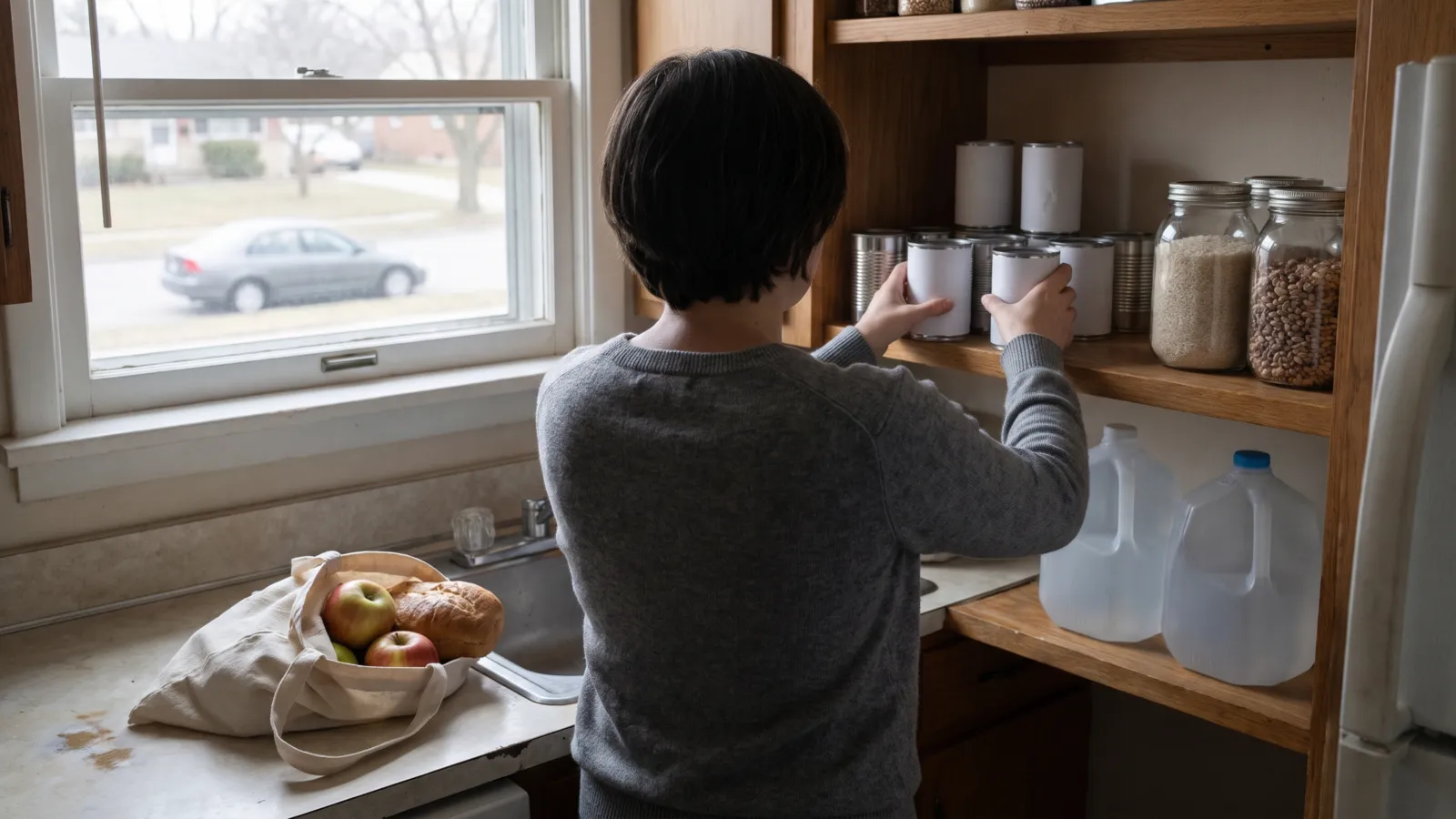
“should i stock up on food because of iran war”
We found no federal agency telling households to. The usual advice stands: several days of food, 2 weeks if you can.
- Should you stock up on food because of the Iran war? Not beyond the usual advice. We found no federal agency telling households to stock up on food because of the conflict, and the Department of Homeland Security's terrorism advisory page says "There are no current advisories." Ready.gov still asks for "at least a several-day supply of non-perishable food", and the American Red Cross suggests a 2-week supply at home.
- USDA's latest forecast, updated October 23, has all food prices up 2.8 percent in 2026 and grocery prices up 2.3 percent, with eggs, dairy, and fats and oils forecast to fall. That is a reason to shop steadily, not to clear the shelves. Build up to 2 weeks over time: canned and dry food you already eat, a manual can opener, and at least a gallon of water per person per day.
The three things most homes are missing
Our top pick from each comparison
as of Nov 20, 2026, 9:52 PM ET · Details
Product prices and availability are accurate as of the date/time indicated and are subject to change. Any price and availability information displayed on Amazon.com at the time of purchase will apply to the purchase of this product.
as of Nov 20, 2026, 9:52 PM ET · Details
Product prices and availability are accurate as of the date/time indicated and are subject to change. Any price and availability information displayed on Amazon.com at the time of purchase will apply to the purchase of this product.
as of Nov 20, 2026, 9:52 PM ET · Details
Product prices and availability are accurate as of the date/time indicated and are subject to change. Any price and availability information displayed on Amazon.com at the time of purchase will apply to the purchase of this product.If you already have these, you're most of the way there. As an Amazon Associate, PreparedStates earns from qualifying purchases. We may earn a commission when you buy through our links. When two products are close, commission can decide which one we pick. A clearly better product always wins.
What officials have said about Iran
In a live Fox News interview the night before, according to the White House's November 19 account, President Trump said of Iran: "They want to make a deal, but I want a deal that can be lasting," and "One way or the other, we'll finish it off." Asked about reports of an Iranian dirty bomb plot, he said "There is indication that Iran is looking at gas and they're looking at the bio," adding "we'll see." The White House's account of the interview says nothing about food, shortages or households.
The Department of Homeland Security's National Terrorism Advisory System page, in its latest archived copy (November 16), says: "There are no current advisories." Its last bulletin, dated June 22, 2025, said "the ongoing Iran conflict is causing a heightened threat environment in the United States." That bulletin expired on September 22, 2025.
What is confirmed, and what is not
Confirmed: food prices are still rising, slowly, by USDA's figures below. Not confirmed: any instruction from USDA, FEMA, Ready.gov, DHS or the White House telling households to stock up on food because of Iran, or any official warning of food shortages in the US. We found neither.
USDA's food price summary doesn't mention Iran, so it doesn't say how much, if any, of the rise comes from the conflict. And finding no warning is not an all-clear from any agency. It means the standing advice applies, and that advice is the same as it was before.
What USDA's numbers show for groceries
USDA's Economic Research Service updated its Food Price Outlook on October 23, using September's price data. It forecasts all food prices up 2.8 percent in 2026, and food-at-home (grocery) prices up 2.3 percent. In September, grocery prices were 1.8 percent higher than a year earlier.
Not everything is rising. USDA forecasts egg prices down 29.3 percent in 2026, and dairy products and fats and oils down too, while beef and veal are forecast up 8.7 percent. For 2027 it forecasts grocery prices up 1.0 percent, within a wide range: from 5.2 percent lower to 7.5 percent higher. Those are USDA's forecasts, not certainties, and a rise of a few percent is a reason to shop steadily, not to buy months of food at once.
What a sensible 2-week supply looks like at home
Ready.gov says that after an emergency "you may need to survive on your own for several days," and asks for "at least a several-day supply of non-perishable food". The Red Cross is more specific: food and water for 3 days if you evacuate, and a "2-week supply for home". The CDC says to store at least 1 gallon of water per person per day for 3 days, and to "try to store a 2-week supply if possible": 56 gallons for a family of four, by our arithmetic.
- Food your household will eat: Ready.gov says to "choose foods your family will eat" and to stock "canned foods, dry mixes and other staples that do not require refrigeration, cooking, water or special preparation"
- A manual can opener and eating utensils, which Ready.gov lists with the food
- Rotation: USDA says low-acid canned goods such as soups and stews keep 2 to 5 years, and high-acid ones such as tomatoes and juices 12 to 18 months, best stored below 85°F. It says to "check your pantry every few weeks" and use the cans you've had longest
- No damaged cans: USDA says not to buy "bulging, rusted, leaking, or deeply dented cans"
- Water: at least a gallon per person per day, as above
- If the power goes out, keep the fridge and freezer shut: the CDC says food stays safe for up to 4 hours in a refrigerator, 48 hours in a full freezer and 24 hours in a half-full one
What not to do
Don't clear the shelves or buy it all at once. Ready.gov says to "build your emergency supply kit over time" and to pick up "an extra item each time" you shop for things you use regularly. You don't need special survival food or a big outlay: the official lists describe everyday canned and dry food that you eat and replace.
Don't keep more than you will use before it dates, because a pantry you never eat from becomes waste. Our kit builder sizes the food and water to your household, and our guide to stockpiling food and water covers storage. After a power outage, the CDC says to throw out perishable food in the fridge "after 4 hours without power or without a cold source like ice," and, when in doubt, to throw it out.
We will update this check if USDA, FEMA, DHS or the White House gives households advice about food supplies because of the conflict with Iran, if DHS issues a new terrorism advisory bulletin, or if USDA publishes a new food price forecast.
Common questions
Should I stock up on food because of Iran war news?
Not beyond the usual advice. We found no federal agency telling households to stock up on food because of the conflict, and DHS lists no current terrorism advisories. Ready.gov's standing advice is at least a several-day supply of non-perishable food, and the Red Cross suggests a 2-week supply at home. If you don't have that yet, build it over time, an extra item each time you shop.
Will the Iran war cause food shortages in the US?
We found no official warning of food shortages in the US. USDA's October forecast has grocery prices up 2.3 percent in 2026, and its summary doesn't say how much, if any, of that comes from the conflict. USDA's range for 2027 grocery prices runs from 5.2 percent lower to 7.5 percent higher, so its forecasts carry real uncertainty.
How much food should I keep at home?
Ready.gov asks for at least a several-day supply of non-perishable food that your family will eat, with a manual can opener. The American Red Cross suggests a 3-day supply for evacuation and a 2-week supply for home. For water, the CDC says at least 1 gallon per person per day for 3 days, and 2 weeks if possible.
Are food prices going up?
Slowly, by USDA's figures. Its October 23 forecast has all food prices up 2.8 percent in 2026 and grocery prices up 2.3 percent. In September, grocery prices were 1.8 percent higher than a year earlier. Egg prices are forecast to fall 29.3 percent in 2026, while beef and veal are forecast to rise 8.7 percent.
How long does canned food last?
USDA says low-acid canned goods, such as canned meat, stews and most soups, keep 2 to 5 years, and high-acid ones, such as tomatoes and juices, 12 to 18 months. Store them somewhere cool and dry, below 85°F if you can, check your pantry every few weeks, and don't buy bulging, rusted, leaking or deeply dented cans.
Sources (11)
- NewsNation: 'Doomsday' prep rush sparked by tech outages, attacks: Ex-FBI agent (Nov 20, 2026)
- White House: ICYMI, President Trump's interview from Shenzhen (Nov 19, 2026)
- DHS: National Terrorism Advisory System
- USDA Economic Research Service: Food Price Outlook, summary findings (updated Oct 23, 2026)
- Ready.gov: Food
- Ready.gov: Build a Kit
- Ready.gov: Low and No Cost Preparedness
- American Red Cross: Survival kit supplies
- CDC: How to create and store an emergency water supply
- USDA FSIS: Shelf-stable food safety
- CDC: Keep food safe after a disaster or emergency
Get one calm email when it matters
Seasonal checklists and gear price drops. No spam, unsubscribe any time.
Keep reading
 Why is everyone talking about stockpiling? Trump says 'relax': what Ready.gov says to keepA week of tech outages has people stocking up, and Walmart says it saw "a small amount" of it. Ready.gov's kit…
 How to stockpile food and water for your household: what the official lists sayHow to stockpile food and water for your household: Ready.gov says several days, the Red Cross says 2 weeks. W…
 Is stockpiling illegal? What hoarding law and price-gouging rules cover at homeNot for ordinary household supplies. The federal hoarding rule covers only goods the President designates as s…
 Will food prices climb higher in 2027? What the World Bank warning means for US groceriesThe World Bank expects food commodity prices to rise about 10% this year and another 7% in 2027. USDA's foreca…