
Stranded at the airport: what to keep in your carry-on, and the FAA's power bank rules
Can you bring a power bank on a plane? Yes, carry-on only; up to 100 Wh needs no airline approval, the FAA says. Plus a short list for a long wait.
By Tom Calder · Updated November 16, 2026 · Sourced to the FAA's PackSafe battery rules and its ground stop questions and answers, TSA's What Can I Bring? pages, and the Department of Transportation's Fly Rights guide and briefing room
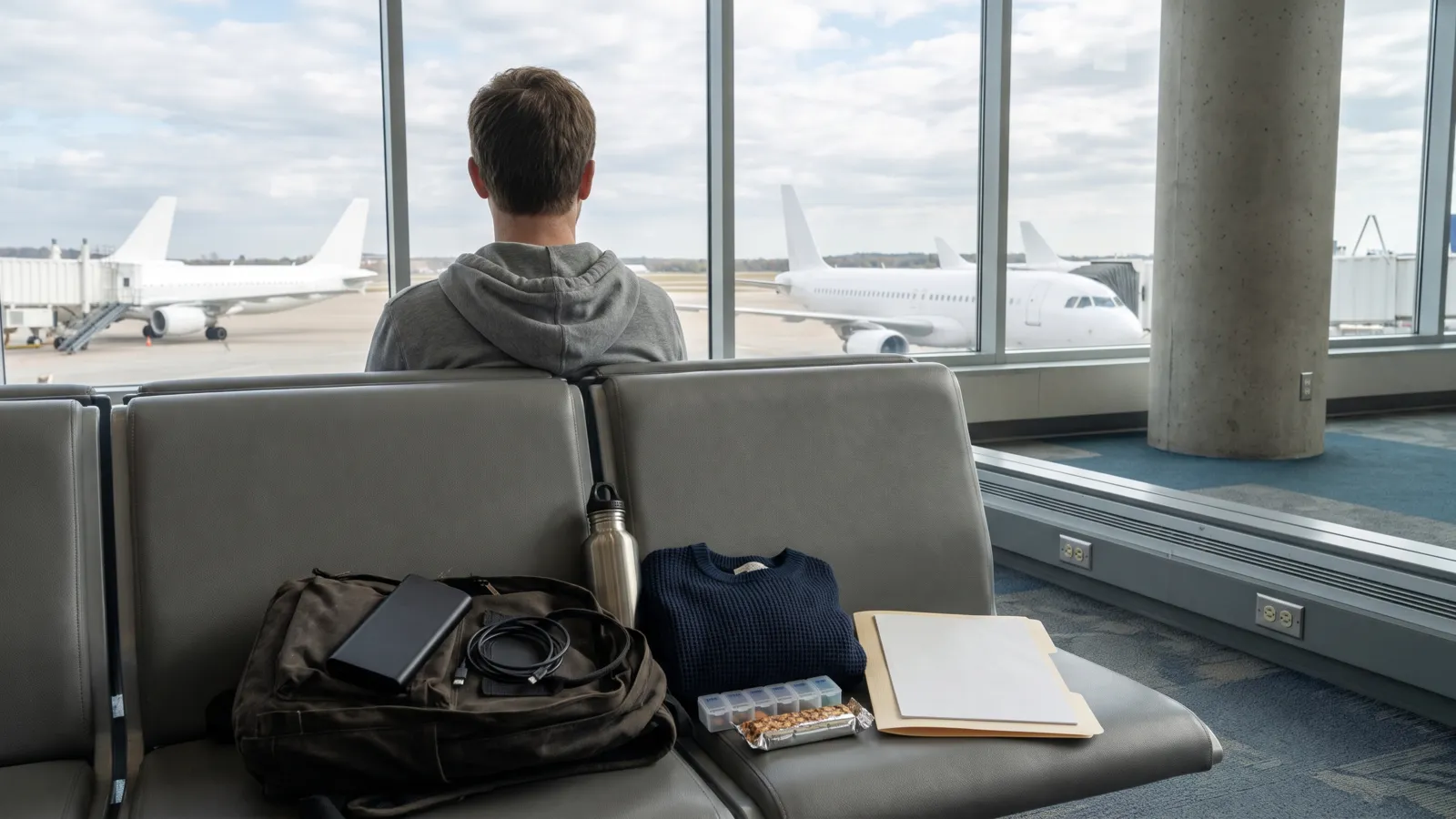
- Yes, you can bring a power bank on a plane, but only in your carry-on. The FAA says spare lithium batteries, "including power banks," must go in carry-on bags only, and a power bank rated up to 100 watt hours (Wh) needs no approval. From 101 to 160 Wh you need the airline's approval; over 160 Wh is forbidden.
- After the FAA's nationwide ground stop on November 13, the FAA says operators canceled about 12,462 flights that day, though not all were directly caused by the ground stop. DOT's Fly Rights guide says medicine, keys, passports and valuables should never go in a checked bag.
- A short carry-on list covers most of a long wait: medicines, a power bank and cable, an empty bottle to fill after security, solid food, a warm layer and paper copies of bookings and key numbers. You probably own most of it already: there's nothing you need to buy.
What happened, and what this page answers
On November 13 at about 3:30 p.m. Eastern, the FAA says, "a technical problem" led it to issue a nationwide ground stop. Air traffic resumed at 8:15 p.m. that evening, and the FAA said recovery "will be slow and steady." It says operators canceled about 12,462 flights that day, adding that not all of those cancellations were directly caused by the ground stop. On November 14, DOT said passengers "should be prepared for some delays and cancellations as flights resume."
What caused it is covered in our check of whether it was a cyberattack and in why US flights were grounded. What a canceled flight entitles you to is in our refund guide. This page answers a different question: what to keep in your carry-on so a long wait in a terminal stays an inconvenience, starting with the rules for power banks.
Can you bring a power bank on a plane? Yes, in your carry-on only
The FAA says: "Spare (uninstalled) lithium ion and lithium metal batteries, including power banks and cell phone battery charging cases, must be carried in carry-on baggage only." TSA's page for power banks says the same thing: carry-on bags yes, checked bags no.
Size matters too. The FAA says rechargeable batteries "with a capacity of 0-100 Wh are allowed on passenger aircraft, while those with a capacity of 101-160 Wh require approval from the air carrier, and batteries exceeding 160 Wh are forbidden." With airline approval you may carry up to two of the larger 101 to 160 Wh spares. The FAA says there are no limits for rechargeable batteries under 100 Wh that are for your own use.
Airlines can be stricter. The FAA says many airlines "may have stricter quantity and Wh limits," including how many power banks each passenger may bring, "regardless of Wh capacity," and asks you to check with your airline before you travel.
If your carry-on is taken at the gate or the plane door to go in the hold, the FAA says all spare lithium batteries and power banks "must be removed from the bag and kept with the passenger in the aircraft cabin." So keep the power bank in a pocket or small bag you'll hold on to.
How to read the watt-hours on your power bank
The FAA says a lithium-ion battery's Wh "should be marked on the battery." Look on the case or the label for a number followed by Wh. Many power banks are sold by milliamp hours (mAh) instead, and the FAA gives the conversion: "For milliamp hours (mAh), divide mAh by 1000 (to get to Ah) and then multiply by the V."
The FAA's own example: "A 12-volt battery rated to 8 Ah is rated at 96 Wh (12 x 8 = 96)." To show the mAh version with our own arithmetic: a bank labeled 20,000 mAh at 3.7 V works out to 20,000 ÷ 1,000 × 3.7 = 74 Wh, under the 100 Wh line. Use the battery voltage printed on your own bank. If you can't find or work out the rating, ask your airline before you fly.
Our power bank comparison lists banks by capacity. Before flying with any of them, check the Wh on the label against the FAA's limits.
Medicines and anything you can't replace
DOT's Fly Rights guide says certain items "should never be put into a piece of luggage that you plan to check," and lists "Critical items: medicine, keys, passport, tour vouchers, business papers" along with cash, cards, jewelry and fragile things like eyeglasses. It says: "the only way to be sure your valuables are not damaged or lost is to keep them with you." It also suggests carrying what you'll need in the first 24 hours, such as toiletries and a change of underwear.
TSA allows medication pills in carry-on bags. For liquid medicines, TSA "allows larger amounts of medically necessary liquids, gels, and aerosols in reasonable quantities for your trip, but you must declare them to TSA officers at the checkpoint for inspection." TSA tells travelers to inform the officer before screening begins and to put these items in a separate bin. TSA says: "We recommend, but do not require, that your medications be labeled to facilitate the security process."
If you take daily medicines, keeping them in your carry-on means a cancellation or a delayed bag doesn't leave you without them overnight.
Water, food and a warm layer for a long wait
TSA's liquids rule limits liquids, gels and aerosols at the checkpoint to travel-sized containers of 3.4 ounces (100 milliliters) or less, in a quart-sized bag (medicines are exempt). Our tip: bring a refillable bottle empty and fill it after security.
TSA says: "Solid food items (not liquids or gels) can be transported in either your carry-on or checked baggage." A couple of snacks that keep, such as granola bars or nuts, cover a wait when terminal food lines are long or shops close. DOT says each airline has its own policies about what it does for delayed passengers at the airport, and "there are no federal requirements." DOT suggests asking the airline staff whether it will pay for meals, so ask, but don't count on it.
A sweater or light jacket in your carry-on helps if you end up waiting for hours in a terminal or on a plane, and a phone charger cable takes little room.
Papers, phone numbers and a tracker in your checked bag
Phones run flat and apps go down. A paper copy of your booking confirmation, your airline's phone number, your hotel's number and a few family contacts let you rebook or reach people without a battery. The FAA says you can check flight status and real-time airport updates at nasstatus.faa.gov, and on November 13 Transportation Secretary Sean Duffy's advice to people at airports was to "check with your airline."
A Bluetooth tracker in a checked bag can show where the bag is if it's rerouted. The FAA's battery chart lists "Air tags, tile tracker" and says trackers with lithium batteries are allowed in checked baggage when they contain no more than 0.3 grams of lithium, or are lithium-ion with a rating no higher than 2.7 Wh. Rechargeable lithium battery-powered devices can be checked only if they are "completely powered off and protected from accidental activation," the FAA says, and a power bank can never be checked.
What not to do
Don't pack a power bank or spare lithium battery in a checked bag, and don't forget to take it out if your carry-on is gate-checked. Don't fly with a damaged battery: the FAA says damaged or recalled batteries that are likely to create sparks or dangerous heat must not be carried aboard, in carry-on or checked bags, unless the battery has been removed or made safe. If a battery or device gets hot, swells, smokes or burns on board, the FAA says to tell the flight crew immediately.
Don't pack medicines or anything you can't replace in a checked bag. And don't rush out to buy new gear because of one ground stop: a phone cable, a water bottle, a sweater and a printout cover most of this list.
- Power bank and cable, in carry-on only (100 Wh or less needs no approval)
- Medicines and anything you can't replace
- An empty refillable bottle and some solid snacks
- A warm layer
- Paper copies of bookings and key phone numbers
- A tracker in your checked bag, if you have one
We'll update this page if the FAA changes its PackSafe battery limits, if TSA changes its rules for power banks, medicines, liquids or food, or if the FAA or DOT publish new guidance for passengers after the November 13 ground stop.
Common questions
Can you bring a power bank on a plane?
Yes, in your carry-on only. The FAA says spare lithium batteries, including power banks, must be carried in carry-on baggage, and TSA says power banks are prohibited in checked luggage. A bank up to 100 Wh needs no approval; 101 to 160 Wh needs the airline's approval; over 160 Wh is forbidden. Some airlines set stricter limits, so check yours.
What is the biggest power bank allowed on a plane?
160 Wh, with your airline's approval. The FAA allows up to two spare batteries of 101 to 160 Wh per person with airline approval, and forbids anything over 160 Wh on passenger aircraft. Up to 100 Wh needs no approval.
How do I work out the Wh of a power bank from mAh?
Divide the mAh by 1,000 and multiply by the voltage, the FAA says. For example, by our arithmetic, 20,000 mAh at 3.7 V is 74 Wh. Many banks print the Wh on the label, which the FAA says is where it should be marked.
Can I put an AirTag in my checked bag?
The FAA's battery chart lists AirTags and Tile trackers and allows lithium-battery trackers in checked baggage when they contain no more than 0.3 grams of lithium, or are lithium-ion rated no higher than 2.7 Wh. Trackers can also go in carry-on.
Do I need to tell TSA about my liquid medicine?
Yes. TSA says to tell the officer before screening begins that you have medically necessary liquids, and to put them in a separate bin. It allows larger amounts than the usual liquids limit in reasonable quantities for your trip, but you must declare them to TSA officers at the checkpoint for inspection. TSA's page for pills says yes for carry-on bags.
Sources (14)
- FAA PackSafe: Lithium batteries
- FAA PackSafe: Airline passengers and batteries, guidance and FAQs
- FAA: Nationwide ground stop, questions and answers (Nov 15, 2026)
- TSA: What Can I Bring? Power banks
- TSA: What Can I Bring? Medications (liquid)
- TSA: What Can I Bring? Medications (pills)
- TSA: What Can I Bring? Medical
- TSA Cares: Disabilities and medical conditions
- TSA: Liquids, aerosols and gels rule
- TSA: What Can I Bring? Snacks
- Department of Transportation: Fly Rights
- Department of Transportation: Secretary Duffy announces lifting of nationwide ground stop (Nov 13, 2026)
- Department of Transportation: Secretary Duffy provides update on restoration of airspace (Nov 14, 2026)
- Anker: How much mAh power bank is allowed in flight (maker's page, for its own product)
Get one calm email when it matters
Seasonal checklists and gear price drops. No spam, unsubscribe any time.
Keep reading
 Was the Microsoft outage and FAA ground stop a cyberattack? What officials have saidDHS says it has seen zero evidence of a cyberattack. The FAA blames a communications failure. Microsoft's outa…
 Why were US flights grounded on November 13, and could it happen again?A router switched in during copper-to-fiber telecom work flooded the FAA's network, Secretary Duffy says. Depa…
 Flight canceled in the FAA ground stop: are you owed a refund, a hotel or compensation?If the airline canceled your flight and you chose not to fly, DOT says you're owed a refund. A hotel, meals or…
 Go-bag checklist: what to pack in case you have to evacuateWhat to pack in a go-bag: documents, medications, cash, chargers, per-person items, kids and pets, and how it …