Could a doomsday cyberattack black out the US? What the grid record says for your home
Could a doomsday cyberattack black out the US? Newsweek's scenario against the official record: what grid cyberattacks have done, what CISA warns, what to keep.
By Tom Calder · Updated November 22, 2026 · Sourced to CISA, GAO, NERC, EIA, Ready.gov, CDC and Newsweek
“What a Doomsday Cyberattack Could Look Like”
A what-if, not a warning. We found no US blackout caused by a cyberattack; CISA warned in 2024 that state-sponsored hackers had got into energy networks.
- Could a doomsday cyberattack black out the US? No official source we checked says one is coming, and we found no official record of a cyberattack cutting power to US homes. GAO reported in 2021 that, according to the Energy Department, none of the cybersecurity incidents reported in the United States had disrupted the grid's distribution systems, the part that delivers power to homes.
- Abroad, it has happened. CISA says cyber intrusions caused power outages in Ukraine on December 23, 2015, affecting about 225,000 customers.
- The threat is real: in 2024 CISA said Chinese state-sponsored hackers were positioning themselves in US networks, including energy, for disruptive attacks in a crisis or conflict. Newsweek's November 22 article is a scenario, and it says officials have found no evidence that this month's outages were connected or malicious.
- You don't need to buy anything new. Ready.gov's advice is supplies for several days.
The three things most homes are missing
Our top pick from each comparison
as of Nov 22, 2026, 12:52 PM ET · Details
Product prices and availability are accurate as of the date/time indicated and are subject to change. Any price and availability information displayed on Amazon.com at the time of purchase will apply to the purchase of this product.
as of Nov 22, 2026, 12:52 PM ET · Details
Product prices and availability are accurate as of the date/time indicated and are subject to change. Any price and availability information displayed on Amazon.com at the time of purchase will apply to the purchase of this product.
as of Nov 22, 2026, 12:52 PM ET · Details
Product prices and availability are accurate as of the date/time indicated and are subject to change. Any price and availability information displayed on Amazon.com at the time of purchase will apply to the purchase of this product.If you already have these, you're most of the way there. As an Amazon Associate, PreparedStates earns from qualifying purchases. We may earn a commission when you buy through our links. When two products are close, commission can decide which one we pick. A clearly better product always wins.
What Newsweek actually reported
The article is careful about the recent outages. It says "U.S. officials have said there is no evidence the recent incidents are connected or the work of malicious actors," and that "There is currently no evidence supporting her claim," referring to an activist's allegation of a coordinated foreign attack.
The doomsday part is a scenario from experts and older reports. It repeats an earlier quote from Emerson Brooking, an international security policy expert: "Unfortunately, cyber 9/11 is a lot closer than it was a few years ago," because AI tools let more people find weaknesses. It also cites a 2022 CISA report on the first 48 hours of a cyber incident and a 2018 federal advisory council study of a catastrophic power outage. The article names no country as planning such an attack and gives no date. It ends by saying experts advise that concern "need not translate to panic."
Has a cyberattack ever blacked out the US? What is confirmed, and what is not
Confirmed abroad: CISA, the federal Cybersecurity and Infrastructure Security Agency, says that on December 23, 2015, "Ukrainian power companies experienced unscheduled power outages." It says they "were caused by remote cyber intrusions at three regional electric power distribution companies," affecting "approximately 225,000 customers," and that "power has been restored." The US government attributes that attack to Russian nation-state cyber actors.
In the US, the official record we found shows attacks on utility computers, not lost power. GAO's March 2021 report says: "None of the cybersecurity incidents reported in the United States have disrupted the reliability or availability of the grid's distribution systems, according to DOE." The closest case it describes is from March 2019, when an attacker made a firewall reboot at a utility serving parts of California, Utah and Wyoming, cutting communications between its control center and remote sites. NERC's write-up of that event says the "outages had no impact to generation."
Not confirmed: any plan, date or warning of a nationwide cyber blackout. NERC's winter assessment, posted November 18, covers weather and demand; we found no mention of cyberattacks in it. GAO's report is from 2021, and we found no later official statement that a cyberattack has cut power to US customers.
Why officials take the threat seriously
The risk is not made up. In a February 2024 advisory, CISA and partner agencies said Chinese state-sponsored hackers known as Volt Typhoon had "compromised the IT environments of multiple critical infrastructure organizations," mainly in communications, energy, transportation and water. CISA, the NSA and the FBI assessed that the actors were seeking "to pre-position themselves on IT networks for disruptive or destructive cyberattacks against U.S. critical infrastructure in the event of a major crisis or conflict with the United States." That describes access to networks, not an outage.
How big an attack could get is uncertain, by GAO's own account. It says "the scale of potential impacts from such attacks is not well understood." Officials it interviewed said the impacts on distribution systems "are likely to be localized," but GAO adds that none were aware of any assessments confirming that. Officials also told GAO that an attack on the systems "for a large city could result in outages of national significance." Cyberattacks are only part of the grid picture: our check of the 18-month blackout claim covers physical attacks and transformer wait times.
What it means for your home
A power cut from a cyberattack would look like any other outage at home, so the same plan covers it. EIA says the average US electricity customer went 262.6 minutes without power in all of 2025, about 4.4 hours (our arithmetic), or 120.8 minutes leaving out major events. Ready.gov warns that long outages can "Close retail businesses, grocery stores, gas stations, ATMs, banks and other services" and "Disrupt communications, water and transportation."
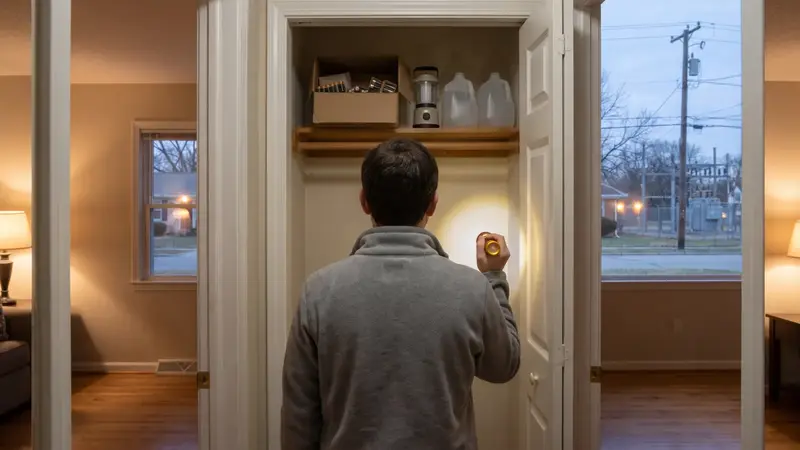
Ready.gov's advice is: "After an emergency, you may need to survive on your own for several days." CDC says to "Store at least 1 gallon of water per person, per day for 3 days," and to "Try to store a 2-week supply if possible." Ready.gov says "The refrigerator will keep food cold for about four hours. A full freezer will keep the temperature for about 48 hours." Our power outage kit builder sizes Ready.gov's list to your household, and what to do in a cyberattack covers your own accounts and devices.
- Water: 1 gallon per person, per day, for at least 3 days; 2 weeks if you can
- Food your household already eats, for several days, that needs no fridge
- A flashlight for every person, plus spare batteries
- Some cash, which Ready.gov's kit list includes, in case card readers and ATMs are down
- Software updates and backups, two of the steps on Ready.gov's cybersecurity page
What not to do
Don't rush to buy a generator or extra stock because of a doomsday headline. No official source we checked asks households to prepare for a cyber blackout, and EIA's figures put the average US customer's outages in 2025 at about 4.4 hours in total. Start with the several days Ready.gov asks for and the power outage checklist.
If you already have a generator, Ready.gov says generators, camp stoves or charcoal grills "should always be used outdoors and at least 20 feet away from windows." Our generator safety guide explains why. And if you think you've been hit by a cyberattack yourself, Ready.gov says to "Let the proper federal, state and local authorities know."
We will update this check if CISA, the Energy Department, NERC or the FBI confirms a cyberattack that cut power to US customers, if a federal agency warns households about a cyber threat to the grid, or if Ready.gov changes its advice. Grid emergencies go on our power outages and state pages.
Common questions
Could a doomsday cyberattack black out the US?
No official source we checked says one is coming or gives a date. GAO wrote in 2021 that, according to the Energy Department, no cybersecurity incident reported in the US had disrupted the grid's distribution systems. CISA warned in 2024 that Chinese state-sponsored hackers were positioning themselves in US energy and other networks for possible disruptive attacks in a crisis or conflict, so agencies treat the risk as real.
Has a cyberattack on the US power grid ever caused a blackout?
We found no official record of one. The nearest US case GAO describes is a March 2019 attack that made firewalls reboot at a utility serving parts of California, Utah and Wyoming, cutting communications between its control center and remote sites. NERC says those outages had no impact to generation.
Where has a cyberattack caused a power outage?
In Ukraine. CISA says remote cyber intrusions at three regional electric power distribution companies caused power outages on December 23, 2015, affecting about 225,000 customers. The US government attributes the attack to Russian nation-state cyber actors. GAO calls these localized power outages.
What is Volt Typhoon?
It is the name US agencies give a Chinese state-sponsored hacking group. In a February 2024 advisory, CISA said it had compromised the IT networks of critical infrastructure organizations, mainly in communications, energy, transportation and water, to pre-position for disruptive or destructive attacks in a major crisis or conflict with the United States.
How should I prepare for a cyberattack on the power grid?
The same way as for any outage. Ready.gov says to be ready to manage on your own for several days, and CDC says to store at least 1 gallon of water per person per day for 3 days, and a 2-week supply if possible. Keep a flashlight for each person and some cash. You don't need to buy anything special for a cyberattack.
Sources (12)
- Newsweek: What a Doomsday Cyberattack Could Look Like (Nov 22, 2026)
- CISA: Cyber-Attack Against Ukrainian Critical Infrastructure (ICS alert IR-ALERT-H-16-056-01)
- CISA: PRC State-Sponsored Actors Compromise and Maintain Persistent Access to U.S. Critical Infrastructure (AA24-038A, Feb 7, 2024)
- GAO: Electricity Grid Cybersecurity: DOE Needs to Ensure Its Plans Fully Address Risks to Distribution Systems (GAO-21-81, Mar 18, 2021)
- GAO-21-81 full report (PDF)
- NERC: Lesson Learned, Risks Posed by Firewall Firmware Vulnerabilities (PDF, Sep 2019)
- NERC: 2026-2027 Winter Reliability Assessment (PDF, November 2026)
- EIA: Electric Power Annual, Table 11.3 reliability metrics (2025 and 2024)
- Ready.gov: Cybersecurity
- Ready.gov: Power Outages
- Ready.gov: Build a Kit
- CDC: Creating and storing an emergency water supply
Get one calm email when it matters
Seasonal checklists and gear price drops. No spam, unsubscribe any time.
Keep reading
 Why are so many outages happening? NSA, Apple and Microsoft down, and what officials sayRubio says there is "zero evidence" so far that the outages are linked or hackers' work. He spoke before Apple…
 Is there going to be a blackout for 18 months? What the grid record and the Pentagon plan sayIs there going to be a blackout for 18 months? No official source says so. Where the figure comes from, what N…
 Can AI chatbots plan power grid attacks? What US investigators found and what it means at homeIn a covert spring 2026 test, GAO got four popular chatbots past their safeguards. What the report shows, what…
 What to do in a cyberattack: a household guide based on CISA, FTC and FBI adviceWhat to do if you are hit by a cyberattack at home: CISA's four basic steps, what Ready.gov says to do during …